Showing posts with label Foreign. Show all posts

Wednesday, July 6, 2011

Melodrama Versus The Sword in Samurai Assassin


Going into a movie you carry a lot of things - many of which you might be hard pressed to realize even on your best day. Not only the entirety of your life story walk through those screening doors and into the land of 'Play,' but so does everything anyone has ever told you (no matter how vague or distant) about the movie. The more time you put between the movie and yourself, the more you're likely to hear. It may be an onslaught of obsessive praising, indifferent moaning, or outright demonizing, or a good ol' fashion mix of the lot. Either way, there's no blank slates. No (as Mad likes to put it) 'blind viewings.'

So, when you managed to sneak in a film you've heard precious little about, read precious little on, and don't find yourself performing a Usain Bolt sprint into a brick wall of excrement, it's a rather rewarding experience. Such is my viewing of Samurai Assassin. Kihachi Okamoto's 1965 samurai tale of the Shakespearean (I know, overused term) variety, was described rather succinctly to me some years ago by an old blogging buddy. He merely offered two brief phrases - 1) "Very beautiful to look at" and 2) "Dreadfully, woefully slow."

He left it at that, and the following day quite blogging entirely when he got a job as a 'proper movie reviewer' (though he has since moved on from that). Probably why I remember his exact words so well. That, and after having finally taken the chance to view the film, I found myself questioning his viewpoint. In the end, I decided he was half right. The first part most indisputably so. From the camera angles to the lighting, Okamoto made Samurai Assassin an unbelievably beautiful film to watch. So much so, I honestly didn't want it to stop. Each sequence, each movement, not matter how shaky or stoic, just felt right. A rare treat by any filmgoer's standards, and doubled so for this film's sake.

The final battle in the field of snow is miracle whip on a beautiful cake. So, perhaps that's why I found myself deterring so much from his second point of view. So enthralled was I in the shots, that the film seemed to glide by with the greatest of ease. The characters, while at times a bit predictable, perfectly juxtaposed the imagery in every way imaginable. Laced with irony, loss, love, and violence all the way through, they are wonderfully layered and rich with indecisiveness, mystery, and complexity.

As to the flow of the narrative - yes, it takes its sweet time, but it does so with great purpose. No scene goes wasted. Each shot, each insight into the characters, reveals something, progresses something, and brings the ending that much more into the greater context of the film. Without these moments, the film would be a sprint to nowhere. But because we are privy to them, the ending hits that much more on point. Like an uppercut from a seasoned vet, it knocks out the audience whom fade in the blackness of the credits. If Okamoto's Sword of Doom contains even the mildest of comparable values as Samurai Assassin, I shall be a truly rewarded soul.

So, what does all this mean to you? I admit, I tried to be as vague as possible, but I do lack the reserved nature my blogging buddy of yesteryear possessed. I'll simply say this: If you love to just watch a movie sometimes, don't pass this one up.

Univarn's Rating: 8.50/10

Thursday, May 19, 2011

Mini-Review: The 36th Chamber of Shaolin (1978)


I've often said the difficulty in going back in cinema viewing is that you are conditioned through years of experience in the present. All our time watching countless movies built upon the shoulders of giants. Those who saw potential in what we see as generic. Those who created grandeur through what we would now call old. And so when going back to see a movie whose influence can neither be denied or quantified, I try my best to keep that in mind.

Luckily enough, The 36th Chamber of Shaolin needed no help from my calculating mind at all. Over the top in cheese, awesomeness, and obsessive self-idealism, The 36th Chamber of Shaolin is entertainment in its purest form. A mild moral tale mixed in with a fantastical styling, wrapped in the comfort of action, under the dark tent of vengeance. It's the kind of movie you kind of wish was dubbed just to increase its magnificence ten-fold. And yet even that wouldn't begin to compliment it.

Now, I'm not saying it's one of those movies that every human being should watch before they die. I'm just saying it's one of those movies every human being should enjoy when they do; watch it, that is. The movie brings to light some of the most mentally staggering questions in history. Questions like "just how many wise old Chinese kung fu monks does it take to train a hothead?" Answer: In and around a baker's dozen. And I take no shame in saying each one is as equally awesome as the last.

That's really the kind of movie this is. Sure, there's the generic young idealist becomes kung fu master arc that has been featured so dominantly throughout the years. But that's just a component. It's the base element, from which the movie derives such an intense sense of awareness. Not afraid to be comical, self-mocking, and confident all at the same time, it imposes an enchanting charm onto the viewer. Glazing over their worries of cliches by standing steadfast alongside them. And in doing so it creates a tale worthy of those who seek out the opportunity to view it.

OVERALL RATING: 8.50/10

Recommended By: Silver Emulsion

Thursday, February 24, 2011

White Material (2010)


OVERALL SCORE: 3.00/10

There have been few moments in my life where I have felt indescribably frustrated while watching a movie. More often than not a bad movie can be easily forgotten, or turned off when they have overstayed their welcome. It is the movies that show such great promise and still fail continuously that create this most maniacal feeling. It is with a mixture of sadness, and resentment, that I now bring the discussion onto White Material.

For going on a month now, I have been sitting on this review. Waiting for something to spark, some sentiment of intellectual reasoning to present itself in a manner of describing my feelings towards this film, but I really have nothing. It is simply a testament to things I dislike about films. Indistinguishable, jumpy, full of self-apprehension washed out by even more self-indulgence, White Material is a movie that has all the frontal appearance of an art-house piece wrapped in subtext. However the more I step back, the more it seems to me that this is a firm case of many parts which seem captivating in their own right, but when combined they add up to a whole lot of bupkis.

The reason: no direction. I'm not saying Claire Denis did not Direct the movie, rather that it always feels as if the scenes are being forced, and not flowing. How does this feeling come about? Intentional narrative editing. White Material is told a-linear, overlapping past and present with no real distinguishable transitions to label where we are at any particular time. To make this even more difficult, Denis has opted to skip time in certain places, and in some cases for some crucial events, and only deal with the aftermath of what we don't know happened.

In terms of basic narrative structure, one could find analogies to be had with the 2004 film Hotel Rwanda. For much of the tale we follow Maria Vial (Isabelle Huppert), the estranged ex-wife of African farm owner Andrew Vial (Christopher Lambert), as she tries to barter and maintain the farm amidst political revolution. At the same time Maria must deal with her despondent son, Manuel (Nicolas Duvauchelle), husband's new fiancee and child, local rebel leader seeking refuge, and a group of workers on the verge of leaving.

All sounds well and good, until the events start playing out, time gets lost in the shuffle, and we end up dealing with a lot of over stylized sequences with no real emphasis on backdrop. Visually arresting, Denis creates a wonderfully shot and tense world, which helps draw in the viewer, but seems annoyed at the prospect of maintaining that connection. Something that serves as a detriment to the great central performances of Huppert, Lambert, and Duvauchelle.

In fact, the strong combination of visuals and acting are the only reasons I would recommend this film. By its own creation, it is not a film that can promise wide spread appeal, and will likely only be taken in and appreciated by those who find some associative quality in its structuring. While I would love to think there is some great benefit to the film's elusive organization, none of that benefit trickled its way onto me.

Film Credits:
Directed By: Claire Denis
Scenario By: Claire Denis and Marie N'Diaye
Collaborator: Lucie Borleteau

Thursday, October 28, 2010

Police, Adjective (2009)

POLICE, ADJECTIVE
WRITTEN AND DIRECTED BY: CORNELIU PORUMBOIU
OVERALL SCORE: 7.75/10

Torn between his duty to arrest a teenage hashish user in his local district and the inevitable consequences it'll have on the teen's life, young police detective Cristi (Dragos Bucur) tries to hunt down the teen's dealer before he is forced to make the arrest.

-----------------------------------------

Police, Adjective, the 2009 Romanian entry for Best Foreign Language Film, is a captivating tale about the battle between duty and conscious. Director and writer Corneliu Porumboiu beautifully captures a few days in the life of Cristi with a methodical precision, slow pacing, and wonderful use of single camera angles. 

Porumboiu's lack of constant cuts, and quick movements, adds an element of realism to the world he creates. The audience is presented with the feeling of being another member in the room, or on the street, with Cristi, as opposed to an omnipresent being. As Cristi becomes aware of things, the audience in turn becomes aware. Though what is most striking about Police, Adjective isn't its ability to shock and wow, as so many cop films try to do, but rather its dedication to the mundane events of police work.

Don't get me wrong, PA is not two hours of paperwork filing. What I mean is that while Cristi is doing a stakeout, we are there with him for event. Any suspicious vehicles he sees we see, any third party member coming and going we both investigate. When Cristi trails someone we're there through every street, turn, and staircase. If Cristi is interrupted by a dog walking by, so are we.

Cristi is handled wonderfully by Dragos Bucur, who manages to capture that sense of struggle without constantly flaunting it. Bucur and Porumboiu allow Cristi's struggles to reveal themselves in the way he treats others, especially his coworkers and wife. The moments of brief frustration and remorse. The way Cristi tries to get his mind off of work with conversations on music and grammar. Cristi's acts of self justification, and the audience's desire to sympathize with him.

The ultimate 'climax,' if one dares call it that, puts Cristi's beliefs to the test in a wonderfully intelligent way, devoid of any over the top action. Like the rest of the film, this climax is slow, taking its time to get to the point with a strict realism. For those who admire this type of story telling, Police Adjective is a perfect example of how effective it can be when used correctly. For those who don't, Police, Adjective will most likely be an exercise in patience and interest.

Slow, methodical, and dedicated to realism, Police, Adjective is an engrossing tale about the mundane actions and human choices that confront the Police every day. Porumboiu delivers a simple and straight forward tale that lacks the twists and turns of conventional narrative, maintaining interest through realistic characters and events.

Note: This film was watched and reviewed by birthday request of Brian's Film Review Blog. If you're celebrating a birthday and want to request a review let me know at twitter.com/univarn or lifeinequinox@gmail.com

Thursday, September 2, 2010

Ip Man (2008)

IP MAN
DIRECTED BY: WILSON YIP
WRITTEN BY: EDMOND WONG
OVERALL SCORE: 7.00/10


Master of the Chinese kung fu style Wing Chun, Ip Man (Donnie Yen), a young wealthy family man living in Foshan, spends his days honing his craft, and relaxing with his family. Suddenly his life is thrust into turmoil when his house, and wealth, is taken from him amidst the 1930's Japanese Invasion. Though when a General offers local fighters the chance to earn food via battle, Ip Man must battle moral principle, and family need.

------------------------------------------

When it comes to kung fu stars, Donnie Yen is cut of a different bread than most. Subtle, almost unassuming in his approach, Yen creates a likable, relatable, character out of Ip Man, with the help of a highly fictionalized telling of Ip Man's life.

Reminding me vaguely of the Ronny Yu/Jet Li film Fearless, Ip Man blends morality, Chinese propaganda, and action in a fun, albeit not mind blowing, cinematic effort. Wilson and Edmond put forth great effort into bringing about 1930's Foshan with great visuals, colorful characters, and exciting action sequences. Yen, whose always been a talented fighter/choreographer (see: Blade 2), is a delight to behold, and easily the film's shining element.

The supporting cast plays their way. Though often times they are caught up in rather overly dramatic subplots, some of which felt a bit soap opera in setup. I do admit that at first I worried the film would be riddled with too many throw away characters. Coming and going for only a fight or two, then leaving. Yet, Wilson and Edmond utilize the plot to their advantage and maintain many of its characters throughout. Giving, what is seemingly paper thin characters at first, a bit of time to flower. Though, none as much as our main character, of course.

As for the story: the fictionalized retelling works, in that it creates enjoyable fight sequences, and manages to bring the 1930's mindset to life. It's not a brilliant narrative. And at times it can feel a bit taxing, especially when it comes to the more "emotional" moments. Though it never flounders to the point of annoyance, keeping interest all the while.

Unfortunately the same can't be said for the film's extras. I usually don't harp on extras, but the one's taking part in this film really phone it in at times. This is most prevalent during the teaching, and group display of skill, sequences in the film. Far too many just idly make the hand gestures, at their own leisure, way off the pace set by the supposed teacher. No real rhythm, and when you're dealing with a city known for its Kung Fu dojos, the extras should look like they've at least tried.

I suppose, though, if that's all one really has to complain about, the film isn't all that bad off. No, Ip Man is a fine film that will entertain, but don't expect to be blown away.

Without the depth to make it a masterpiece, Ip Man gets by on strong fight sequences, and acceptable plot, and a strong turn by seasoned choreographer Donnie Yen. Whether or not you enjoy it likely be related to how many plot contrivances you can stand, and how much you enjoy your action.


Saturday, July 10, 2010

Micmacs (2010)

MICMACS
DIRECTED BY: JEAN-PIERRE JEUNET
WRITTEN BY: JEAN-PIERRE JEUNET & GUILLAUME LAURANT
OVERALL SCORE: 7.00/10


Bazil (Danny Boon), and his rag tag "family" of colorful homeless, team up to get revenge on the manufacturing companies that lead to the death of his father, and the bullet in his head.

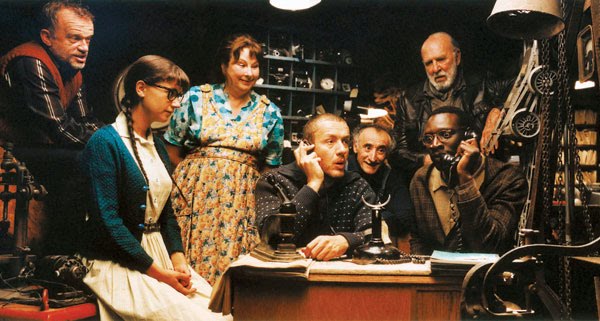
Like a calculating magician Jean-Pierre Jeunet crafts a film with an amazing amount of visual allure, and misdirection. Not so much misdirection from some grand secret behind it all, but more so to hide the film's rather blatant narrative flaws. Though by taking the time to deliver such an enviable array of charm, you'll likely find you don't really care at all.

Micmacs, much in the same vein as Amelie, presents us with a collection of misfit characters, each with a wide array of particular quirks, brought together through happenstance. Apart they're weak, fragile, and likely to be taken apart by society, but combined they are as powerful a force as any. And to his credit, Jeunet spins one amazing collection of characters together.

Unfortunately, unlike Amelie, Jeunet lacks the plots to really bring them together. Rushed villain, and backstory, development, Micmacs quickly becomes more about the odd situations our motley crew put themselves into. Amusing without a doubt, but at times seemingly meaningless. Without the strength to really tie down our character relationships.

Their reasons become rather void, and as such I couldn't help but feel a bit unsatisfied with their intergroup dynamic. Sure, it's designed to put a smile on your face, and it most certainly does that. But I wanted more heart, connection, emotional attachment. Where instead I get amusing predicaments, and silly antics.

Though with such a big smile on my face, I find it hard to fault the film too greatly. Sure I wanted more, but I enjoyed what I got with great extent. That level of charm exudes from every scene, shot, and presents the viewer with just a lovely time.

Saved by its colorful characters, and captivating style, Micmacs is an enjoyable couple of hours of entertainment. Void of real depth however, it may struggle to resonate among viewers who are unimpressed with quirky antics, and over the top situations, and outcomes.


Saturday, May 1, 2010

The Official Story (1985)

THE OFFICIAL STORY
DIRECTED BY: LUIS PUENZO
WRITTEN BY: LUIS PUENZO & AIDA BORTNIK
REVIEW FOR: 1001 MOVIES CLUB
OVERALL SCORE: 8.75/10


After the return of her longtime friend, Ana (Chunchuna Villafane), Alicia (Norma Aleandro), a local high school history teacher, is confronted with a very dangerous possibility: What if her government was capturing, torturing, and stealing the babies of people solely for their political differences? And, what if her adopted daughter is one of those babies?

Based around the events of the Argentinean Dirty War of the 1970's, The Official Story is a gripping character piece, analyzing, criticizing, and unveiling the country's dark history. Painful realistic, and emotionally raw, the film is a captivating experience. Difficult to take your eyes off, and harder to shy your heart away from. Alicia's journey of self discovery is as mesmerizing, and shocking, as any tale you're likely to see.

The careful direction at the hands of Puenzo really brings a great life to the story. Breathing into each scene a certain knack for character, and politics, blending not too often seen among modern mainstream films. He creates a world, real in its authenticity, but even more so in its portrayal. We learn of the events as Alicia does. We see only through the small scope that she is able to. This world built around her, shattered, torn, and coming apart. Visceral, without belittling. Few films manage that sense of emotion and heart, especially with such a strength and determination to make it so.

My only complaints would lay in that at times certain scenes felt off, and overly long. Perhaps it's the handling of them, or my inability to grasp the emotional backlog, but, at times, I felt as if the character's forced plot developments. Especially towards the middle of the film, after a rather lulling opening, just as the movie begins to move into the political surroundings. These plot elements tend to compound on top of each other, and suddenly explode in the finale.

Said finale ends up being perhaps the most telling scene of the film. While it leaves much on the table, Aleandro delivers an award worthy emotional spill. While Hector Alterio (who plays the husband, Roberto) is forced into a corner, stuck in such a powerful scene of raw emotion where he's outacted, but manages to hold his ground. This, and the early emotional break of Ana, give the film a bit of a operatic, over the top flair. But still maintaining that level of humanism that has earned the film such praise. There's no arguing it, this movie is a movie to see before you die.

While it may be a bit operatic at times, The Official History is a powerful tale of human emotion, and discovery. As these characters are pushed to their breaking points, we are absorbed into their world. The most gripping, and emotionally relatable of worlds: one that is real.


Wednesday, March 17, 2010

I Live in Fear (1955)

I LIVE IN FEAR
DIRECTED BY: AKIRA KUROSAWA
WRITTEN BY: SHINOBU HASHIMOTO AND HIDEO OGUNI
OVERALL SCORE: 7.25/10

When Dr. Harada (Takashi Shimura) is called to act as an advisor for a family court case, he never imagines the case will shape his life. The case involves the protest of the Nakajima family, who are seeking an injunction on their elderly father's (Toshiro Mifune) recent desire to sell all his Japanese belongings and move to Brazil for fear of another atomic attack.

In the midst of his 1950s-60s boom as a director Kurosawa decided to make a controversial, political, drama centering on the struggles of a worldwide society to decide what is safe. Toshiro Mifune is simply unrecognizable, perfectly incognito, as the main role of Kiichi Nakajima, something I was surprised to find considering many believe him to have been a miscast. On the contrary, Mifune delivers a captivating character performance, much in the same traits of the elderly man in Eastwood's Gran Torino, based in tradition, and struggling to analyze the need to protect his family with the impending dangers of another attack.

The movie could be compared, on some level, to the later Kurosawa film Rhapsody in August. In Rhapsody, Kurosawa analyzes the effects the a-bomb of Nagasaki have on an elderly woman, who, much like our character here, in the end performs a final irrational action that leads to a strong break in the mental fortitude of the family. Still, it's the interactions between these characters that elevate this film above sub-par.

The final conversation between Nakajima and Dr. Harada strikes at the very core of the viewer. A final mental deterioration that will leave you in a state of true inner reflection. I Live in Fear, even here, manages to remain unjudging. For the majority of the film both the children and Kiichi are presented in equal light, with favor waying back and forth between the two of them as they both possess moments of negative display.

The only real flaw for I Live in Fear lies in its storytelling. Not exactly the best in execution, the writing feels a bit bland, and simplified considering the deep emotionally straining plot.

While not handled with the greatest of care, Kurosawa's '55 film on the times of the cold war delivers great acting, intriguing subject matter, and a central tone that allows the viewers to judge for themselves.


Tuesday, March 16, 2010

The Lower Depths (1957)

THE LOWER DEPTHS
DIRECTED BY: AKIRA KUROSAWA
WRITTEN BY: AKIRA KUROSAWA & HIDEO OGUNI
BASED ON THE PLAY BY: MAXIM GORKY
OVERALL SCORE: 8.75/10

A thief (Toshiro Mifune), an elderly pilgrim (Bokuzen Hidari), an evil landlady (Isuzu Yamada), and other misfits try to cope with their less than satisfactory life during a harsh Japanese winter.

Filled with Kurosawa regulars, with the exception of no Takashi Shimura, The Lower Depths is a dark look at a group of individuals trying to understand how they got to their current down trodden life. Living in the nearly destroyed farm house of a devilish landlady, and her older husband. Just about every group you can imagine is represented, and in each case we're allowed a unique look at the troubles that have plagued their life. Now, Kurosawa being Kurosawa, he's not going to spell it all out for you, instead Kurosawa perfectly uses nuances, subtle actions, and great character actors to bring forth these vibrant characters.

Inspired by the Maxim Gorky play of the same name, Kurosawa perfectly adapts this early 1900s play into the Edo period of Japan. What makes this adaptation work so brilliantly is Kurosawa's simple play setup, keeping the camera in the barn fixated on these characters well over 75% of the runtime. Moving the camera through the barn, we're allowed to see these characters as observers, and in return we're given the chance to understand them. This is quite obviously Kurosawa's great interest, as he really takes the time to get into the the stories behind these people. Something I've felt Kurosawa has always shown desire for, in his other works.

Now there is a central plot, involving a three-way love triangle centered around the lovable thief, Sutekichi (played by the always vibrant Toshiro Mifune), but even that takes the heavy back burner to the backstories. It's here that the varied actors really get a chance to shine.

Centering on Bokuzen Hidari, as the lovable old pilgrim Kahei, who arrives towards the beginning, and acts as a grandfather figure to those characters farther gone mentally. Supported, and intellectually opposed, by Koji Mitsui, as the intelligent gambler, Yoshisabur, who finds their personal predicaments more amusing than depressing. The sparing between these two not only provides great insight to the moral arguments being display. As well as Kurosawa's oft displayed love for analyzing the plight of the poor.

All of these are supported by Kurosawa's general character skill, using beautiful cinematography (much in the same respect as his 1965 film Red Beard) to focus attention as needed. Now I'll admit, within this movie's comedic moments, and light hearted tone, lies a very dark, and painful subtext, something that will give the viewer a chance to maul over for days to come. Especially as its plot comes to fruition, and the characters begin to unfold. Still, it's a character piece, and an exciting one at that.
Without a doubt, The Lower Depths ranks in my top list of Kurosawa films. Perfectly challenging its viewer both emotionally and intellectually, to a point that makes it impossible to deny or ignore. I greatly hope that it one day receives its due credit among the Kurosawa fans out there.

Saturday, March 6, 2010

Ikiru (1952)

IKIRU (TO LIVE)
DIRECTED BY: AKIRA KUROSAWA
WRITTEN BY: AKIRA KUROSAWA, SHINOBU HASHIMOTO, & HIDEO OGUNI
TOP 100 FILMS: #5
OVERALL SCORE: 10/10


Government worker, and widower, of nearly 30 years, Kanji Watanabe (Takashi Shimura), learns he has stomach cancer, and only a few months to a year of life left. As he confronts the realization of his impending death, he must also confront another fact: what has he truly done all these years?

"I can't afford to hate people. I haven't got that kind of time."

What does it mean to live? Is it breathing? Is it work? Work keeps you busy, sure. But what are you really doing? Are you actually living, or merely passing time? If you're passing time, then what for? Death? Is that all living really is? Passing time until we die?

In our daily lives maybe once a year we confront questions of this nature. And what do we do? We deal with it for a couple of days, self loathe, and then we go back to work. We stamp forms, file paperwork, double check forms, file more paperwork. But what in the world are we really doing? Is it true that it's not until were are actually forced to face death that we really feel any desire to do anything about life? Why can't we live our lives everyday? Perhaps because we live in a world in which doing anything but nothing is considered strange (as Ikiru so finely puts it). To do anything else would be... hard.

Don't worry I'm not quizzing you. Instead I'm addressing something of grave importance. You see I'm going to openly give you right off the bat that Ikiru is not a perfect film. It's last half hour splits more audiences than a Zach Snyder marathon, and it's rather long-winded. So there, you have that. Good for you. Now what? Ikiru didn't become #5 on my list because it was perfectly well written, or because it's direction was so jaw dropping, or its acting beyond dynamic. It got there for one reason: Regardless of who you are, Ikiru is among the top 5 most important thematic films you should have to watch at least once in your life.

"I have less than a year to live. When I found that out... somehow I was drawn to you. Once when I was a child, I almost drowned. It's just like that feeling. Darkness everywhere, and nothing for me to hold onto, no matter how hard I try. There's just you."

Ikiru is not an answer key to life. If you find an answer, it's your own, not the films. For every move forward, there's a move backward. For every move backward, there's a move sideways. Ikiru is instead a film that challenges you to find out what it means to truly live. All through the scope of Kanji Watanabe trying to find what it means for himself. He tries a wild night out only to be left empty and tired. He tries spending time with a young ex-coworker who now works in a factory, certain she has figured out something he doesn't understand. But he still can't grasp it.

And when he's finally found what he needs to live, Kurosawa cuts us off. Why? Why the sudden shift? Because nobody can understand what it means to live through the viewpoint of a single individual. Now we must address life from the viewpoint of all those closest to him. Why did they not know? What did he see that they don't see? Is it too late for them to change? In this world, can they truly change at all?

Ikiru is the kind of movie you never forget, unless you go in determined to. Takashi Shimura's performance reaches deep into the heart of the viewer and never lets go. His singing of Gondola no Uta comes from the very depth of human struggle. So powerful and moving, not even those in the same scene as him can handle it's true strength. And as each new individual runs into him they must also confront what life means to them.

But don't let that fool you. Ikiru is not a movie about someone finding what it means to live, and changing everyone around him. Ikiru confronts head on the very fact that it's so hard to change until you have nothing to lose. And Kurosawa is there to capture each transition, each memory, each struggle a man, and those he most readily effects, have. That's why I love Ikiru. That's why I watch it time and time again.

Perhaps life is meaningless. Perhaps life is about what you leave behind. Perhaps life is about what you do. Perhaps it's all of those and none of them. Who knows? Ikiru is going to show you all of them. And now it's up to you to decide: what does living mean?

I'll grant you Ikiru is flawed, and I'll simply reply I really don't care. Ikiru is the rare kind of film so well written, thought out, and composed it hits you at the very fabric of your being. It's throws its questions right at you, and you have to decide. Can I do what this character did? Should I do what he did? And that's its brilliance. If you come away from Ikiru unchanged, unmoved, or without real introspective, then you're the very kind of person it criticizes.

--------------------------------------------------------
Alternate Perspectives:

"Some characters triumph, others die, but they all realize that the world is evil and try to do something about it. In a world of rote and banality, these characters decide to actually live." - Not Just Movies

"The visual beauty of Ikiru cannot be denied. Few films I've seen are better shot, better acted and more emotionally honest. Unfortunately, unlike Rashomon, I can't forgive Ikiru's contrivances." - Brian's Film Review Blog

Wednesday, February 17, 2010

Gankutsuou: The Count of Monte Cristo (2004-2005)

GANKUTSUOU: THE COUNT OF MONTE CRISTO
SERIES DIRECTOR: MAHIRO MAEDA
WRITERS: NATSUKO TAKAHASHI & TOMOHIRO YAMASHITA
BASED ON THE NOVEL BY: ALEXANDRE DUMAS
STUDIO: GONZO
NUMBER OF EPISODES: 24
OVERALL SCORE: 6.00/10


While vacationing at Lunar, Albert de Morcerf encounters the vibrant Count of Monte Cristo, and is soon saved by him following a kidnapping. Enamored with the Count, Albert agrees to introduce the Count to the royal families upon his return to Paris. Little does Albert know he has just became a pawn in a very dangerous game of revenge.

A quick way to get me to watch an anime series is to tell me it's a futuristic take on the legendary Alexandre Dumas tale, recognized for its unique artistic qualities, and from the point of view of the young Albert, and odds are, you're going to peak my interest. Despite my reservations about reading, The Count of Monte Cristo is such a captivating tale, even I couldn't keep away. So I had very high hopes going into this one (especially considering the many rave reviews I had read)... perhaps they were too high though?

Throughout Gankutsuou it was apparently obvious, the best thing it had going for it was its writing. Gankutsuou is not for the faint of heart, or mind. It deals with revenge, suicide, murder, incest, homosexuality, prejudice, class distinction, and demonic possession. So much so I found each new episode deeply captivating, a strong sense of narrative need, willing to go the extra mile for the story, even if it will distance itself from those viewers unable to take it. Taking the tale to the future gave the crew the ability to use mecha for battle sequences, outer worldly items, and new twists (they do take some liberties with the plot). Still, it's an absolutely amazing, and dark, tale.

Yet despite the many claims of its artistic value, I found Gankutsuou's animation to be generally sub-par. Utilizing 3d layering, and graphics, on top of hand drawn animation, it's one of those situations that when it works, it is absolutely beautiful (see above picture), but when it doesn't... it's a disaster. The 3D graphics during many chase/fight scenes felt like an N64 video game, and often took me out of the more intense moments. The layering on the clothes sometimes works, but throughout it often felt odd to me, the texture and lighting always felt odd. As if it all didn't match, and in the end this irritated me the entire time. The few amazing sequences were seldom outweighed by the many disastrous ones, and when you have such heavy thematic elements, you don't need to try and overdo it with the animation.

*Spoilers Lay Ahead* One thing I found particularly interesting though, is that the final episode of the show is dedicated entirely to monologue. This is something I have to admit I champion heavily, as after you've spend 12-25+ hours with a show, I think a little knowledge of what lay ahead for them is earned... and I hate to say it but Gankutsuou drops the ball here. Much of this final act is spent watching the main character wonder around, and a subtle hint at the reunion with his love, but nothing concrete. It was nice to see a little bit of closure to some of the other storylines, but even with a final 23mins they seem more interested with their graphics, than closure to the story.

It's a shame too, as this is such a well written anime, I kept hoping for it to leave the animation alone and just go heavy on story. It's got tear jerkers, emotional farewells, and reunions. It's got all you could ever want from a narrative point of view, and still they want to go that extra 3D render too long. Sometimes it's simple that is better. Here is a case where too much effort at flair weighs down heavily an amazing story.

Despite an amazing story, it's a shame so much of whether or not you'll enjoy this series lays on whether or not it's unique style of animation works for you. For me, I found it obtrusive, but I admire the strength of the writing so much, I dare not give it a negative score.

Saturday, February 6, 2010

The Adventures of Priscilla, Queen of the Desert (1994)

THE ADVENTURES OF PRISCILLA, QUEEN OF THE DESERT
WRITTEN AND DIRECTED BY: STEPHAN ELLIOT
REVIEWED FOR: 1001 MOVIE CLUB
OVERALL SCORE: 6.25/10


Three drag queens (Terrence Stamp, Hugo Weaving, Guy Pearce) travel in a bus across the desert to perform an act at a hotel as a favor for the ex-wife of one of them.

Some movies are cult hits because they bombed upon release and later gained a following, and some movies are a cult hits because they simply just appeal to a certain sect of society. Priscilla is, by all means, the latter in that argument. Over the top with attitude, costumes, and characters, Priscilla is part absurd adventures and part humanization of drag queens and transsexuals in our society. It handles both of these amusingly well, but at the back drop comes the fact that if you already humanize them, and don't care for their outlandish outfits, you'll find yourself annexed by the film.

Grounded by three solid performances, from three people whose movies I grew up watching, Priscilla is able, on some level, to shine a light on the difficult lifestyle of drag queens. While it does attempt to understand them as well, each cast member getting a single flash back, in some, what I would call mis-guided, effort to explain where they come from. It's simplification is matched only by the absurd, and sometimes funny, situations they get them into. On some level I felt as if the movie was trying to force me to laugh at them (especially when it comes to the outfits), instead of with them. Yet these are three real people, with real social struggles, and personal dreams.

Not all of these are well explored, and the movie gets by on the many entertaining situations it puts them into. But finding reasons to care is really up to the viewer. Priscilla drops you a few lines here and there, but much of the film's development doesn't take place except in a couple of setup scenes. In between there's a lot of singing, costumes, dancing, and boredom. If you're into the music you'll likely find this fun, and full of excitement. If not, you'll be stuck perhaps laughing at their actions, or trying to understand why. Still I suppose I sound a bit too negative. I got a good amount of laughs from the movie, and it held my attention perfectly fine, I just never felt enough of a connection to really care, or enjoy, everything it presented.

While it's outlandish persona will inspire love from many, it only managed to inspire indifference from me, someone who was looking for a little less pizazz, and a little more heart.

Tuesday, January 26, 2010

The Hidden Blade (2004)

THE HIDDEN BLADE
DIRECTED BY: YOJI YAMADA
WRITTEN BY: YOJI YAMADA & YOSHITAKA ASAMA
SHORT STORIES BY: SHUHEI FUJISAWA
OVERALL SCORE: 6.25/10


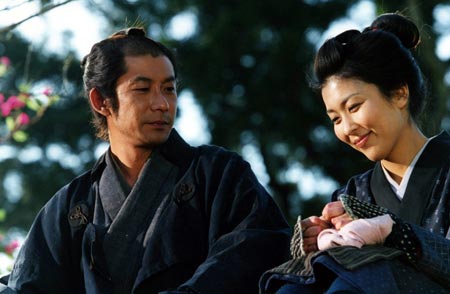
When his childhood friend, and family maid, turns out to be abused by the family she has married into, samurai Katagiri (Masatoshi Nagase), goes in and rescues her, at the cost of his reputation. From different castes systems, Katagiri and Kie (Takako Matsu) are unable to marry, and Kie stays around as his personal maid, causing ill-thoughts to be spread amongst the clan. Yet as the age of the Samurai falls aside, the rise of firearms begins, Katagiri must find a way to balance his hate of killing, disallowed love, and modern ways of living.

The spiritual sequel, and companion piece, to the 2002 hit The Twilight Samurai, re-enacts pretty much the same story (really they're the exact same) with new characters, all stuck in the same time period. As a stand alone movie The Hidden Blade is far more about the characters, than action, with the film containing only one fight sequence, which lasts all of five minutes towards the end. Echoing throughout the film is a sense of hatred towards death, and the act of killing. Katagiri re-iterates throughout his dislike of violence, and that nobody ever wants to kill someone else. It's a nice notion, which adds a certain level of impact to the final duel, and even more to the subtext of our main character.

In many respects Katagiri is the polar opposite of Twilight's Iguchi, and his interaction with the world around him. While he's a follower, Katagiri is none submissive, and willing to voice his opinion quite loudly when he feels others are being wronged. On one hand it makes him a very likable, and heroic, character, while at the same time making him seem too pure of a person. Kie, as the film's main female, is a rather submissive individual, and by no means a model women. She's willing to deal with any amount of pain, or insult, because society, or her personal desires, declare her to do so. The Katagiri having to save her will definitely not add any points to feminism, but the dynamic plays rather well off of itself throughout the film.

What made the original Twilight Samurai work, though, was the balance of flaws in our main characters. Here those flaws have been subsided in favor of simple romance, little developed emotion, and a more chipper ending. Hidden Blade seeks to be a simple love story, with little depth, and on many levels accomplishes that. Yet I can't help but feel a lack in real connection to the main characters I developed with the first film. Here I care, but not so much that I dream for their happiness. This forces me into a state in which I sway back and forth between interested and disinterested, and while I enjoyed it more than I hated it, I couldn't help but keep asking for things to more well rounded, and developed.

While The Hidden Blade is a capable, and at times beautiful, companion film, it lacks the depth created, and tries to often to be an imitation than its own entity. Which is a shame, as there is such beauty in the characters and performances that it could be classic.

Wednesday, January 13, 2010

Samurai 7 (2004)

SAMURAI 7
DIRECTED BY: TOSHIFUMI TAKIZAWA
BASED ON THE ORIGINAL FILM BY: AKIRA KUROSAWA
TOTAL EPISODES: 26
OVERALL SCORE: 6.75/10


After years of having their rice harvest taken by bandits (ex-samurai warriors who have abandoned their ways), a local group of peasant farmers seek to hire a group of Samurais to protect their village. Gaining 7 such samurai, the farmers and the samurai, both of whom come from very different pasts, must find common ground if they wish to succeed in their task.

If you're going to take my all time favorite film remake it as an anime tv show, include mecha (giant robots controlled by humans) mythos, and throw in a modern spin on it, it's safe to say you're going to get my attention. Samurai 7 brings Kurosawa's classic tale to life in a new, and unique way. Utilizing its 26 episodes to build, analyze, and look deep into the characters, Samurai 7 creates an exciting world for the story to take place in. As well maintaining an opening as true to Kurosawa as any lover could imagine. There's a strong sense of loyalty to the original story (for a while - but more on that later).

Breathing new life into the characters, I was quickly thrust back into the world of Seven Samurai I love so much. The scenery, the tale of woe, and the harsh view of the world by such held down people. The opening episodes for Samurai 7 are easily among the most riveting of any anime show I've seen to date. The action is well incorporated, the characters, colorful, but not cheesy, and the story loyal and yet refreshingly original. Samurai 7 walks the thin line between episodic tale and single narrative. This gives each episode a sense of new life on a classic tale, while getting your blood pumping with some insanely creative action scenes.

As well Samurai 7 shows a great aptitude for fun characters. The early sequences are hilarious, off the cuff, and a stark reminder of Kurosawa's view on life and war. The new characters introduced for the anime show great depth, and the new take on the legendary seven samurai provides a nice insight for an alternate way of evaluating their lives up until that point. Continuing our journey the defending of the village remains strong its loyalty to Kurosawa's original story. Many of the same developments occur, and Takizawa perfectly adapts anime fighting style with the original plot points. At this point the anime had me completely sold. I was ready to dash out and buy my season copy, whale it a 9+ score, and cheer its name. Only one problem.... there were still 9 more episodes!?

To keep the original fans on their feet Samurai 7 throws in a rather strong curveball. Seeking to take Kurosawa's original story to the next level, the writers behind the series have created their own, far more world encompassing, side plot which comes into full fruition. As well to keep the original fans off their game, Samurai 7 kills off one of the seven during this battle sequence, in a manner far different from the original. This leaves them open to endless possibilities: who will they kill next? will they change who is killed? etc. So many possibilities. Unfortunately though the death of this figure becomes more of an allegory for the series than a catalyst for its characters.

From here Samurai 7 begins a fast descent into mediocrity. Undoing many of its character developments, and trying to force new character moves far from their established traits. It's at this point I felt the series getting away from me. As the characters become more distant, the plot becomes more enamored with itself, piling on one political conspiracy after another, until it begins to sink in its own mess. From here Samurai 7 is merely a shell of its former, wonderful, self. The action scenes feel forced, and uninspired. The characters' actions dull, and devoid of the beauty with which they had once shown. It's almost as if Takizawa and company have developed a resentment of their own creation (especially in dealing with the story of Katsushiro and Kirara).

It's not all bad though. Takizawa manages to save face with an epic final 3 episode long battle sequence that would get even the dead's blood pumping. But he's never quite able to tie it all down. Leaving much unanswered. As well Takizawa still wants to maintain that Kurosawa Seven Samurai ending. Unfortunately with his new plot came new complications to that ending, and it just never holds steady. Their ambition to go for more proved to be more than they could handle, and perhaps should have been where they aimed from the start of the series.

Samurai 7 is without a doubt a visual feast, and its action is near unmatched. Unfortunately though, the more it seeks to get away from the Kurosawa fable, the more obvious it becomes it needs it. Ultimately Samurai 7 is the best 17 episode series I've seen. I recommend watching that, turning it off, and just making up your own final 9.

Friday, January 8, 2010

The Girl Who Leapt Through Time (2006)

THE GIRL WHO LEAPT THROUGH TIME
DIRECTED BY: MAMORU HOSODA
WRITTEN BY: SATOKO OKUDERA
NOVEL BY: YASUTAKA TSUTSUI
OVERALL SCORE: 7.25/10


Makoto Konno (Riisa Naka) spends most of her days going to school and playing baseball with her best friends, the mysterious Chiaki (Takuya Ishida), and the kindly, Kousuke (Mitsutaka Itakura). On a particularly bad day, Makoto trips, and falls, inside the science room landing on a mysterious object. After narrowly avoiding a train incident a few hours later Makoto realizes she now has the power to leap back through time. Using this to her advantage Makoto starts getting good grades, avoids unwanted events..... but at what cost to herself and others does this new power come?

Listed by several sites as one of the best anime films of the decade, Hosoda's The Girl Who Leapt Through Time is a fun, off the wall, while emotionally in depth, anime film. The movie wonderfully tackles this rather old tale of the consequences of time travel while at the same time dealing with the emotional insecurities of teenage girls and boys. What caught me most off guard was the movie's surprising depth, and grasp of teenage life. The boring ends and outs, how even the little things matter, and the impact our events can have on the lives of others. We see Makoto's actions, how they nearly destroy the lives of some of those dearest to her, and the selfishness she pertains.

Make no mistake about it, while Makoto is a fun character, her actions are not always the most respectable. Of course it helps that Makoto is grounded by her two best friends Kousuke and Chiaki. They're attitudes perfectly balance out the playful, and somewhat ignorant, nature of Makoto. While Hosoda takes the necessary time to build them as characters, and not just leave them as cardboard cutouts. As the movie progresses we grow closer to this trio, and fond of their personality quirks. This all sets the groundwork for a strong, and emotional, finale that will put a smile on your face, and a little tear in your eye.

Though without the animation team behind the film there would be little emotion. While there's a handful of scenes I can easily pick out as badly drawn, the animation team has a talent for capturing scenery. And Hosoda knows how to use the fact that this is an animated film to the tee. Combining the endless bounds of an animated character with grounded realism (even with time travel as the backdrop) is a truly humanist heavy art form. And while I recognize few (if any) of my followers dig anime, The Girl Who Leapt Through Time is a firm example of how it can be both entertaining and emotional at the same time. The different journeys are often fun, random, and amusing, while the consequences can come heavy handed. An enjoyable, even if flawed, tale, worthy of any anime lovers time.

Capturing beautiful scenery, an emotional story, and a sense of wonder in the world, The Girl Who Leapt Through Time is a solid addition to the ever growing world of anime films.

Wednesday, December 30, 2009

Oldboy (2003)

OLDBOY
DIRECTED BY: CHAN-WOOK PARK
WRITTEN BY: JO-YUN HWANG, CHUN-HYEONG LIM, JOON-HYUNG LIM, & CHAN-WOOK PARK
BASED ON THE COMICS BY: NOBUAKI MINEGISHI
OVERALL SCORE: 8.75/10


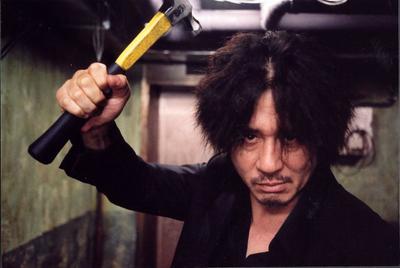
After having been imprisoned in a hotel room and fed nothing but fried dumplings for 15 years, Oh Dae-su (Min-sik Choi) hunts down those responsible.

Part of Chan-wook Park's Vengeance trilogy Oldboy is one of those films I've had on my must see list for some time but never really got around to seeing it. As vengeance films go Oldboy is definitely a unique experience. Insanely hard hitting on action scenes, well developed story, solid combination of all the basics, and an ending that screams "WHAT THE ****." Some films develop into a shock, some movies develop into gross, Oldboy says screw it all and goes for absolutely everything. Ambiguous? Yes. Crazy? Oh definitely. Let's just say it's hard hitting enough I felt like the only way I could be saved is through a long, hot, bath.

Min-sik Choi perfectly encompasses the very odd, and constantly transforming, Oh Dae-su. He manages to make a generally unlikable character, very sympathetic (for the most part). Back by Chan-wook Park's almost John Woo (pre-american) style for action scenes, many of which are insanely memorable. Then again all would amount to nothing if it wasn't for the element of captivation. From the opening shot to the very end, Park keeps Oldboy high octane, mentally engaging, and really drags the viewer into this world. It makes the film absolutely unmistakable, impossible to take your eyes off, and at the same time painfully harsh.

Oldboy doesn't deal with your basic vengeance plot points. It's not about what you'll probably expect, and even that's giving it too little credit. At the same time Oldboy is incredibly violent, and risque, to the point of being an exercise in excess. Scenes are visually powerful, and emotionally shocking, it hits every moral center you have, forcing you to confront your just about everything you think. There's little denying just how intense of a movie going experience this film is. A definite must see.

Not for the faint of heart, Oldboy is an engrossing experience unlike almost any other film I've seen to date.

Wednesday, December 2, 2009

Vampyr (1932)

VAMPYR
DIRECTED BY: CARL DREYER
WRITTEN BY: CHRISTEN JUL & CARL DREYER
WATCHED FOR: 1001 MOVIES TO SEE
OVERALL SCORE: 8.25/10


Upon his arrival in the town of Courteempierre, Allan Grey (Julian West), a young man fascinated by the supernatural, finds there is more going on than he anticipated. Taken in by a local mansion, he soon discovers the town is haunted by a vampire, which keeps people's shadowy spirits clung to this world.

If you were to grade a film solely on its visual strengths, it would be difficult to not give Vampyr a perfect 10. It's go it all. Effects well ahead of its time, great mood setting, strong use of scenery, and and all around aura of creepy it's difficult to shake. Dreyer is perfect at setting a tone to his film, beginning with the opening shot of an innocent Gray wondering into the town to the constant use of darkness and unique imagery. Though what ties it all together, allowing it to really stick with you, is that Dreyer's never compromises when it comes to the tone. He never cheapens out and utilizes quick scare tactics such as things popping out of nowhere, and instead he utilizes just natural eeriness of the situation. For example: shadows with no bodies, out of body experiences, and the notion of being buried alive.

Unfortunately for Dreyer, his desire to keep the film Silent in structure, with moments of dialogue, doesn't sit well with the tone. When actors do speak their voices constantly feel off, and the actors themselves are not the most talented, with West maintaining a single emotion pretty much throughout the run time. As well while I felt a sense of fear, Dreyer failed to really bring about a sense of danger. The scenes with the vampire are sparse, and not always effective. Instead it's the scenes not involving the vampires that I found most intriguing. The general mood is set so perfectly the vampire angle almost seems unnecessary at times.

Of course for all the negative, we'll never really know what Dreyer intended for us to see. Since it's release in 1932, mostly to much backlash, the original copy of Vampyr has long sense been lost, including Dreyer's personal edits following the first showing. All that exists now are compilations, combining the best from the few remaining copies, and what little dialogue could be salvaged. As such I feel a bit off about reviewing this film as it is presented too us. At best what we currently possess is a "best guess" of the film in its entirety, and as such any review is subject to much opinion, and guess work. Even then though it's impossible to deny the sheer impact of Dreyer's work, his skill behind the camera, and the mood with which Vampyr perfectly displays itself.

While it is unarguably masterful, and important in the development of the horror genre, Vampyr forces itself to overcome uninteresting characters with amazing cinematography and camera skill from director Dreyer.

Monday, November 23, 2009

Samurai Champloo (2004-2005)

I'm back with another anime show review, because you all cared so much the first time around :P *cries*

SAMURAI CHAMPLOO
SERIES DIRECTED AND CREATED BY: SHINICHIRO WATANABE
NUMBER OF EPISODES: 26
OVERALL RATING: 7.50/10


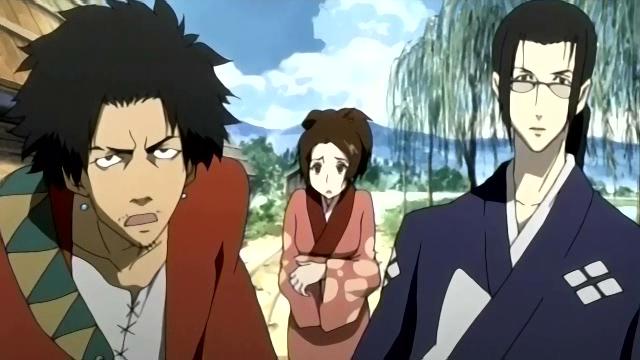
Following the destruction of the tea shop she works in, Fuu saves the lives of two violent samurai, in exchange for their help in finding "The Samurai Who Smells of Sunflowers." On one hand there is Mugen, born on an island of criminals he is not a true samurai, is often sought after by the police, and has a very wild, constantly moving fighting style. On the other hand is Jin, a quiet ronin, born and bread to be the perfect samurai warrior, often giving him the appearance of being cold on the outside.

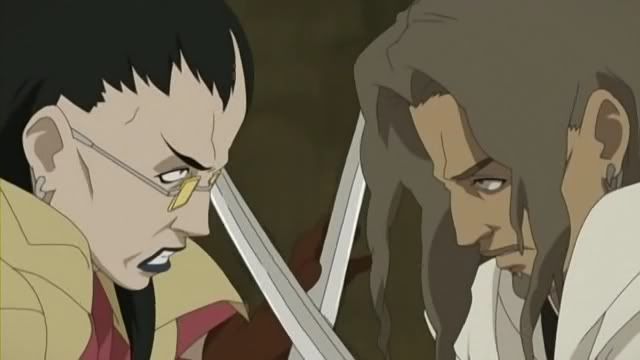
It's difficult to watch Watanabe's latest anime without bringing up comparisons to his first, and legendarily influential Cowboy Bebop. On some level it is quite obvious Watanabe learned from different mistakes his first outing, doing a better job of time management, and character development. Though at the same time Champloo is a much more cheerful affair than Bebop. That's not to say it's without heavy handed emotion, many of its episodes (especially the arc ones) are, but it doesn't dwell so heavily on the painful pasts of our three main characters. Instead it deals with their journey, the trouble they get into, and the different tasks they must complete along the way.

Though perhaps best of all in comparison to Cowboy Bebop is this time around we really get to spend a lot of time with the main characters. They're there from the first episode, and each episode deals with displaying another aspect of their character. We see how Fuu becomes both a mother and a task to Mugen and Jin, while the two struggle between their sense of freedom, and personal commitment to Fuu. We see them fight, their subtle moments of emotional attachment, and their strange sense of duty despite their volatile attitudes. It's quite amazing how well created the characters are. Each appealing to a different group, all filled with emotional moments, and a sense of care and uncaring towards one another at the same time.

Of course when it comes to Watanabe everyone is always curious about one thing: the style. Here Watanabe combines modern age hip hop with classical Edo attitudes to create a very intriguing style. Often side characters will beat box, talk in modern slang, or even discuss modern events despite them not fitting with the time period. For the most part this works, though at times I found the transitions to be a little distracting. Even then though Watanabe is fully aware of when to, and when not to, use certain aspects of Hip hop. During the show's more emotional moments Watanabe goes for standard dramatic techniques to build a connection with the audience.

As narratives go, Samurai Champloo is rather straightforward. Combining absurd tales for amusement's sake only with deep emotional backstories and tales interwoven. It's a good combination that really allows you to go through the entire range of emotions throughout the series. It never sacrifices plot for action, nor action for plot. Watanabe has a great eye for momentary story telling. By that I mean when the moment comes for the characters to do something that matches their developed character they do it. Even towards the later episodes as they develop certain bonds, they still show signs of disconnection given their harsh pasts.

Unlike Cowboy Bebop though this time around the show's highlight episodes are not found in clumps or story arcs. Instead they're well balanced throughout the series, with each new character arc constantly being brought to the attention of the viewer. While with some shows you can skip entire episodes, Samurai Champloo probably only has maybe 2-3 episodes that bring nothing to the table story wise, but they're probably the most entertaining (including an absurd baseball side story). It's just pure entertainment from beginning to end, great for any anime fan.

At times absurd, and other times deeply moving, Watanabe's followup anime series is a viewer's delight.

Sunday, November 22, 2009

Out of the Blue (2006)

OUT OF THE BLUE
DIRECTED BY: ROBERT SARKIES
WRITTEN BY: ROBERT SARKIES AND GRAEME TETLEY
WATCHED FOR: GREAT FILMS NOBODY SAW
RECOMMENDED BY: ThisTimeItWillBeDifferent
OVERALL SCORE: 7.00/10

On November 13, 1990 at roughly 7:30pm David Gray (Matthew Sunderland) shot and killed his neighbor. That night he would go on to indiscriminately kill a total of 13 men, women, and children in Aramoana, New Zealand. Out of Blue tells the story of the Gray, his victims, and the undermanned local police forced tasked with taking him down.

Knowing very little about the Aramoana massacre prior to entering Out of the Blue I must say it's a powerful, painful, and gripping story, with lots of heart and emotion. As a director Sarkies wonderfully captures the characters, both good and bad, involved in this heartbreaking tragedy. Best of all though is Sarkies willingness to bring us in to the life of Gray. Socially anxious, gun fanatic, and his flailing mental state, Sarkies spends much of the first first 40 minutes developing Gray as a character.

The only other characters we spend a lot of time with are Nick Harvey (Karl Urban), a local policeman, and Garry Holden (Simon Ferry), David's first victim. Once the tragedy begins we really spend a lot of time with reaction. The organization of the police, the elderly lady down the street, Helen Dickson (Lois Lawn) who tries to help an injured man. We seldom see the actual violence, almost always the lead up takes narrative precedent, while during the actual shooting we often see the expressions of onlookers. This is where lots of the real drama comes in. We watch parents seeing their children killed, and vice versa, at the hands of this vicious man, and it's hard to not get absorbed in.

Of course it doesn't hurt that Sarkies gets the right cast, filled with inexperienced actors who perfectly embrace their characters, United 93 style. My one complaint about the film is that we don't spend enough time with certain victims. For example officer Stu Guthrie (William Kircher) who posthumously won the George Cross for bravery is merely a 4th/5th lead and maybe takes up 15-20minutes of screen time. Though I understand Sarkies desire to spend most of his time with the survivors, and really get their reaction to the events, I do think it takes down the immediate emotional impact a notch or two. Of course when tasked to tell the story of the most violent day in your nations history, the impact is always a good place to start.

Powerful, gripping, and dark, the tale of the Aramoana massacre is well honored in the hands of director Robert Sarkies.

Sunday, November 8, 2009

Cowboy Bebop: The Complete Series (1998)

Note: This marks a first for me as a reviewer. Not only does this mark the first time I'll be reviewing an entire show but it also marks the first time I'll be doing something anime on this blog (on my previous journal I often did posts on Miyazaki films) so I do ask please give as much feedback as possible.

COWBOY BEBOP
SERIES DIRECTED BY: SHINICHIRO WATANABE
WRITTEN BY: KEIKO NOBUMOTO
NUMBER OF EPISODES: 26
OVERALL RATING: 9.50/10


The year is 2071, a gate incident has all but destroyed earth, and people now reside on a variety of planets across the solar system. A group of misfit bounty hunters (known as cowboys) aboard the spaceship Bebop deal with difficult bounties, somber pasts, and unknown futures.

If you were to tell someone in the US that a show ran for only one season that was it they'd probably call it a failure. In reality Cowboy Bebop is an immensely successful series that run from fall of 1998 to 1999 in Japan. It subsequently had a run in the US via Cartoon Network's Adult Swim during 2001 and 2002 (briefly halted due to 9/11). The 26 episodes of Cowboy Bebop are definitely among the most intriguing television show viewing experience I've had, and has re-inspired that childhood love of Anime that was once overrun by Dragonball Z. The show was recommended to me by a friend who noted my love of Serenity/Firefly and the outlying similarities.

Cowboy Bebop has 4 central characters. First, the show's central character, Spike Spiegel, an ex crime syndicate member whose dark past is the subject of many of the show's storyline. Then there's Jet Black, the captain of Bebop, a big, tough, ex-cop who left the force after a combination of relationship and career issues, including the loss of his arm. A third of the way into the series they are joined by Faye Valentine, a tough, gambling addicted woman whose past is a mystery even to herself. Faye was stuck in cryogenic slumber for nearly 54 years until she was awaken, only to find her time has accumulated massive debt. Lastly there's Ed, a genius but absurdly weird teenage hacker who forces her way onto the Bebop, ranging from helpful to an odd distraction.

These characters, each with their own characters quirks, create a great sort of chemistry that really carries the show, bringing out much the shows emotion through the later half which delves much more in their past. Watanabe and Nobumoto wonderfully allow the viewer to see both the tough and tender sides of these characters. Some episodes will move you to tears while others will hit your action bone with non-stop intensity. All the while though the creators carefully keep a little bit of a playful side to the show, really keeping a smile on your face. Alas though Cowboy Bebop is never afraid to show deep emotional conflict, all villains aren't quite so easy, and all heroes aren't so pure. Spike's dark past brings about an emotional finale that will touch even the most hard hearted of viewers.

Meanwhile Faye provides an intriguing counter to Spike, while being the show's sort of sex appeal (if that's your thing). Faye sees Spike in a way nobody else on the crew does, leading to a powerful central show chemistry that can really bring the viewer in. Jet's fatherly figure provides a sense of moral center to the show as it is often pushed into very morally ambiguous situations where money or life are forced into play. Meanwhile Ed is sort of the comedic break in the show, pushing out these absurd situations, often getting the way, and struggling with personal communication. Her time with the crew's pet dog really helps provide a cheerful counter to much of the show's heavy material.

One of the most intriguing aspects of Cowboy Bebop though is the visual style. Combining old school westerns and 40's noir style with jazz and rock music is an undeniably captivating combination. Melancholy and yet upbeat, Watanabe wonderfully brings out style that supports the substance instead of overbearing it. A combination of sexy and action, Bebop pulls out some visually breathtaking episodes, each of which always feels about 5-10 minutes too short.

Though if I had to pick something out I'd say that the show's final 3 episodes are the real highlights. While the lead up episodes are great (especially the Jupiter Jazz two episode arc) the final three are filled with emotion, unveiling, and really hit a home run in terms of style and storytelling. I can't say I loved the ending, while appropriate, it's definitely a tear getter, and I can't help but feel certain character relationships could have been better ended. Though I don't intend to be overly nitpicky. As series go, this ones a definite powerhouse, it has something to say and it's going to say it, in every way possibly. It's not one-minded often displaying a wide variety of opinions on different life issues through a variety of storylines.

It is safe to say there's something for everyone here, and I thoroughly enjoyed and constantly looked forward to seeing the show's next episode. A must see for anime fans, and a good introductory show for those not sure if anime is quite their cup of tee.
Related Posts with Thumbnails