Showing posts with label Comedy. Show all posts

Wednesday, November 16, 2011

Laughing My Head Off

I consider myself relatively 'in the know' when it comes to staying abreast of the latest and greatest of the stand up comedy circuit. For years I would watch every new Comedy Central Presents, and quickly determine the absolute quality of each involved. I would judge them, and if they were good enough I'd seek out the remainder of their material on the internet. It should suffice to say, not a lot got the full treatment, but quite a few impressed me enough to get my full support. Oddly enough though I don't go out to watch stand up commedians live, but I'll admit that's more of a money issue (the closest comedy club to me charges a cool $40+ just to get in the door for the unknowns).

But as of late I've shied away from the American comedy circuit due to the heavy influx of Dane "look how 'dude' I am" Cook imitators who present a style of comedy that irritates the very depth of my soul. So I started looking overseas for comedians for my humor. I dove through the likes of Frankie Boyle, Jimmy Carr, Ricky Gervais, Rob Ghilbert, and even doubled back in time to check out some old Billy Connolly routines. Yet one stand up really stood out above them all. Perhaps it's because he talks about issues that are the most near and dear to my satirical soul, but also because the guy's just f****** awesome.

I am referring to Irish comedian - and television show presenter - Dara O'Briain. If you're not familiar with his work, don't worry, you're in for a treat. Here are a couple of my favorite routines of his:

*Warning - there's some mature content in these so don't say I didn't warn you.


Thursday, October 13, 2011

50/50 (2011)


Often times in life its not the fears you plan for that throw up roadblocks, but rather the fears you never saw coming. The ones you hide behind under the belief that you're too young, live too healthy of a lifestyle, or too cautious and therefore they'll never happen to you. The very fears that allow you to get up in the morning and jog past busy streets, take those roller coaster rides, have that second hot dog, and breeze through the day while your conventional worries hog the rest of the time. Worries about your job, your living space, or your social environment.

Enter "cancer," the one word no human being on the planet wants to hear. Especially not when its directed in diagnostic format at them. But perhaps the greater question is once that word is out there, how do you react?

There's a lot to admire in the 2011 dramady that is 50/50. Its central figurehead is not a conventional cinema protagonist. The surrounding cast is each doused in their own collection of flaws and visible shortcomings as people, friends, and lovers. The approach taken to the very serious subject matter of cancer can be off putting to some, given the stark contrasting movements between levitating humor and emotional lashing out.

But at the core of it all is Adam, and I have to say he's quite a well crafted character, and one given the full treatment by Joseph Gordon Levitt. While it would have been easy to place Adam on the back-burner and use him as a medium to craft the characters around him, 50/50 Dives in head first in dealing with Adam's new found dilemma. We go on a journey through treatment, and the stages of acceptance as Adam not only overcomes some of his interpersonal problems, but also comes to embrace some of those peculiarities that make him who he is.

Behind the camera Jonathan Levine treads the thin line between style and substance. He intervenes only when he feels an added laugh or emotional tug can be gained through a bit of camera trickery, but for the most part holds himself at bay. His organization of shots and movement never left me wanting, never jerked me out of the film, or disassociated me with the characters. Will Reiser's steady pen boosts each character by laying on a level of complexity for each. Adam chews his nails, his therapist is unsure of herself and lacks seasoned confidence, his mother struggles with his father who has Alzheimer's and can't find a way to connect with her now sick son, his best friend tries his best to cheer Adam up but his plans are often misguided and seemingly selfish, and his girlfriend doesn't know how to be there when he needs her the most.

All of this plays out in a sea of well crafted drama and comedy, that floats below the line of greatness for me. Despite a few incredibly relatable and powerful dramatic moments, I still felt just on the cuff of that lasting emotional connection. As if there were a missing piece that would have turned a few passing sniffles and grins into a waterworks of tears and endless smiles. The added meh factor of Seth Rogan playing Seth Rogan squared did little to amplify my love for the characters. I don't dislike Rogan but his brand of comedy felt a bit out of touch with the emotional tone of the rest of the film. Sure Reiser and Levine do a find job of wrangling it in at the necessary moments of drama, but for the most part I wouldn't have minded him being put farther into the background.

Overall Score: 8.00/10

Film Credits:
Directed By - Jonathan Levine
Written By - Will Reiser

Thursday, September 8, 2011

A Town Called Panic (2009)


Overall Score: 8.50/10

I have to be honest, A Town Called Panic frustrates me deeply. It is almost entirely Univarn critic proof. My usual go to items on character development, lack of narrative flow, or blatant misnomers pale in comparison to the film's sheer "WTF" factor. A factor so pushed to the extreme of its capabilities, one might imagine this film ought to be watched through multiple levels of consciousness if only in the name of determining which level most amplifies this film's more unique qualities. Because let's be honest, there's absolutely no way you could complain about the movie's weak characters and still keep a straight face when suddenly the image of cow kamikazes works itself into the forefront of your brain.

So I find it hard to know what to say about the film. I think it's pretty much a movie that can only be reviewed on the enjoyment factor. That's how it sells, and presents itself. There's no "now my main character will twist his head in a slightly downward and away direction in the hope of gaining audience sympathy even though he has less dimensions than the marketing's cardboard cutout of him" scenes which press the dramatic issue that's just not there. Nope, A Town Called Panic starts off with a small slice of zany, and just continues piling until the credits roll.

Which leaves the question - how much of the film did I actually enjoy? A pretty good percentage. I won't say I found everything to be quite as glorious, and certain sequences left me wondering more about what will happen next and less about what's going on in the moment. But that is the film's greatest strength. Even during its moments which are low on entertainment, there's a constant feeling that what will happen next can only be even better. This is important for a reason all too often forgotten by Hollywood blockbusters - it keeps you smiling, guessing, and wanting more throughout the film. There's no better feeling than walking away from a movie knowing that at no point did you think "this is a waste of time."

Now I'm not going to deny that A Town Called Panic appeals to a very specific base of filmgoers. Those who expect nothing less than a montage of 'realistic' over the top action sequences loosely tied together by what someone calls a plot, are probably not going to be quick to hop on the Panic bandwagon. Same might be said for those who see the world in only "chick flicks" and "everything else." So if you're going to seek out and indulge in this experience, consider yourself warned. But I should say, I'd recommend indulging in this anyway.

Monday, September 5, 2011

Cedar Rapids (2011)


Overall Score: 6.50/10

It seems as of late that adult oriented comedy has taken on a handful of base characteristics that need be repeated in as many forms as one can possibly derive. The first being a brief time window in which to operate. This can be anywhere from one night to a couple of days. The second, a collection of people who seemingly get along though are constantly at odds with one another due to a few eccentricities. Then, upon those two you pile, interweave, or just dive right into a solid collection of drunken stupor and sexual awkwardness (or indulgence) as you can. Cedar Rapids doesn't deviate much from this formula. But what it does do is take that formula - which is all too often annexed by the 'Dude' persona - and written over some of its more gross out elements and morphed it into an appreciable comedy about the social awakening of a repressed man.

Tim Lippe (Ed Helms) is not exactly your run of the mill Hollywood star material. He's a mild manner, shy man in a sexual relationship with his once teacher (Sigourney Weaver), who has never left town, and his room would remind anyone of their own at age six. Yet, when his long time idol and fellow employ, Roger (Thomas Lennon) dies of auto-erotic asphyxiation - a fact Tim refuses to believe given Roger's family man mentality - Tim is called up by his boss (Stephen Root) to attend their yearly conference at Cedar Rapids. One hitch though, Tim must follow in Roger's footsteps and win the Two Diamond award or else he'll lose his job. Toss in chance encounters with the conference 'bad-boy' Dean Ziegler (John C. Reilly), the seductive party girl Joan Fox (Anne Heche), and the dignified Ronald Wilkes (Isiah Whitlock Jr.) and Tim is in for a weekend he'll not soon forget.

For me, Cedar Rapids is a film of highs and lows. While I appreciate the underlying jabs at company conferences and the dry, satirical nature of it, I often find myself twiddling my thumbs and wondering if the film was aware of what it wanted to accomplish. The scenes of drinking and John C. Reilly yelling random things of mild amusement are all well and good, but they don't do much for the film. Sure, they setup Tim for what will inevitably be his trek towards the 'dark side' of social entertainment, but it's just not an avenue by which I find much laughter.

In fact my favorite scenes of the film are the ones where Tim and his fellow cohorts are just interacting, helping each other out, or performing random tasks to gain various rewards at the conference. With their inner child on full display, they really bring out a great sentiment of adoration and pure joy. It's not bogged down by trying to turn awkward into hilarity. It's just plain fun, and you can feel it when you watch the characters and in turn it injects that emotional feeling of fun into you. A feeling that one can carry along with them throughout the film and keep them smiling. That's where Cedar Rapids is its strongest, and that's where I wish it spent its entire runtime.

Then again, more Isiah Whitlock Jr would also have been appreciate. The guy is just awesome. Every scene he was in this film I just wanted him to keep talking. Anne Heche is nice, and I would love to see her get more work, but her character's been done, and better (paging Vera Farmiga please report to isle Univarn). John C. Reilly is always a joy, but it felt like just another string in his ever continuing trek to be more Will Ferrell than Will Ferrell. Which leaves us with good ol' Ed Helms. Sure, I like him on one level just because we share a last name and I feel some kindred in that (though as far as I am aware there's no relation). Still, I think he's got a great screen presence and displays that he's quite capable of carrying a film on his own right.

So while I won't join the adoring mass whom have interlocked hands and marched out to champion this film, I will say there's plenty to love and respect here, depending on your particular comedy preference. It never goes so low as to dwell in the land of raunchy comedy, nor does it rise so hire as to be full on satire. It exists in the middle, and to the middle it shall stay. Enjoyable, and pleasant, it won't put you on the floor with laughter, but it'll keep a smile ready and waiting for you to take away as the credits roll.

Film Credits:
Directed By: Miguel Arteta
Written By: Phil Johnston

Wednesday, May 25, 2011

Love in the Afternoon: Love Audrey Any Time


I don't mean to sound hyperbolic, but you could show me a film with Audrey Hepburn spending two hours counting dimes and I'd probably still give it a six out of ten. For my part, she's just that mesmerizing to watch. Of course, it doesn't hurt that in this 1957 seductive romantic sex-comedy, Hepburn plays the shy, seductive french (? - well, they say she's french) girl, who lures in the strapping American, Gary Cooper as Gary Cooper, and begins a tantalizing affair.

So, that's about thirty minutes of the two+ hour long film taken care of. What for the rest? Well a lot of montages, waiting for the characters to get back together, and then more seductive talk as Hepburn's character grows into a full woman, and Cooper begins the slow transition process from Master of Debauchery to Love Sick Womanizer. Oh, and don't forget to throw in some Gypsies and Maurice Chevalier for a bit of flavor (not exactly a sentence you get to write every day - shame).

And it's lucky for Love in the Afternoon that it has such a strong cast. Because in all honesty, I love you Billy Wilder, but this one is a bit of a bore. The middle just doesn't end. Once the setup is gone, the movie's footing is swiped out from underneath it quicker than a foot on top of a banana peel in a '30s slapstick film. The scenes were Hepburn and Cooper are apart are just agonizing to watch. It's not that they're bad, but rather that they don't go anywhere. So much rush for the setup only to sit around and wait for the film to roll back around again.

But that's OK, because you get to pass the time staring at one of Hollywood's finest stars. Hepburn may not have to pull off a french accent, but she knows how to work a camera. And few have ever come close to her level. Maurice Chevalier is always a delight to behold. Gary Cooper oozes manliness, even if it does come with a bit too much of the grandpa smell. Then, you have the gypsies, who are a solid recurring gag throughout the whole affair.

Wilder's direction is tame, and lacks the oomph of so many of his efforts. The dark, cynical edged, comedy he so often interspliced throughout his rom-coms is visibly missing from this affair. If it weren't for the opening credits, this film would lack the markers of a Wilder installment. Which is fine in some respects, but I couldn't help but long for that exaggerated zany, anti-romantic sentiment. Yet, what the film lacks in laughs it makes up for in torrid passion. A highly sexualized blend, stirred together using some of Hollywood's finest, and thrown into an era where such talk was far from the social norm. Now that's the Wilder I know and love!

Overall Rating: 7.00/10


Public Service Announcement:
Warning - Films starring Audrey Hepburn have been officially labeled aphrodisiacs by the Food and Drug Administration. Those sensitive to such 'energetic expressions' may want to consult their doctor prior to seeing any of her films. Ah screw, it live a little!

His Kind of Woman: A Priceless Affair


Is it too great a pun to call His Kind of Woman, Priceless? If so, slap the cuffs on me and take me away to jail because His Kind of Woman is a film which lives and dies by the vocal wonder that is Vincent Price. A constant reminder that the greatest flaw our society will always face is that he failed to live long enough to do a GPS voice over.

When dealing with a movie of the flair of His Kind of Woman, it's important to categorize just what kind of film it is. Setup and packed with all the markings of a fly by night, run of the mill noir tale, His Kind of Woman injects a lovely dose of self-awareness, and light hearted adventure along the way. The interplay and romantic tinglings between our picture of masculinity (Mitchum) and the epitome of sex appeal (Russell), reaches a chemical overload, exploding off the screen. And it's a good thing to, because the story just isn't that great.

But His Kind of Woman has a good enough story to do what it wants to do: spin noir on its head. Vincent Price's overblown tour de force finale, matched with Mitchum's tough guy looking for answers setup, all at the background of a beautiful costal resort in South America, it's just too much to handle. In most other hands, this film would be inept, generic, or so cheesy even milk would pass. Yet, it never falters.

True to the course, and willing to take a chance, His Kind of Woman shines in the most nuanced, twilight lit light. Of course, it doesn't hurt that the film features Jim "the Thurston Howell III Mr. Magoo" Backus as a bumbling background loafer - obviously present to supply this film with the necessary street cred. Oh, this is just a joy to be had.

Every character just works. Not only on their own right, but with respect to the personas of those around them. Their conversations bounce off one other flawlessly. It's almost as if the cast was born to work together. From bit players to big stars, everyone pulls their own weight. And the film is all the better for it!

Overall Rating: 8.00/10

Wednesday, March 30, 2011

Rango (2011)


Overall Score: 7.75/10

To be absolutely honest, it's not very often that I find myself turned off by a commercial for a movie and then perform a complete 180 when I finally seek it out for an official viewing. If anything, it is far more often that I am drawn in by a commercial and then sulk into a darkened corner and rant when the final product is unveiled. So, it is always a pleasant surprise to find a movie which without caution sails past my lowered expectations, and finds a place high upon my shelf of entertainment.

Last year, that movie was How to Train Your Dragon. This year, the movie is Rango. And believe me, the commercials couldn't be worse with respect to what this film is trying to do. Combining elements of Star Wars and the Sergio Leone Spaghetti Westerns, whose connection might be less vague than you realize, with surrealism in the vein of Hitchcock/Dali's Spellbound, Rango is a mentally entrancing experience. An experience wrapped in the fragile shell of generic loner becomes hero, family stamped and approved storyline simplicity.

With more curious head turns than a Dancing With the Stars audience at a Higgs Boson seminar, Rango is a charming, lonely soul whose infectious stories and flamboyant mannerisms can take charge of any scene. Where many films deal only with surface level, external aspects of being lonely, Rango's is tackled internally, through the use of dream expositions. We see the power of a vivid imagination and dedication to a character, mixed in with the longing for friends who both appreciate, but also idolize you. You're not just good to them, you're the best to them. And in the case of Rango, that draw means more to him than even the most basic fundamentals of his personality.

Depp delivers a whimsical performance as the sporadic protagonist lizard, Rango. Rich in layers, and heavy on quirky, the character is T-ed up perfectly for Depp's cinematic persona. Ned Beatty continues racking up the villainous vocal roles transition from a cuddly teddy bear to the turtle mayor of Dirt. A straight forward, self-interested baddy whose evil ways rely more on Beatty's strong voice command than demonstrable action. And simply put, the movie couldn't handle much more characterization than that.

The rest of the cast is a hodge podge of worthwhile characters, each with their pre-associated character quirk to maintain their usefulness throughout the run time. There's not much digging to be had here, and the film's better for it. Rango is by all accounts a character piece, living the shadow of the family genre. It's only there because the main story wants to be, but it could easily transfer to another medium without fault.

That's not to say Rango is without faults. Despite the high voltage action, the film Rango can be as unfocused as its titular star. It can turn a hilarious moment that will split the guts of audiences right into the kind of comedy you'd expect to find on some Saturday morning cartoon rehashing the same joke over and over. Taking the ride of Rango is like hoping on a beast of a roller coaster. When it's high, it's as high as any would dare go, but when it's low... well, let's just say the fall is steep, quick, and may involve nausea. But it is to the endless credit of the talent involved that those low moments are brief and far between, using every bit of inertia to keep the movie going up.

Gore Verbinski may have lost me on the last two pirate films, but he sold me hook line and sinker here. Rango is a pure enjoyment of a watch. Granted, its referential obsessions may be lost on those without the cinema knowledge to back it up. Seriously people, if you're over forty and didn't get that was Clint Eastwood, you need a good talking too!

Film Credits:
Directed By - Gore Verbinski
Written By - John Logan


Addendum - Am I the only one who went 'oh come off it' when Music By Hans Zimmer rolled out into the credits? At least half the music in the movie was The Good, the Bad and the Ugly and the Harmonica theme from Once Upon a Time in the West.

Sunday, January 16, 2011

Knight and Day (2010)


OVERALL SCORE: 5.00/10

Every neighborhood has that one kid. You know the one I'm talking about. He's not the brightest bulb in the bunch, is a bit sycophantic, but everyone puts up with it because he's rather amusing to be around. In the most abstract sense, that's what Knight and Day is.

Like most romantic-comedy action-adventures, Knight and Day relies heavily on the action to save it from the romance, and in turn build some comedy. The movie borrows none too shyly from the likes of True Lies and the action-comedies of the nineties. Unfortunately, it's no where near as good as many of them, and itself, aspired to be.

Director James Mangold orders up a Tom Cruise number 1 special with the infamous "happy mcSmiley face w/ sunglasses" staple performance. Cameron Diaz shows up in a hollow shell of her prior works - the ditsy, but cute business girl with no luck in love. Together they formulate the kind of chemistry that can only be rivaled by a turtle using pick-up lines on a green and brown checkered wall. There's not much there, and to be quite honestly there doesn't need to be.

Perhaps the most saddening aspect of Knight and Day is just how hard it tries to be something more than a shoot 'em up, on the run tale. It's quite apparent that writer Patrick O'Neill wanted to say more about the life of a spy and resigned himself to a cheap little side story with next to no direct impact. Much in the same way one could define the entire movie.

Peter Sarsgaard comes and goes as the 'too obvious for his own good' villain matching wits with Viola Davis (who seems more than happy to play the same character she did in Law Abiding Citizen). We even get a few brief Paul Dano sightings as an uber-cliche, absent minded genius.

In many reviews I've read, they've pointed out the movie should have stuck with the opening concept of Roy being an agent whose simply gone crazy/paranoid. To be honest, I have to agree. The film's efforts at a modern technology based plot come off hokey, even for a film lathered in cheese (a super battery? really?). There's simply not enough in the engine to go the distance. It can be oddly charming at times, even quite a bit humorous, but never to the level it needs to be for sustained interest.

In the end, Knight and Day is an amusing tale that won't bore you, though it may offend your sensibilities. The kind of film you start forgetting the second the credits begin to role. Then again, if that's all you're looking for - no harm done.

Sunday, December 26, 2010

I Love You Phillip Morris (2010)


OVERALL RATING: 7.00/10

Hollywood loves a good confidence man film. The sly, charming, manipulative ways these con-men carry out their tasks with wit and backhanded tricks gives these films an alluring style. More than that, Hollywood often enjoys making movies that analyze and dissect the characters who make these cons possible. I Love You Phillip Morris follows in those footsteps... as best as it can.

As a comedy-drama I Love You Phillip Morris serves more towards the comedy side when telling the real life story of Steven Jay Russell (Jim Carrey), a noted prison escape artist and conman. Much of the first act is spent setting up Russell's back story, such as his childhood, wife Debbie (Leslie Mann), and coming out with his first boyfriend (Rodrigo Santoro). All of which inevitably lead to his first jailing. Here we are finally introduced to the mysterious Phillip Morris (Ewan McGregor). The pretty, kind, but often used, fellow prisoner who becomes the object of Steven's infatuation. From there on I Love You Phillip Morris becomes a tale of cons, prison breaks, and deceit as Russell does everything in his power to keep the two of them together... or so he hopes.

Told through the use of flashbacks and narration, much of the story of Steven Russell centers on his desire to lavish his boyfriends with a chic lifestyle, and the extremes to which he goes to maintain them. Russell is not a bad individual, in that he doesn't intentionally harm anyone, but he often fails to see the true victims of his actions (i.e. the ones who care about him). Eventually Russell's world crumbles in around him, and he is forced to go far to get back the things he loves. A common motif in I Love You Phillip Morris is that no matter how hard he try, Russell never quite figures out how to get back his lifestyle because he never sees the legal way out of any situation. This creates a few solid laughs, but a very repetitive sequence of events.


Jim Carrey is serviceable as Russell, willingly giving in to the more 'physical' requirements of the role. The comedy style gears itself more in favor of Carrey's patented hyperbolic style, which is met with mixed results. Many of the film's best comedic moments come to fruition when Carrey's style is mellowed in favor of a more audible comedy. During the film's more dramatic moments, Carrey is more than up to the task, nailing them brilliantly. Unfortunately, there's just not a lot of them.

Under-utilizing Ewan McGregory and Leslie Mann, writing-directing team John Requa and Glenn Ficarra maintain a very 'bright' and colorful approach to the film. Much of the movie's drama is supplanted in favor of beautiful imagery and silly antics. They manage to avoid the classic director mishap of constantly reminding the audience of their sexuality through cheap punchlines, while still extracting as much lighthearted humor as they can. This left me with a struggle between my joy for the humor and the movie's obvious desire to avoid in depth character analysis.

Many of the decisions our characters make feel void and out of context. The reason being: we aren't given the context. Requa and Ficarra draw a great deal of love for callbacks to fill in the missing pieces of a sequence. This is a common method used in confidence films to display how a trick was pulled off by the hero after we see the end results. However, its use is usually tame and kept to a minimum. I Love You Phillip Morris lives in the callback. Throughout the film we are constantly flashing back to things our narrator, Russell, skipped telling us until some time later when they may or may not apply. It's not the worst thing you can do, but when you're flashing back in mid-flashback there needs to be a cease and desist letter sent pronto.

Much like its cast of characters, I Love You Phillip Morris survives on a happy-go-lucky mentality that permeates throughout the runtime. It never reaches for more than meets the eye, keeping the comedy and exaggerated nature of the entire thing at the forefront. The characters are strong enough for the haul, but will likely sprint through one ear and out the other once the credits roll. A bit more background and supporting scenes, with a better blend of drama and con antics, and this could have been a real gem of a film. It's not, but that doesn't mean you shouldn't check it out. In the end, I Love You Phillip Morris is a fine, amusing, comedy that plays well to the strengths of its cast... when it decides to use them.

Film Credits:
Written and Directed By: Glenn Ficarra & John Requa
Based on the Biography By: Steve McVicker

Sunday, December 19, 2010

The A-Team (2010)


Overall Score: 7.00/10

I've long been a subscriber to the belief that every action film, no matter what level of realistm they aim for, gets one "give-me" action sequence. Usually these scenes involve a ludicrous leap from a tall building ending in a last minute catch by a helicopter, netting, tent rooftop for a fruit shop, or the rope you've latched around your stomach jerking tight and flinging you through a window. We accept these because, in the grand scheme of things, the plot of the film carries the blunt force of our interest. That and we always enjoy a bit of absurdity in our blockbusters. The A-Team is the kind of film that steps up to challenge those cinematic norms. Willing to ask the question at every turn - "just how much absurdity can we get away with?" The answer: surprisingly enough, quite a bit.

The A-Team's action scenes unfold through a series of Ocean's 11 style unveilings. You know the general gist of the plot at hand, but the in depth components that tie it all together are kept hidden. In the same manner its both a blessing and a curse. On one hand you find yourself absorbed in the action while it's occurring, waiting for the next play. On the other hand, the moment the action scene is finished you're questioning all the little components that fit into their grand schemes. Films such as this have found a real niche in film industry production following the success of Tropic Thunder, but recent efforts in Kick-Ass and Scott Pilgrim vs. the World to embrace over the top action have been met with mixed results (neither film broke the $50m box office barrier domestically). In fairness, both films are niche films for even more niche markets.

If it wasn't for the charming on screen persona of main cast, it could all be lost. Liam Neeson seems to have lost about five years (in the right lighting), and really embodies the cool, intelligent, comic nature of Hannibal Smith. Bradley Cooper's Faceman is merely an extension of his Hangover role, adding ladies man to the equation, and it's the kind of character he excels at. I was surprised to find Quinton "Rampage" Jackson a suitable substitute for Mr. T, even if his character gets a very glazed over subtext. Though to me, the real highlight of the film was Sharlto Copley, channeling Spike Jonze from Three Kings, as Captain H.M. Murdock. At times his character isn't given the lines to work with, but when the dialogue steps up to Copley's charisma hilarity ensues.


Weaving its plot around the desired action sequences, The A-Team serves as a prequel to the events that would come to define much of the television series. For those of us, myself included, with little to no prior knowledge of the original 1980's television show, this becomes a solid introduction. Through cliche, but well timed, freeze frames + names we're given a breakneck introduction to the colorful cast of misunderstood good guys on the run. Newcomers Jessica Biel as Faceman's ex Charisma Sosa and Patrick Wilson as CIA man Lynch (not the one from the 80's) are fine additions, but neither are asked to do much, and their character revelations can be seen coming from miles off.

The real faltering point for The A-Team lies in its misguided narrative. Often jerking you from destination to destination, the plot feels as if it's being written on the fly; like the action sequences were planned out long before the plot made it there. This clumsy experience does help keep you on your toes, but the transitional elements required to piece everything together end up having to be explained to you afterward. While this isn't bad in small quantities, it gets a bit tedious when every twenty minutes one of the characters has to ask Hannibal to fill them in on everything that just happened (and in turn filling in the audience). Director Joe Carnahan (Smoking Aces, Narc) does an outstanding job of keeping it all together. When the plot becomes obvious, he creates action sequences that keep you guessing. And of course, vice-versa.

Another, more minor, issue I had can be found in the lackluster Faceman-Sossa romance which receives tidbits of backstory and even less moments of cohesiveness. Their relationship becomes a crucial component in the development of Sossa's generic chasing government agent slowly coming to realize there's something else going on. Unfortunately, we're left to imagine the blanks filled in, and trust the writers when they tell us there was something deep and emotionally invested there. For a romantic like myself, it's a bit frustrating, but it can be allowed in favor of accelerated pacing.

Once it's all been pieced together, The A-Team becomes an enjoyable ride that you're likely to forget, but always have the option of enjoying again. It's the kind of action film that can get your blood pumping and laughter going without being overtly predictable, nor necessarily original. No ground is broken in subtext, character analysis, or plot contrivances. Instead, the film embraces them all, and comes out with a product fans of action-comedy will find a perfectly suitable way to spend two hours of their day.

Film Credits:
Directed by: Joe Carnahan
Written by: Joe Carnahan, Brian Bloom, and Skip Woods
Based on the TV series by: Frank Lupo and Stephen J. Cannell

Thursday, November 18, 2010

The Kids Are All Right (2010)

THE KIDS ARE ALL RIGHT
DIRECTED BY: LISA CHOLODENKO
WRITTEN BY: LISA CHOLODENKO & STUART BLUMBERG
OVERALL SCORE: 8.25/10

When their children (Mia Wasikowska, Josh Hutcherson) seek out their biological birth father (Mark Ruffalo), lesbian couple Nic (Annette Benning) and Jules (Julianne Moore) must battle ever building insecurities, relationship issues, and a weakening family dynamic.

-----------------------------

Wonderfully balancing comedy and family drama, Lisa Cholodenko's The Kids Are All Right is one of the best films of the year, thus far. The dedication to realism, the depth of the characters, and the various issues they encounter breaths fresh life into the often hyperbolic subgenre dealing with homosexual relationships. Cholodenko's knack for creating viable character relationships allows the viewer to shed preconceived notions, and envelope themselves in these characters.

The viewer is allowed into the mindset of each character. We see Jules longing to be loved, Nic's desire to be in charge, the kids struggling to find balance in life, and Paul (Ruffalo) clinging to the hope of a family he never had. Very seldom throughout its run time does The Kids Are All Right ever feel forced, false, or disingenuous. The movie doesn't try and manipulate you into siding with the actions of one of the main characters over the other, but it wants you to understand each of them.

Cholodenko wonderfully crafts situations and common events to open the viewers mind to the insecurities of these characters. However, like any director, the actors need to deliver, and here each and every one does. Ruffalo, Benning, and Moore carry the heart of the film with their years of experience, while Hutcherson and Wasikowska match their talent scene for scene with great displays of potential.

One thing I found most fascinating about the film was its blatant distaste towards mainstream media based character archetypes. The 'dude' character often displayed as a cool, skateboarding, misunderstood genius, here is an idiot with no respect for anyone or anything. The 'not so subtle high school slut' gets set aside for her obsessive narcissism, instead of learning through some random series of events about true love. Paul, during his many tangents on the 'bohemian' lifestyle he represents comes off pompous. Even Nic, her dedication to work, and Jules, clinging to outward expressions of love, get the cynical eye from Cholodenko.

The well layered characters help to keep things rolling, especially when the plot falls back on some basic narrative conventions. The audience knows things will inevitably blow up, but the want to know how, and why is always at the forefront. Cholodenko keeps you wanting these characters to succeed, and hoping they will. Something only a great writer can truly knack.

The only real snag the film runs into is the lack of a substantial conclusion. While most likely intentional, the film leaves quite a few questions dangling for the viewer. Most notably, the ever frustrating 'now what?' The Kids Are All Right does an amicable job of hinting at the things to come, but it doesn't desire to be too descriptive. For the two hour emotional journey one goes on, it leaves a simultaneous feeling of joy and lacking. Not the most exciting duality of emotions to leave the theater with.

That doesn't change the fact that The Kids Are All Right is one of the better journeys of the year. The performances match the realism and intensity of the characters. The humor is fresh, serving as a perfect counterpoint to the drama. The movie is lighthearted enough to not feel like a burden upon the viewer, while deep enough to avoid feeling cliche. It should suffice to say The Kids Are All Right is one heck of a film.

The Kids Are All Right finds just the right balance between drama, comedy, and life to make its story not only plausible, but incredibly relatable. The film escapes genre cliches with ease, and stretches for that extra bit of realism. Lisa Cholodenko directs beautifully, never substituting style for substance. Cholodenko gets down to the core anxieties of the characters, peels back all their layers and allows the viewer to evaluate them on their own accord. All of which combines to make a great piece of cinema.

Wednesday, October 6, 2010

The Social Network (2010)

THE SOCIAL NETWORK
DIRECTED BY: DAVID FINCHER
WRITTEN BY: AARON SORKIN
NOVEL BY: BEN MEZRICH
OVERALL SCORE: 8.50/10

Currently being sued simultaneously by his best friend, Eduardo Saverin (Andrew Garfield) and three ex-college aspiring businessmen, Mark Zuckerberg (Jesse Eisenberg) reflects on the rise of FACEBOOK.

-----------------------------------

If creating a great film could be mathematically quantified, and predetermined, one would be hard pressed to look for a better case study than The Social Network. You have a proven director, one who can blend drama, style, and thrill onto the screen like few others. A writer with a proven record of taking factual events and blending them seamlessly with fictional ones in order to create a captivating tale. A cast of talented unknowns, each deserving more public appreciation than they get. Put it together, and well, I think the film speaks rather well for itself on that matter.

Gripping, funny, dark, emotional, The Social Network is a breathtaking tale of deceit, conquest, and consequences. Delivering admirably at each category it wishes to approach, a feat seldom achieved by many modern films.

The Social Network is one of those rare cases where there isn't a single glue. No one thing holds it together throughout. Fincher reaches broad, goes for the gold, and connects with most every effort. Though few can get as much out of a cast as well as he can.

Eisenberg is an absolute delight as the emotionally calm, intellectually elitist, Zuckerberg. Arnie Hammer lights up as the competitive Winklevoss twins. Even Justin Timberlake manages to make the most of his appearance. Though for me the real shining star was Andrew Garfield as Eduardo Saverin.

While Saverin's tale here is quite beefed up for emotional draw, Garfield handles the role perfectly, supplying the right amount of emotional sympathy many of he other lead characters lack. With Rashida Jones there along the way to provide an outsider perspectives, and moral compass, to the film.

If there is one area where The Social Network left me feeling down it would be the ending. It serves as a great bookmark on the central Zuckerberg, yet I can't help but feel after all that emotion bubbled up into the finale, the film deserved a few more minutes. Perhaps a final confrontation? Something more than text explanations would have been a nice treat.

Otherwise, I have very few complaints about The Social Network. They took the time to make the code talk sound legitimate, and as far as I can tell be legitimate (though I'm not among the hacking sort). It's a tale that takes the best cinema has to offer, and makes it work to its advantage time and time again.

One would be hard pressed to call The Social Network perfect, but in a year of mediocrity it shines brighter than most. Intelligently written, The Social Network is a multi-layered character study about some truly fascinating characters. It may fudge the facts, but every change is for the better. Never drudging, The Social Network blends comedy and drama in a way well worth your time and attention.

Sunday, July 11, 2010

Toy Story 3 (2010)

TOY STORY 3
DIRECTED BY: LEE UNKRICH
WRITTEN BY: MICHAEL ARNDT
ORIGINAL STORY BY: LEE UNKRICH, JOHN LASSETER, & ANDREW STANTON
OVERALL SCORE: 8.00/10


As Andy heads off to college, begins to bid farewell to his much beloved toys, Woody (Tom Hanks) and Buzz (Tim Allen) find themselves accidentally sent to the local Daycare. Believing they have found themselves a new home, they quickly find things are not what they seem.

"Sunnyside is a place of ruin and despair, ruled by an evil bear who smells of strawberries!"

When I first heard Pixar was heading back to Toy Story, now taking their only sequel and turning it into a trilogy, I feared they had run out of ideas. Were perhaps looking for a quick filler film to tie them over till the next year. I think it's safe to say, Toy Story 3 has well over proven that theory wrong.

While it can be simply marginalized to a tale about a boy learning to let go of his childhood toys, Toy Story 3 is more about the great changes in life. The farewells that must be said. The accepting that things will not always be the same. And the appreciating that no matter what changes, you never really lose the ones you care about.

Wrap that up in a hilarious hour and 40 minutes, and you've roughly got Toy Story 3. As fun a movie as I've seen this year, with all the heart to support what it seeks to portray. Intelligently created, blending genre cliches, with its own, finding a way to make each scene matter. If by no other method than appealing to the children in all of us... something Pixar does better than any other American animated company.

To cap off its appeal, Toy Story 3 brings to life a plethora of new characters for our entertainment. Ken (Michael Keaton) and Barbie (Jodi Benson) provide a colorful goofiness that just can't be shaken. And one can never be at loss when you add Ned Beatty to your cast list (not to mention the brief Totoro appearance). Support that with the return of Don Rickles, who always puts a smile on my face, and much of the old crew (of course minus Jim Varney replaced by longtime friend Blake Clark), and sweeping memories of my own childhood watching Toy Story comes back.

While it's story is a few years behind me, the message it carries still resonates in my mind. The leaving of childhood, entering adulthood, and what that really entails. Still, as the film quite well lays out, change is not bad. It's merely an opportunity to find something new, and just as meaningful as before.

Toy Story 3 doesn't seek to re-invent the series wheel. No, instead it relies on old tricks, wonderful characters, and great creativity to spin a whole new tale for its viewer. A tale filled with heart, longing, and acceptance, all of which reach deep into the psyche. Begging you to revisit your childhood one last time, no matter how "grown up" you are.


Saturday, July 10, 2010

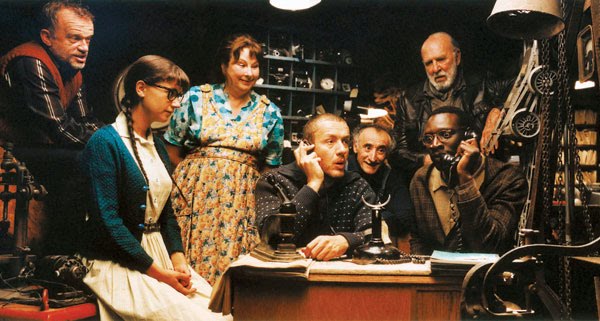
Micmacs (2010)

MICMACS
DIRECTED BY: JEAN-PIERRE JEUNET
WRITTEN BY: JEAN-PIERRE JEUNET & GUILLAUME LAURANT
OVERALL SCORE: 7.00/10


Bazil (Danny Boon), and his rag tag "family" of colorful homeless, team up to get revenge on the manufacturing companies that lead to the death of his father, and the bullet in his head.

Like a calculating magician Jean-Pierre Jeunet crafts a film with an amazing amount of visual allure, and misdirection. Not so much misdirection from some grand secret behind it all, but more so to hide the film's rather blatant narrative flaws. Though by taking the time to deliver such an enviable array of charm, you'll likely find you don't really care at all.

Micmacs, much in the same vein as Amelie, presents us with a collection of misfit characters, each with a wide array of particular quirks, brought together through happenstance. Apart they're weak, fragile, and likely to be taken apart by society, but combined they are as powerful a force as any. And to his credit, Jeunet spins one amazing collection of characters together.

Unfortunately, unlike Amelie, Jeunet lacks the plots to really bring them together. Rushed villain, and backstory, development, Micmacs quickly becomes more about the odd situations our motley crew put themselves into. Amusing without a doubt, but at times seemingly meaningless. Without the strength to really tie down our character relationships.

Their reasons become rather void, and as such I couldn't help but feel a bit unsatisfied with their intergroup dynamic. Sure, it's designed to put a smile on your face, and it most certainly does that. But I wanted more heart, connection, emotional attachment. Where instead I get amusing predicaments, and silly antics.

Though with such a big smile on my face, I find it hard to fault the film too greatly. Sure I wanted more, but I enjoyed what I got with great extent. That level of charm exudes from every scene, shot, and presents the viewer with just a lovely time.

Saved by its colorful characters, and captivating style, Micmacs is an enjoyable couple of hours of entertainment. Void of real depth however, it may struggle to resonate among viewers who are unimpressed with quirky antics, and over the top situations, and outcomes.


Thursday, June 24, 2010

The Great Dictator (1940)

THE GREAT DICTATOR
WRITTEN AND DIRECTED BY: CHARLES CHAPLIN
TOP 100 FILMS: #4
OVERALL SCORE: 10/10


Jewish Barber must wrestle with the rise of dictator Hynkel (Charles Chaplin in both roles) whom he not only looks exactly like, but who is also persecuting him, and those around him. Meanwhile Hynkel attempts to befriend fellow dictator in an effort to expand his empire, and prepare for global war.

Commander Shutz: "Strange, I thought you were an Aryan."
Barber: "No, I'm a vegetarian."


Quick, make fun of one of the greatest mass murderers in the history of man. Not too hard right? Now try and do it while, not only is that person alive (and perfectly capable of taking offense/action), but in the most accessible of all mediums, film. Not quite as easy is it? Well, there in lies the absolute brilliance that is Chaplin's feature talkie debut, The Great Dictator.

These days Chaplin may not be seen as hip, or cool, as modern comedies attempt to be. Instead, Chaplin had a charm unlike any other. His subtle mockings at pre-wartime Germany, the rise of Hitler, and the impacts on society, laced in political satire, moves at the speed of light beyond cinematic norms. The ability to find silliness in such tragedy. The ability to find humor out of such human despair. It's a power, wit, and charisma you just don't find anymore.

Chaplin could do it all, and The Great Dictator is the stage. He's not just a goofy tramp, but an accomplished, and talented actor, who can blend verbal jabs flawlessly with quiet zaniness. Let's be honest, who else could tackle Hitler's desire for world domination by combining dance and a floating globe? It's that visual eye for character, and humor, that allows The Great Dictator to breath such life.

Sentiments of humanity, grazed throughout a land of humor in dark context. Laughter blended with sadness. Hope blended with despair. A comedy that reaches beyond the confines of its own genre to be something more.... but only when necessary. You see, Chaplin knows comedy, perhaps better than anyone in the history of cinema. He knows when you just have to be funny. Be goofy. Take a chance. Have two dictators fighting over chair height to prove themselves.

Then of course you have, the speech. If you've yet to see the film, and therefore have missed the film's final speech you've missed one for the books. Not only socially important, but hope filled. Riddled with triumph. A calling for those to dream again. Powerful, beautiful, all in one. Impossible to be beaten. The sort of speech writers can only dream of penning. Perfectly exuding everything Chaplin sought out to say with this film, and so much more. It's simply icing on one of the world's greatest cakes.

I recall once saying to a friend: "Chaplin isn't for everyone... I've just never met someone worth knowing who didn't enjoy Chaplin." Sure, that's a bit of a hyperbole, but there's also some honesty. Chaplin had a way of seeing the humor in things most others couldn't. He could bring it to life, creating this amazing world. While still reminding us the world created is not so different from our own. It is apart of each of us, our lives, and affects us greatly. And, for my money, The Great Dictator is the ultimate highlight of that motif.


Saturday, May 22, 2010

The General (1926)

THE GENERAL
DIRECTED & WRITTEN BY: CLYDE BRUCKMAN & BUSTER KEATON
BOOK BY: WILLIAM PITTENGER
REVIEWED FOR: 1001 MOVIE CLUB
OVERALL SCORE: 8.00/10


After his train is stolen, along with the love of his life, by Union spies, southern train engineer Johnnie Gray (Buster Keaton) must race into enemy lines of the North to get them before its too late.

There's a certain uncanny charm to the films of Buster Keaton. If you've never seen a film of his, the best way I could summarize it in modern terms would be to think of 90's Jackie Chan without all the Kung Fu. Keaton had a knack circus like stunts, using his scrawny figure to put himself into situations few others could imagine. And The General is just the kind of film that offers itself to that medium of comedic entertainment.

An element of lunacy, and character, wrapped into one situation after another as our typical bumbling hero just can't seem to get everything right. Put that man in charge of a huge vehicle, and let the magic happen.

Add to that two thrilling train chase sequences, and you've got yourself the basic plot of The General. What the film really serves as, is a stage for Keaton to work his magic time after time. The movie doesn't slow down to deal with different plots. Everything moves as the pace of the train, and in that Keaton and Bruckman created a fast paced thriller with plenty of laughs to go around.

The only real weakness in the film lies in that its comedic setups are at times far too obvious. Not so much a problem with the film, as much as it is a telling on how many films have taken notes from it.

Benefiting from the thrilling predicament, The General doesn't have to rely solely on its gags to get through. Keaton's natural charisma stands plenty strong enough to keep viewers at the edge of their seat. Each new plot point increases the tension, and Keaton handles it with care.

The only supporting character to get any screen time is that of Gray's beloved, Annabelle Lee (Marion Mack). A typical dimwitted, yet beautiful, female heroine, who is good for a few laughs, but really there as the romantic counter to Keaton's frantic nature.

Frantic, perhaps the best way to summarize The General. Always on the move. Keeping you zoned in at every turn. Never a wasted shot, never a waste scene. Sit back, throw up your boots, and just enjoy this Silent film classic.

A testament to the ever talented, physical specimen, that is Buster Keaton, The General will wow, thrill, and amuse film goers from beginning to end.

Wednesday, May 12, 2010

Fruits Basket (2001)

FRUITS BASKET
SERIES DIRECTOR: AKITARO DAICHI
MANGA BY: NATSUKI TAKAYA
STUDIO: STUDIO DEEN
NUMBER OF EPISODES: 26
OVERALL SCORE: 8.25/10


After the death of her mother, quiet, unassuming, high school girl Tohru Honda opts to live alone in the forest after the rest of her family rejects her. After an accident destroys her self made tent/home she is taken in by the Sohma's, a reserved family who take a liking to her kindness. Though Tohru quickly finds all is not well with the Sohmas, as they are actually cursed by the zodiac animals, and transform when shown any real affection.

I have to admit, judging by the pictures I avoided Fruits Basket for a long time, because it just looked too "bubbly." And for the first few episodes the show was very much that. Comically over the top, lots of random fighting, and really a collection of amusing moments. It doesn't take long for that tone to change though. As Tohru, and in turn ourselves, get to know the Sohma's better, we gain a deeper understanding of our painful their lives are. Unable to be held by their mothers, avoided by family, and ruled by a rather tyrannical family head, they are a somber group that struggles emotionally each day.

Tohru in essence becomes their cure (far more literally in the manga adaptation). Her unwavering kindness, and seemingly infinite sympathy, reaches deep into the heart of each of them. Throughout the series these are without a doubt my absolutely favorite moments. They're powerfully heartfelt, and really get deep into the struggles of each character.

Not to mention Tohru's close friends, who are able to provide a leveling factor for Tohru, and some great comedic moments (including one Blair Witch style episode). It allows for these heartfelt moments to gain a certain sentiment of levity. Creating a simple, enjoyable, tale for the viewer to be immersed in.

The show's real weakness lies in its main decision. Without the length of the manga, the show delves into 26 episodes in which about 20 characters are introduced and examined (with some getting a couple repeats). While this offers great insight into the world of the Sohma's, the huge downside is plot. Throughout the series the main arc of Tohru, the love two of the Sohma brothers Yuki (the "school prince") and Kyo (the red headed family reject) have for her is put on the back burner. It's never fully explored, and only a few real plot developments are made.

Of course the obvious upside of deep character analysis, and hilarious episodes, is a good countering factor. Still, there's always this overbearing knowledge that with a handful of cuts, they could have gone more into the core relationships. Putting aside the random episodes (while mostly amusing), and offering the viewer something truly epic.

Incredibly memorable, with a wide breadth of emotion, Fruits Basket is a powerfully entertaining, and emotionally wrenching series that'll keep you in until the final episode. The only thing that prevents it from near, to even absolute, perfection is too few episodes, and too many characters.


Sunday, April 18, 2010

Defendor (2009)

DEFENDOR
WRITTEN AND DIRECTED BY: PETER STEBBINGS
OVERALL SCORE: 7.00/10


Well meaning, but delusional, Arthur Poppington (Woody Harrelson) dresses up at night as the superhero Defendor, hunting down Captain Industry. After getting beaten up by some local thugs, he teams up with a young hooker, Kat (Kat Dennings), to take down a city crime lord.

Defendor is the kind of film that without blogging I would never get a chance to see. This small budget Canadian film would likely have not even gazed near my radar, and what a shame that would have been. A dramady centered around a couple of personally flawed individuals trying to find their place in the world, is a captivating, and emotionally griping tale.

A parody the loves the genre cheesiness, but at the same time truly cares about its characters. Much of the film really takes the time to develop Arthur. We get to see his past, what made him the way he is, and what he aspires to be. His tale is heartbreaking, and Harrelson handles it with a dimwitted charm that makes him beyond lovable. While Kat Dennings doesn't offer much, she provides a suitable counter balance to Arthur, with a well developed backstory herself.

It's the attention to its characters that really struck me about the film. The two main leads are the only developed ones, but they are well developed. And, at the same time, they provide a good amount of comedy to keep the film refreshing. The movie knows when it's funny, but it doesn't try to force it. Never halting the progress of the story to try and make it funnier. The characters natural actions take care of that.

The real downsides for the film lie in some mishandling. Above the main four actors the second tier performances are skiddish at best. And while Stebbings does a commendable job, during many of the key dramatic moments I felt he came up a bit short in writing and direction. Not really grasping the levity of the moment, and settling for an extra bit of cheese, when not necessary.

Regardless, Defendor is a perfectly entertaining affair. Grounded by solid action, absorbed in superhero mythos, and completely full of heart.

While far from perfect Defendor is the rare kind of parody that manages to be both amusing and heartfelt. A little gem of a movie, that definitely gets my recommendation.

Wednesday, April 14, 2010

Soul Eater (2008-2009)

SOUL EATER
SERIES DIRECTED BY: TAKUYA IGARASHI
STUDIO: BONES
NUMBER OF EPISODES: 51
OVERALL SCORE: 8.00/10


When the witch Medusa seeks to free Asura, an evil being who nearly destroyed the world over 800 years ago, the Death Weapon Meister Academy, run by Death himself, must band together to stop them. At the heart of the tale lies Maki, her scythe partner, Soul Eater, Black Star, his multi-weapon partner Tsubaki, and Death the Kid, the son of Death, and dual pistol partners Liz and Patty.

Being a male fan of anime is a bit of a tricky thing. There's really two contingents to the categorization of shounen (male oriented) anime. On the one hand you have your shows like Death Note, Code Geass, and Cowboy Bebop. Style, action, and strict story telling with some comedy. While on the other hand you have your Naruto and One Peace (which I think combine for about 1000 episodes by now). High comedy, episodic, with action, but mostly ride in the realm of absurdest comedy.

Soul Eater is a show that generously borrows from all of the previously mentioned, and manages to create something that's refreshingly original, if not blatantly copied. It's opening 3 episodes are exactly what you might expect. Episode 1 - intro for Maki. Episode 2 - intro for Black Star. Episode 3 - intro for Death the Kid. Covering each of the character quirks, and building the world they live in along the way. To be fair, it's safe to warn you that the early episodes of this show are just wow, out there. It's quick paced, frantic, and absolutely hilarious. But not in a I can't stop laughing now, but more of a, wow I can't believe I'm still laughing, way. But, fear not, as the series progresses it straightens out, and narrows its focus down to a single plot line that is constantly taking shape.

Still, until the latter half of the series, the characters are really at the heart of everything. They're fun, well developed, all with their complimentary character quirk. Black Star's ego, Soul's cool obsession, Death's need for symmetry. These can be fun, but only if you're open minded. While at the same time, the supporting cast, including Death, Dr. Franken Stein, and the like, also offer lots of fun, well rounded, characters for us to get to know. It's style isn't necessarily anything new, but it keeps it refreshing, fun, and most importantly, entertaining.


Not to mention, the music. Soul Eater wonderfully blends punk rock, with a bit of rap and melodic rock vibe, into the series. These opening and closing themes, often interspersed throughout the fight scenes, are some of the most fun I've had listening to a series music in quite some time. It also marks one of the few times where I really felt bad if I didn't sit through both opening and closing credit sequences. You can check out one of the opening themes above.

It's not until Soul Eater hits the final stretch, and deviates from the manga, that the show really gets on a bit of rocky ground. Not that I would say it's bad, as it's one of the few animes who actually ties up most of its plot points. Rather, it feels a bit rushed. Especially the epic final battle (and I do mean epic). The constant action backs off a bit on the characters, and it leaves out a bit of the heart that was so well on display early on.

The finale works best when it really dedicates itself to the action. The fight sequences are incredibly exciting, and are seldom, if ever, repetitive (something that often plagues an action anime series). Working in the favor of the various characters that have been established throughout the series. The few throw-away characters, and couple of incredibly annoying ones, seem hardly noteworthy in retrospect.

Soul Eater is ultimately the kind of show you just sit back and enjoy. I was moved through a wide array of emotions throughout the series, and really grew to care about the show's many unique individuals. At times it can lean towards over the top, but it's always best intentioned. And even the drawn out episodes always felt like it had something more to bring. For any anime, that's an important thing to have.

Despite a few bumps towards the end, Soul Eater is a thoroughly enjoyable show, if you can adapt to its goofy approach to things. Its dedication to its humor and characters is respectable. And that it does it with great care, and attention, to what makes them who they are is highly admirable. All of these help make Soul Eater the much beloved series it has become. One with mass appeal, and the strength to do what it does best.


Wednesday, March 31, 2010

Rurouni Kenshin (1996 - 1998)

RUROUNI KENSHIN (AKA SAMURAI X)
SERIES DIRECTOR: KAZUHIRO FURUHASHI
STUDIO: STUDIO GALLOP + STUDIO DEEN
NUMBER OF EPISODES: 95
OVERALL SCORE: 8.75/10


Himura Kenshin, formerly known for his brutal manslaying, has taken it upon himself to leave behind his violent ways, and now wanders Japan aiding those in need with his reverse blade sword. Haunted by his past, he meets local dojo master Kamiya Kaoru, and the two begin a deep friendship, and go on many harrowing journeys.

It's nearly impossible to review a series like Rurouni Kenshin by today's standards. It was a breakthrough in more ways than one, and laid the ground work for episodic samurai tales that would follow. Still, for a movie with as much dark and entrancing past, the series is a rather goofy and amusing affair.

Basically the series breaks down into three parts. There's the first 20 episodes or so, which are mostly episodic, and serve the purpose of introducing the key characters that will re-occur throughout the series. The second is what is commonly known as the Kyoto Arc, which is a single, near 40 episode, story that evolves and delves into the various established characters. Then there's the final 30 episodes which returns to the episode format, and is more of a "return home" series, and a cool down from the emotionally intense central arc.

It's hard to review these as a whole, but when stepping back the strengths and weakness of the entire story are rather well laid out throughout each. It's easy to say that the Kyoto Arc is the highlight. It's dark, action packed, and yet develops the characters, and exposes their various struggles, especially with their past. While on the other side of things, the first and last series are much more fun, and goofy, with some emotion, usually around side characters, introduced. Don't let that fool you though, some of the arcs will really hit you in the gut emotionally.

Compound that emotional impact with some absolutely beautiful imagery and animation, and it's no wonder the series gets so much love and respect. Personally, I was hooked from the get go. Watching all 95 episodes in about a week. The characters are fun, creative, and supplied with enough depth to make them interesting. Their relationship dynamics, and how that evolves, stands strong as a centerpoint to the series.

As for the downside of things, my complaints really lay in two parts. First, since our main character is such an incredibly powerful one, it's hard to take many of the challenges he faces seriously. And some attempts to make them more severe feel forced, and not all that effective. This is especially prevalent after the Kyoto Arc, and the raw intensity it presented. In some part this is due to the series heavy departure from the manga, avoiding Kenshin's personal, and painful, past and instead opting for a more episodic flair. Though this past is touched on in one of the OVAs (Trust and Betrayal).

The other is its approach to the romance. While the manga has no problem being a romance journey, the anime seems much less confident in the characters. Instead the series opts to dance around the issue. Throwing you reasons to believe it and reasons to doubt it, and while that works for some, after 95 episodes, just making up their minds would suffice... and, they never do. The final episode is the most painfully obvious testament to this. As it manages to offer nothing that episode 65, 30 prior offered in development.

But, the fact that you watch those 30 episodes is proof of just how well done the series is overall. These filler episodes, like any show, range from great to mediocre, but I found even the worst ones entertaining. If only they hadn't deviated so much from the anime, the final collection wouldn't feel so much like a stumble to the finish line. Then again, few shows know when to go out on top.

While Rurouni Kenshin is undoubtedly classic in the anime genre, and a truly enjoyable viewing experience, the strength of its middle section does highlight the weaknesses of the other two, as it drags out its finale with far too many filler episodes.
Related Posts with Thumbnails