Showing posts with label 1970's. Show all posts

Thursday, May 19, 2011

Mini-Review: The 36th Chamber of Shaolin (1978)


I've often said the difficulty in going back in cinema viewing is that you are conditioned through years of experience in the present. All our time watching countless movies built upon the shoulders of giants. Those who saw potential in what we see as generic. Those who created grandeur through what we would now call old. And so when going back to see a movie whose influence can neither be denied or quantified, I try my best to keep that in mind.

Luckily enough, The 36th Chamber of Shaolin needed no help from my calculating mind at all. Over the top in cheese, awesomeness, and obsessive self-idealism, The 36th Chamber of Shaolin is entertainment in its purest form. A mild moral tale mixed in with a fantastical styling, wrapped in the comfort of action, under the dark tent of vengeance. It's the kind of movie you kind of wish was dubbed just to increase its magnificence ten-fold. And yet even that wouldn't begin to compliment it.

Now, I'm not saying it's one of those movies that every human being should watch before they die. I'm just saying it's one of those movies every human being should enjoy when they do; watch it, that is. The movie brings to light some of the most mentally staggering questions in history. Questions like "just how many wise old Chinese kung fu monks does it take to train a hothead?" Answer: In and around a baker's dozen. And I take no shame in saying each one is as equally awesome as the last.

That's really the kind of movie this is. Sure, there's the generic young idealist becomes kung fu master arc that has been featured so dominantly throughout the years. But that's just a component. It's the base element, from which the movie derives such an intense sense of awareness. Not afraid to be comical, self-mocking, and confident all at the same time, it imposes an enchanting charm onto the viewer. Glazing over their worries of cliches by standing steadfast alongside them. And in doing so it creates a tale worthy of those who seek out the opportunity to view it.

OVERALL RATING: 8.50/10

Recommended By: Silver Emulsion

Saturday, April 24, 2010

All the President's Men (1976)

ALL THE PRESIDENT'S MEN
DIRECTED BY: ALAN J. PAKULA
WRITTEN BY: WILLIAM GOLDMAN
BASED ON THE BOOK BY: CARL BERNSTEIN & BOB WOODWARD
REVIEWED FOR: 1001 MOVIE CLUB
OVERALL SCORE: 8.50/10


After the Watergate break in, up and coming reporters Bob Woodward (Robert Redford) and Carl Bernstein (Dustin Hoffman) team up to track down the real story. Leading the dynamic duo to break one of the biggest scandals in US history.

What first struck me as I sat there watching All the President's Men for the first time wasn't the story, it wasn't the amazing cast, but rather the impeccable realism. All the President's Men is as much a tale about Watergate as it is a tale about the ups and downs of being a reporter in the 1970's. Through the scope of this riveting scandal we see their lives, the constant battles with other papers and networks. We see how they struggle to stay awake, and at the same time must travel all over the country to find just one more clue.

Old school reporting in the set of one of the most shocking scandals in history, well, let's just say the movie just plain works. Hoffman and Redford are a wonder to see. They play to their strength perfectly blending in to the office, never overreaching for more screen time. Supplying their characters with the strongest of wit, emotion, and human flaws to make them oh so real.

Jason Robards, Hal Holbrook, Martin Balsam, Jack Warden, and a supporting cast that just never ends, are all sights to see as the supporting players to our Redford/Hoffman duo. Robards and Holbrook especially stand out as Washington Post editor Bradlee and Deep Throat respectively. They have a sort of unmistakable presence that captures at the heart of the film so well.

To bring that heart to life Pakula and Goldman go the extra distance for that little bit of added realism. You really feel apart of the journey, the trails, and the tails. It doesn't heighten tension or scenes with unnecessary soundtracks, it plays to the beat of the typewriter. To the pace of the pen. The movie moves exactly as fast as the important conversations take, and not a moment faster, or slower. Sure there's some added tension towards the end, but for the most part, it's the gripping conversations written, and captured, so marvelously, you can't help but feel apart of something.

Gripping, smart, and oh so true, All the President's Men is an unmistakable classic, brimming with a fondness for in depth reporting, and an insight to how one of the greatest scandal's in history came to be.


Wednesday, January 27, 2010

The Last Picture Show (1971)

THE LAST PICTURE SHOW
DIRECTED BY: PETER BOGDANOVICH
WRITTEN BY: PETER BOGDANOVICH & LARRY McMURTRY
NOVEL BY: LARRY McMURTRY
REVIEWED FOR: 1001 MOVIE CLUB
OVERALL SCORE: 7.75/10


High school seniors Sonny Crawford (Timothy Buttons) and Duane Jackson (Jeff Bridges) must deal with the mundane day in and day out struggles of life, and love, in a small Texas town.

Certain movies I have to admit I'm never really sure of how to review. On one hand while watching them I find myself wavering back and forth between interest, and boredom, while the farther I get away from them the more I grow to love and appreciate them. The Last Picture Show is one of those rare cases where I find myself caught between my admiration for what it is, and my annoyance for how slow, and at times uninvolving, it can be. On all levels The Last Picture Show is two films in one. It's both a coming of age tale, and a city tale. It chronicles the struggles of teenage life, and the fall of a town after the death of its moral center, here embodied by Sam the Lion (Ben Johnson).

The moral center is an intriguing tale, in how following his removal, much of the film's characters begin to fall apart, and relationships developed crumbled under self pity, and boredom. The main characters all show varying signs of uncertainty with life, such uncertainty that was only partially there beforehand. It allows The Last Picture Show to elevate above boredom, and into the realm of character study. We see how Sonny and Duane deal with these various circumstances, how they act, and if they can ever truly grow as people. The turmoil they face is by no means simple, and each complication adds new layers to their personal struggles. Even still, it's by no means a perfect tale.

With inexperienced actors heading much of the central cast, at times I felt a bit detached from the emotion they were trying to display. As well a film about the boring existence of life in a small town is going to struggle to avoid being boring itself. Yet if you can get caught up in the characters, and there are a lot, you can find yourself whisked away for a couple of hours into this world. Sure it rambles on, and has long periods where very little happens, but such is life for these individuals. They, like the viewer, must find ways of getting through the various difficulties, and if they can do so, there is a more grand reward awaiting.

The Last Picture Show isn't going to captivate action audiences, especially not in modern terms, but overall it's a rewarding, and intriguing, look at the difficulties of a small town life.

Monday, January 25, 2010

Manhattan (1979)

MANHATTAN
DIRECTED BY: WOODY ALLEN
WRITTEN BY: WOODY ALLEN & MARSHALL BRICKMAN
REVIEWED FOR: 1001 MOVIE CLUB
OVERALL SCORE: 7.25/10

Currently in a relationship with a high school student, Isaac (Woody Allen), quits his job, and tries to write his next book. Things get complicated when his best friend, Yale (Michael Murphy), begins an extramarital affair with Mary (Diane Keaton), as Isaac finds himself falling for Mary as well.

Continuing his streak of romantic analysis, Manhattan is a film of two faces. On one hand it's a portrayal of the beauty, and complications, of New York City, from the eyes of a man lost in his own life. While on the other hand it's a look at the various complications our different romantic inclinations throw us into throughout our life. It's sort of the staple of any classic Woody Allen film to be quite honest. Combining his often confusion with the different aspects of romance, with an intrigue for understanding the world around him, and if the two can co-exist on any level. It's always intriguing to observe, but often I find myself more appreciative for what Allen is trying to do, than what he often accomplishes.

With each actor perfectly portraying their roles, Allen is easily able to negotiate the rough terrain of intellectual dialogue, and side splitting humor, his audience comes to expect. Yet Manhattan is by no means a comedy. There's a few good laughs, but for the most part it's an analysis. Here is where we get into some rocky regions. While Allen is adept at the dialogue, and character development, at times I felt far to distanced from the characters to really care about their next decision. Some of them are left cold, and without appropriate balance for us to truly understand their various decisions. As such our view is mostly from the eyes of Isaac, the downside being events just occur, leaving us, and Isaac, oblivious as to why.

This all comes at the backdrop of some striking images of Manhattan. From the opening shot to the bridge scene, and final, Allen shows a great love for the city. It's nice to see such passion, but I don't share the same love, nor does the film do anything to convince me I should. The movie is really a testament to life in the city more than anything. The various ups and downs that go with it, and as such there's plenty to enjoy about the tale. It's far from perfect, but when a final dialogue as strong as the one Manhattan presents, you gain a nice bit of narrative closure... well, at least the amount of closure you get with any old school Allen film.

Using his best tactics, Allen crafts an enjoyable, while still flawed, film about life and love in Manhattan. It works, just not as well as it should have.

Sunday, January 3, 2010

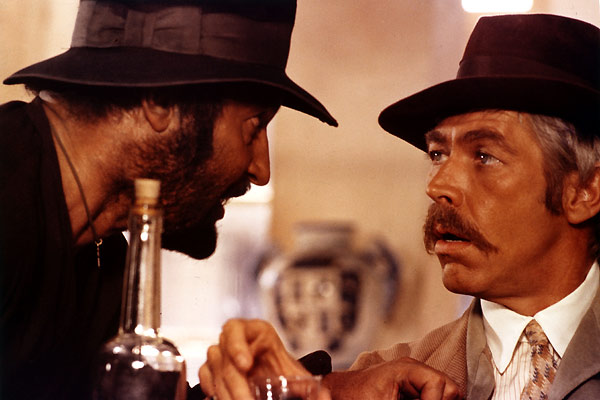
Duck, You Sucker (1971)

DUCK, YOU SUCKER (a.k.a. A FISTFUL OF DYNAMITE)
DIRECTED BY: SERGIO LEONE
WRITTEN BY: SERGIO LEONE, LUCIANO VINCENZONI, & SERGIO DONATI
ORIGINALLY REVIEWED: APRIL 18, 2009
OVERALL SCORE: 7.50/10


Juan Miranda (Rod Steiger) is a low life scum who spends his days robbing stagecoaches, killing its rich inhabitants, and raping women with his many illegitimate children. After a successful robbery one day he comes across an Irish dynamite expert, John Malloy (James Coburn). The two get off to a very rocky start, but are quickly thrust into the middle of the Mexican Revolution, one by choice, the other by accident. Seeking out very different things in life, John and Juan become an unlikely but capable team in aiding the Revolution.

From the opening Mao Tse-Tung quote on the troubles of revolution, to the first shot of Juan urinating on group of beetles, it's clear right off the bat this western is not your typical Sergio Leone. Juan is a despicable character, using his family only for his own profit, and having raped a women no more than 15 minutes into the film. John on the other hand, keeps to himself, and only through extended flashbacks do we learn more about his dark past (ala Once Upon a Time in the West Style/Few Dollars More style).

Even for all Juan's faults, he maintains a quasi-Tuco style to life which makes him entertaining, and as the film moves, his character grows into the sympathetic character we find in the films finale. John on the other hand takes a very intriguing, Blondie-esque, trait as the always two steps ahead of the game intellectual character. With neither character we get a solid background, even John's backstory is quite complex, and ambiguous. Yet for all the films characters, it takes a long time to get where it's going. Much of the opening half of the film is spent developing the relationship between John and Juan. How they seek to use each other for personal gain, while Leone spends his time developing a series of gags and situations for them to fall victim too.

Sergio Leone delivers some great directing moments, combining a sort of comical flair for the first hour, while a darker, more painful use of camera work towards the later half. At the backdrop, Ennio Morricone's score is much more quirky than his previous Leone collaborations, but by the end of the film I was completely sold on it. The great weakness of Duck, You Sucker is that its opening hour is just spread far too thin. It's unable to sustain the greatest of interest, but once the PoW scene kicks in, Leone goes into overdrive and delivers a final 1 and a half as good as any I've ever witnessed. It's painful, epic, moving, allowing us to develop a strange connection to these oddball characters, while they themselves grow closer as a pair. A poignant tale on the tragedy of revolution.

The all too often overlooked, Duck, You Sucker, is a powerful and epic tale (despite its title) of two complete opposite characters, and a harsh look at Leone's personal perspective on revolutions.

Tuesday, November 17, 2009

Close Encounters of the Third Kind (1977)

CLOSE ENCOUNTERS OF THE THIRD KIND
WRITTEN AND DIRECTED BY: STEVEN SPIELBERG
OVERALL SCORE: 10/10
TOP 100 FILMS: #56


After a strange encounter with a UFO, Roy Neary (Richard Dreyfuss) finds himself obsessed with a single image he can't figure out, but knows it holds the key for something important. Meanwhile the government is desperately trying to solve an alien mystery after a collection of military planes that have been missing for decades suddenly return.

As a self proclaimed sci-fi fanatic I think we can all agree Close Encounters is one of the granddaddy's to the genre. Filled with wonder, mysticism, and an odd tie to some level of realism, Spielberg's loving homage to the thrill of the beyond holds a special quality few other science fiction films can attain. Encounters delves into a variety of aspects of an alien arrival. The mystery, expectation, fear, and belief without understanding. The journey of Neary is not an easy one for us to watch. At times comical, heartbreaking, and difficult to attach to as he becomes obsessed with this image in his head, it's amazing to see the different trials he must overcome to save himself from this overwhelming need to know.

Though Spielberg's aptitude doesn't end there, as he goes to the other side of the coin, the governmental. Here represented predominately by translator Bob Balaban and french scientist Francois Truffaut. The two work together with other scientist in order to translate the codes used by the aliens in order to communicate their arrival coordinates. Of course none of this would work without great performances from each and every cast member. There's a sense of real humanity to the characters, they're easy to attach to, and call for us to want to see their journey to the end, without being false images of perfection. Dreyfuss is especially on his best game here, forced to play a sort of anti-hero, as we are driven into him by his obsession we are pushed away by his detachment from his family. It's never easy to make that sort of character work, especially when you're dealing with such an involved film as Close Encounters.

Of course Spielberg shows why he's lasted all these years with Encounters. Each new movement in story is a movement in film, with great effects, beautiful scenery, and lasting character moments. Granted even Spielberg can't take full credit for this film's long term success. The classic musical score, consisting of only a few notes, has become a true staple of the sci-fi genre. Every time I hear it, I'm immediately thrown back into the awe and mystery of this film. That sense of wonder lost on so many science fiction films concerned with immediate action than the fantasy realm it encompasses. Close Encounters works because it embraces all that science fiction films can without ever stepping out of bounds in favor of cheap thrills.

An awe inspiring science fiction film, with all the elements any fan of the genre could ever want, Close Encounters of the Third Kind is a true genre classic.

Monday, November 16, 2009

Halloween (1978)

HALLOWEEN
DIRECTED BY: JOHN CARPENTER
WRITTEN BY: JOHN CARPENTER & DEBRA HILL
OVERALL SCORE: 10/10
TOP 100 FILMS: #57


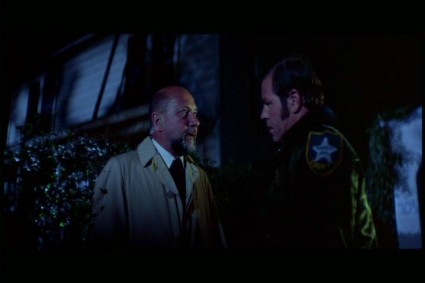
Years after having killed his older sister, a now much older Michael Myers returns to his home town having just escaped the mental institution. Being sought after by Dr. Loomis (Donald Pleasence), Myers has found new victims in local teens who are spending Halloween night babysitting.

There are some films that despite their flaws are just legendary. From the opening scene of creative slasher bliss to the finale that screams horror, Halloween is the film that helped to define a genre. Aided by the Hitchcock classic Psycho (which came in at #81 on my list), Carpenter crafted a film so full of awesome moments, and slasher film fan boy love it's nearly impossible to recreate it (as Rob Zombie has proven twice over). What ties it all together though is its simplicity. Halloween doesn't come with any heavy handed morality tales, no prolonged scenes of grotesque violence or random characters shoved into moments simply for body count. Instead Carpenter follows the time tested rule of simple is usually best keeping the characters down to a handful.

With so few characters we get to spend time with them, see what they're like, and decide how we feel about their ultimate fate. Some we cheer for, some we fear for, and others we think the world is a bit better off without. Through this, we as the viewers gain a sort of intrigue, we get to play along with Michael, Laurie (Jamie Lee Curtis), and Loomis, all trying to figure out exactly what's going to happen next. The speeches given by Loomis, one of my all time favorite on screen characters, give a dark insight to this masked killer, who he describes as "pure evil." As films go Halloween gives more verbal chills than you can imagine.

Of course it doesn't hurt when you have one of the all time great musical scores leading the way. As memorable as the scenes it encompasses, Carpenter's knack of situational music and horror film mood really grabs at the viewer. Michael's distinct evil nature has taken some rather comical turns since the release of the original Halloween, but with Carpenter behind the camera everything is kept perfectly in check. The story all adds up, while maintaining a scary unknown quality that keeps the viewer guessing long after he credits have rolled. Few horror films pull off that sense of fear and darkness as well, and few these days ever will again.

One of the most fluid, scary, and dark slasher films of all time, Halloween is one hell of a genre parent figure.
Related Posts with Thumbnails