From Screen To Street: How Movies Shape Our Expectations Of City Nightlife
-
Cinema shapes how we experience nightlife, turning city streets into
backdrops for connection, mood, and unexpected adventure beyond the big
screen.
The ...
Showing posts with label Fantasy. Show all posts
Thursday, December 1, 2011
Hugo (2011)
Hugo has everything you need to make a classic movie that critics will eat up like kids at a candy store. You've got a director everyone admires, a cast full of solid character actors, a story about a child's coming of age, and to top it all off it's a throwback film to the dawn of cinema itself. Don't even get me started on the beautiful Paris setting, the amazing set designs, and the inclusion of one of my favorite directors of all time. So why is it that I couldn't shake the desire to pull a Maxwell Smart and say "missed it by that much" the second the credits started to roll?
I've spent a long time mulling it all over. Why didn't a film with everything I'd want in a movie not end up being everything I wanted in a movie? After all, I did everything exactly the way I'd always dreamed of doing it. I kept my knowledge of the film's plot low. I read minimal reviews. I didn't let any positive or negative hype impact me. I kept my expectations perfectly in check. I went into this film in a manner I wish I went into every film. But in the words of Jake Holman "what the hell happened?"
Hugo is a very good film. It is the kind of very good film you wish you could get more people to want to see. Not only because it is good but because it has the ability to open people up to something that so many of them vehemently close themselves off to. It longs to bring out the passionate nostalgia in any moviegoer, and inspire those who have historically remained in the dark. And it interweaves the history of film around the tale of an orphan child wonderfully.
Yet throughout the film I failed to create an earnest connection with any of the core characters. Despite all the sentimentality laden throughout, Hugo often felt as if it settled for melodrama when honest drama would have been more than enough. No more so than in the dealings with the film's titular character, Hugo Cabret (Asa Butterfield - greatest name ever?).
On multiple occasions I found myself rolling my eyes during the first act of the film as the foundation for our connection with Hugo is built. At first I didn't think much of it, but as the film continued, the plot unfolded, and I started to see the world around Hugo expand, I began to realize just how tough that missed connection made enjoying the film. After all, each main character - in their own way - is an extension of the base Hugo caricature.
Each of them is longing for something missing in their life. Most ostensibly this is found in the form of their place in the greater part of the functioning world, but more immediately they long for family, romance, escape, and the past. A remembrance of better times and a hope for more of them. The basic components of life so many of us take for granted in our everyday dealings with one another. These are holes left unfilled for many of these characters and Hugo's journey provides each of them - himself most of all - the opportunity to attain the very thing, or things, they're missing.
Without that heavy bond with Hugo, the entire tale at large is difficult to bond with. The scenes are there but my heart was never with them. From Papa Georges missing past to Isabelle's (Hermione Granger Lite) adventure seeking to the Station Inspector's effective representation of a future Hugo without those around him. All of the pieces were there but the puzzle never felt complete. So when it came time for my fellow movie goers to whip out a Kleenex and dab away the welling in their eyes, I found myself clean dry.
Hugo has a lot going for it, and those capable of latching onto the characters will likely find the journey rewarding of the highest order. For my own part, I found myself wrapped up in the world but fighting an uphill battle for the characters. On balance I still recommend it, but for now my appreciation for it outweighs my enjoyment of it.
Overall Score:7.50
Film Credits:
Directed by Martin Scorcese
Written by John Logan
Based on the Novel "The Invention of Hugo Cabret" by Brian Selznick
Sunday, August 7, 2011
Rise of the Planet of the Apes (2011)
OVERALL SCORE: 8.50/10
With a tagline that sent shockwaves through the cerebral cortex of any human being who dared look upon it, and a sequence of trailers sequentially more unsatisfying than the last, Rise of the Planet of the Apes seemed to me almost t-ed up for a screeching thud into land of the easily forgotten. Yet hidden beneath the surface of all that mangled marketing phooey is a film with a distinguishable depth, compassion, and curiosity that blends summer blockbuster and character study into a compact, and engrossing two hour journey.
The evolution of Caesar from curious but gentle hearted baby chimpanzee to the intellectual leader of a new race of super Apes brings much to the table for the viewer wanting such an experience. It would have been easy for the directors to throw a simple spin 'look dumb apes, now smart apes - action ahoy' rush job in order to maintain a high intensity thrill ride of a picture, but Director Rupert Wyatt and writers Rick Jaffa and Amanda Silver knew exactly what needed to be done with this - create a world and put the viewer in it. I say it all the time, but it's perhaps the most undervalued trait a movie can give its viewer. If the team behind the picture can build that world, convince the viewer of the sincerity of the people inside it, and then carry on from there, it becomes a film viewers remember.
Though to build this world, Wyatt and company rely heavily on ol' fashion Hollywood archetypes, and seem comfortable not stretching out beyond such. Caesar is the real scene stealer for the film, and Serkis knows how to pull that off better than perhaps any other working actor. Franco's dry demeanor is put on turbo dry for this tale. Pinto is easy on the eyes but her character is given next to nothing to do, the same could be said for Brian Cox (especially the easy on the eyes part - just saying). Lithgow is always a delight, but he's unfortunately trapped in an overwritten role. The only two stars who represent the human side of the film with any memorable prowess are Tom Felton and David Oyelowo.
Felton, whose character embodies a rather generic 'bully' caretaker, shows a lot of gumption in what has to be said is basically a Draco-esque character to Caesar. Though he carries it off, and even goes head to head with Serkis in one of the film's most memorable scenes. Oyelowo is another underused character, given the good ol' fashion "I'm just in for the dough (money, not bread)!" boss, but seems to grow in terms of interest as the film progresses - culminating in a very well acted, and likely to be overlooked, final scene.
What I found most surprising about Rise of the Planet of the Apes is just how much story and development it manages to cram in an hour and forty-five minutes. The amount of non-verbal character building and molding it creates, it simply admirable - especially when you factor in the heavy summer-based requirement of action and violence to keep the audiences in check.
So, what kind of action does the film bring to the table? Well, more or less, it blends it into the plot. When I must say is such a refreshing feeling. The action works as a compliment to the story, not the navigating factor of it. Even the final battle, which we all know the film is building towards, doesn't feel forced or a simple baseline requirement. The film builds to its conclusion, not the other way around. Though with that comes a certain lack of sharp cynicism that reverberated throughout the prior installments, which I can honestly say was rather refreshing.
Film Credits:
Directed By: Rupert Wyatt
Written By: Rick Jaffa & Amanda Silver
Novel "La Planete Des Singes" By: Pierre Boulle
Wednesday, July 20, 2011
Harry Potter and the Deathly Hallows Part 2 (2011)
Overall Score: 7.75/10
And so now, the journey ends. Matched in equal measure with whimpers and bangs, Harry Potter and the Deathly Hallows Part 2 concludes in a manner equal to that of the film series itself - just fine. Never reaching beyond into that upper echelon of greatness, nor being bogged down by the sorrow filled world of rubbish. They are compliments to the novels that gave birth to them, and little more. Solid compliments, don't get me wrong. They are in every phrasing exactly what fans could want. Unfortunately because of this, they often find themselves wanting.
Deathly Hallows Part 2 picks up right where Part 1 left off (I know - shocker), as Harry, Hermione, and Ron plan their next move while Voldemort comes to the realization that his greatest secret has been unveiled. The game of chess is in full motion, and now is the time for everyone to move into position before the end is truly at hand.
Perhaps the most joyous aspect - for me anyways - to return to this installment of the series was a delectably thick slice of dark humor which had faded in Part 1 of the films. A sense of light hearted cheese mixed into tragedy which was always one of my favorite ingredients of the series. So, with a sense of urgency the film glides (or jerks) us from scene to scene, working its way to the epic finale of epicness (to steal a tagline from Scott Pilgrim).
A finale which I believe fully captures the scale of Rowling's novel, but also drags in with it some of the lesser aspects of the book. That is - the deaths. So many colorful and lovable characters fall in this battle and yet, they are merely sideshow pieces. Shuffled off to the side and and only presented to us in the aftermath, which I have always found as heartbreaking as the loss of the characters themselves. In favor of a few cheap gags, and an increased battle presence of Neville (something I fully support), we lose out on those solemn farewells and are thrust into the cries "wait, they died? When? How? COME ONNNNN!" Not to mention the problematic 'wait, who was that?' in the quick cuts to show the bodies before just as quickly moving away.
However, lamenting that one part would deprive us from the overall scale of the final battle - which is quite awe inspiring. A beautiful array of neon colors flashing throughout the dark scenery just illuminates the tension and intensity of the event. With many of our favorite characters returning in a collage of background characters running, screaming, and fighting for their life. We recognize their faces, remember the scenes of theirs brought a smile to our face, and continue on to the next.
Which brings me to something I struggled with. The entire time Deathly Hallows Part 2 was playing, I couldn't shake this uncanny feeling that I'd been through this before. I did try, oh did I ever try, but no matter how hard I did, it just wouldn't fade. The memory of Matrix Revolutions. A big battle leading up to an over the top final battle with an obscure switch up of an ending, none of which really makes all that much sense. Granted, DH P2 is beyond compare a better film (in part because it has the novel accompaniment to fill in the gaps), but I couldn't help but leave both thinking the same thing - "there should have been more." More exposition, more time to say farewell to the characters, more time dove into the final battle. Forgive my greediness, but one cannot help what they want.
Of course, getting what you want and liking what you get are two entirely different things. And I did quite love what I got. The tragic tale of Snape (Alan Rickman + super makeup for the win), the lovable presence of Minerva and all the Hogwart's staff, the coming of age of our main characters, and Ralph Fiennes absorbing all the scenery with each twitch and panic. There's such an assortment of wonder and beauty to behold in this adaptation. An exuberance of cheer and loss blended with an enduring dedication to hope.
Which I believe is a testament to the unsung hero of the Harry Potter films - Steve Kloves. Kloves burst onto the writing scene with his 2000 film Wonder Boys, and has been riding high on the Potter bandwagon since. Tasked with the ungodly difficulty of bringing Rowling's vision to life, Kloves has survived the series four directors (the film for which he didn't do a screenplay was Order of the Phoenix - Yates first entry as director). Though of course a great amount of respect must go to the directors themselves. Yates, not the most talented of the bunch, found a way to please newcomers and fans alike with his darkened style. He knew his place and knew what fans wanted. The dark tones and nature of Alfonso Curaon's Prisoner of Azkaban and the character dedicated sentiment that was Mike Newell's Goblet of Fire.
It is never easy saying goodbye to something that has been with you as long as this, but like all things one must travel onward and like the characters themselves - look to the future.
Film Credits:
Directed By: David Yates
Written By: Steve Kloves
Novel By: J.K. Rowling
Wednesday, June 15, 2011
Traveling On Wings of Desire
Can you truly love a film and not understand one lick of it? I like to think so. Appreciation for films can often be found in the way they manipulate your mood, create a sense of elevation, and transport your mind into a realm far removed from the everyday. Oh, Wings of Desire, how you intrigue me.
Don't get me wrong, a good sixty percent of your dialogue sounded like the ramblings of a traumatized philosophy professor. Not to mention all the wrapped in layers of reiteration, subtext, and reflection on an eternal scale. You certainly don't make it easy, but you indisputably make it enchanting. So enchanting in fact that once the credits began to roll I felt a sudden jolt, thrusting me back into reality. What a harsh thing for you to go and do.
There's a definitive style to Wings of Desire. You can feel it in every scene, in every moment of dialogue. A fluidity to the language that rolls with the tongue. A strolling, indifference that trudges along with the camera. Then - a snap - all that color suddenly thrust right out at the viewer amidst an onslaught of black and white. Humans - color, Angels - black and white. It's an interesting superimposition that serves somewhere in the heart of Wender's tale.
A collage of esoteric beliefs colliding with introspective desires. At times trapped in moody contextualization, Wender blends new age lifestyle with a sort of frail longing to simultaneously escape and embrace a German past so distraught with conflict.
As entrancing an experience as I've had in some time, Wings of Desire lives up to the high acclaim it has garnered over the years. Not the kind of film built for those who seek mindless entertainment, Wender's tale of two perennial angels juxtaposed against the backwash of life is a wondrous affair.
Wednesday, May 11, 2011
Thor (2011)
Overall Score: 7.00/10
Hi, and welcome to Thor Review number 9,291 in your Google Feed Reader. We here at A Life in Equinox are proud to now present our vaguely similar thoughts to what most other people are saying about the film. If you don't want to read anything negative about Thor, please cover your eyes and whack aimlessly at your mouse now.
If I could boil down Marvel's latest endeavor to just one simple concept, it would be this: self-awareness. Every movie is not just aware of its place within the context of the greater cinematic picture. It's also aware of its place within public lore. The aspects of its story that can be mocked, are. The aspects of its story that can be championed, are. And this concept succeeds because of one simple thing: Marvel knows the formula for making a successful superhero movie.
Unfortunately, one thing is lost amidst all that self-awareness... a sense of self. Each movie is so wrapped up in being ironic, self-referential, and inter-series referential that it leaves its characterizations at the door. Life defining events are simplified into one or two sentence conversations. Character backstories are summed up in single facial expressions. And the dialogue of the world you're creating... well it's just used without context, definition, or explination.
All these things are fine, if you're dealing with an audience in which one can generally expect a great deal of knowledge on the subject matter going in. However, much is the same case with Harry Potter, that's not the norm. And for those like myself who didn't grow up caring about comic books, or superheroes for that matter, much is lost in a sea of names I can't understand, people who just seem to be doing things at random, and a hammer whose Arthurian 'sword in the stone' narrative seems to deliver a limitless power source to its holder.
These are the things I find frustrating about modern cinema in general, but if I don't want to get lost in a sea of 'looky looky,' I suppose it's time I start adapting. However, don't expect me to go easily. There are certain basic components I expect from a film, and in that regard Thor reaches the finish line by the narrowest of margins.
If nothing else, I'd say it's the 'cute factor' that saves Thor. Despite its PG-13 and occasional subtle adult humor, Thor is a relatively tame affair which embraces a childlike innocence of a comic book reader. The jokes are well timed, founded on over the top characters, and packed with plenty of charismatic talent to see it through to the end. The visuals are stunning, amped up by 3D - even if it is blatantly unnecessary - and full of color and life.
Breakthrough villain, Loki (Tom Hiddleston) finds an off-kilter balance between Commodus and The Joker, making him equal parts mysterious and creative, but ultimately lacking the villainy of the aforementioned. Sure, he gets up to a bit of 'mischief,' but for the most part his efforts are conventional and ill-conceived. Sort of how one would imagine an evil David Copperfield.
Chris Hemsworth utilizes charm, intensity, and dead on comedic timing in bringing our Titular superhero to life. By playing up the camp of the role he is involved in, we are allowed to buy into the camp of the surrounding story. A style fellow actors Natalie Portman, Kat Dennings, the 'Warriors Three,' and the infallible Clark Gregg embrace in whole. Especially when you consider that the relationships built between them are founded almost entirely on non-verbal communication.
Anthony Hopkins knows how to command the screen, and is a dead ringer for Odin alongside Stellan Skarsgard, who just seems to exude fatherly experience with each vocalization. Leaving the rest in the capable, if not overtly theatrical, directing skills of Kenneth Branagh.
Thor does not reinvent the wheel, it just adds a polish, little bit of gold plating, and allows the viewer to get wrapped up in the continuous motion. And for those seeking out Thor for their viewing, that's most likely the full range of what they seek.
Film Credits:
Directed By: Kenneth Branagh
Written By: Ashley Miller, Zack Stentz, and Don Payne
Based on the Comics By: Stan Lee, Jerry Lieber, and Jack Kirby
Wednesday, March 16, 2011
The Adjustment Bureau (2011)
Overall Score: 7.25/10
Set against a mosaic of blue and gray control interspersed throughout bright world of free will, The Adjustment Bureau takes on the long standing battle of Free Will vs. Pre-Ordained Path. And much like its political savvy centerfold, Adjustment Bureau knows to walk the thin line right in between the two. Unwilling to commit to religious overtones or undertones, Adjustment Bureau is a fresh spin on a tired romance genre, blending in a science fiction - fantasy element with some pseudo-religion that supplies just enough juice to keep the engine rolling along.
Despite being a romance-thriller, The Adjustment Bureau is surprisingly tame on both accounts. Instead, the film relies heavily on drama and anticipation in building to its inevitable 'run for freedom' climax. In turn, utilizing the strength of its characters to get it there. This is an admirable decision in an age in which unnecessary chase sequences to nowhere have become common place, and romances have been 'dumbed down' to 'asshole gets the girl.'
Relying on its cast of colorful characters, and the romantic inclinations of its audience members, The Adjustment Bureau finds a way to overcome the many 'really?' moments that would plague a film of this nature; while still maintaining viewer interest. Matt Damon is better than he's been in a few of his more 'Oscar-Bait' centric roles as of late, and Emily Blunt is always a delight to watch. Anthony Mackie continues his upward trend following The Hurt Locker, and John Slattery provides the film with a much needed whimsical edge. Terence Stamp seems set for a collision course with Frank Langella for the title of 'ultimate talk-only bad guy in a suit and hat,' but Langella still holds the edge. Last, but not least, professional 'that guy' Michael Kelly rounds out the film's strong cast, and gives us the necessary realist amidst this sea of fantasy.
Despite the film's unique color scheme, abandoned entirely by the marketing team, writer-director George Nolfi doesn't bring much to the table that one wouldn't expect from other directors. His greatest strength lies in his awareness of the openness to the world he has created. In a Matrix style environment where every door can lead to anywhere, Nolfi incorporates this motif through a series of exciting chase sequences spread across the entirety of New York. This high speed contrast keeps things exhilarating, allowing the film to touch on the finer landmarks without being too obsessive about them. Granted the one-two punch of Yankee stadium and the Statue of Liberty is a bit pushing it.
However, Nolfi also shows a concern in dealing with his supporting characters. Mackie's Harry Mitchell could have easily been written off as your typical 'they're not all bad guys' routine, but Nolfi takes the time to explore and expand deeper. He's more than just a knowledge bridge to the bureau, he serves as the center of the character web, keeping everything in balance for us to appreciate. Unfortunately, this comes at a cost a bit big to chew on. The almost complete loss of characterization for our main romantic counterpart in Elise (Blunt). We don't understand her reasoning, and her backstory is rushed at cataclysmic rates through brief encounters.
The obvious consequence leaves the romantic stronghold of the film in a bit of muddy water. You can stand to be there, but it's far from the comfort and safety you would expect given the conditions. It is by those standards that I find myself quite torn on The Adjustment Bureau. It's good enough to be enjoyed and appreciated, but where one can find potential, many can easily find fault.
Film Credits:
Written and Directed By - George Nolfi
Based on the Short Story By - Philip K. Dick
Thursday, December 9, 2010
Tangled (2010)
OVERALL RATING: 6.50/10
When deriving the formula for a Disney 'Princess' film, it's often easy to forget the real factors that make them work time and time again. The way in which music, creation, and drama can be woven into our basic desires - our dreams. Disney knows better than most that the product of a great (family friendly) fantasy tale involves people rising beyond the monotony of their life. Those at the bottom realizing their dream and helping those on the top to understand theirs. In that respect Disney's 2010 offering, Tangled, knows what it's doing.
Tangled is not a unique experience. It's characters carry with them many allusions to Disney's classic - Aladdin, for example. A thief who dreams big. A princess who seeks to know and love. Cute animal sidekicks that are as defiant, as they are helpful. However, to end any analysis of Tangled there would be to sell the film short. At every turn, Tangled finds a way create something new with old Disney lore and formulate a fresh perspective on life.
It's unfortunate that Tangled doesn't start off strong. The opening is a solid setup narration, but it leads into a handful of musical numbers that are, let's be honest, dreadful. These opening musical numbers are bland, crammed together, and repetitive. Right from the start I was ready to repel the rest of Tangled, and write it off as another film I don't understand the praise for. Rapunzel's (Mandy Moore) depth felt fragile, and frustratingly trite. Her 'adventures' involve a lot of hair flying around, which makes for great CGI but not hilarious moments. Well, not as hilarious as the directors want them to be. With the introduction of Flynn Rider (Zachery Levi), everything changes.
![]() |
| The Rock called, he wants his eyebrow back... oh and a career if you've got it. |
Directors Nathan Greno and Byron Howard weave in and out of Disney norms flawlessly. They balance the pleasure with the pain, the love with the loss, and when it comes time to make us fear for the character's lives, they deliver. Intelligently using 3D sparingly, Tangled is a movie that can be revisited without worry on home systems. The 3D here accentuates, not defines, the film. It highlights the visual strengths, such as Rapunzel's hair and the lamp scene by the lake, without resorting to cheap gags (yes I'm looking at you awful Yogi Bear commercial).
The only real downside to Tangled is the lack of character exposition. Donna Murphy is fine as the evil Mother Gothel, but beyond some vanity and cinematic evilness her motivations are left entirely blank. The romantic aspect of Flynn and Rapunzel's relationship seems to grow in leaps and bounds, without solid transition moments to justify some of their sudden changes. During the middle, Tangled sprints on, requesting the audience to keep up as best they can.
By the end, Tangled does enough to leave the audience with a smile on their face, but lacks the depth to impose on them a long lasting connection. They'll remember the highs as it tries desperately to sweep past the lows, but that's a given. The best thing an aspiring audience member can do is to approach Tangled with an awareness of what it isn't (deep) and a desire for what it is (lighthearted fun). At best, it's a high quality imitation that escapes the cliche label through sheer charisma and determination. The characters may lack the fine tuning to make them Disney greats, but they do plenty for one solid outing.
Film Credits:
Directed By: Nathan Greno, Byron Howard
Written By: Dan Fogelman
Based on the Fairy Tale By: Jacob & William Grimm
Wednesday, November 24, 2010
Harry Potter and the Deathly Hallows Part 1 (2010)
HARRY POTTER AND THE DEATHLY HALLOWS PART 1
DIRECTED BY: DAVID YATES
WRITTEN BY: STEVE KLOVES
NOVEL BY: J.K. ROWLING
OVERALL SCORE: 7.50/10
With Dumbledore dead and Voldemort's horcruxes still out there, Harry (Daniel Radcliffe), Ron (Rupert Grint), and Hermione (Emma Watson) go on the run from an increasingly corrupt Ministry of Magic to complete Dumbledore's final task for them.
"These are dark times, There is no denying."
The screen goes black. After a brief pause the words 'Directed By David Yates" appear in rusted gold. An audible groan permeates throughout the audience. They were there, right on the hook. Ready to go anywhere with these characters, do anything with them, the will of the filmmakers was there's to obey. Then the line snapped, the audience splashed back into the world it has always known. It was an incredible deflating moment. The audience begged for it to just go on. Alas it would not... well, not for a few more months anyways.
Harry Potter an the Deathly Hallows (Part 1) is an engrossing adventure film that takes its audience on a roller-coaster of emotion. Traveling over lands vast and wide, through lore deep and mystical, there's never any sign of stopping. A few idle moments of pause, a few minor turns, all setting up for the big drop... that never comes.
David Yates' wonderful visual prowess has never been better. He captures the world Rowling described so eloquently her novel. Kloves intertwines drama, action, and narrative progression with the greatest of ease. At least that's what I'd like to write. The truth is Kloves' writing has never been jerkier. Yates direction has never felt more pressed for time.
Don't get me wrong Yates and Kloves do a bang up job accounting for all the things they left out of the previous films, but they also struggle with a desire to maintain an authenticity to the original work. There's so much setup information to be found in those first few hundred pages of Deathly Hallows each moment in the subsequent film rattles them off as casual observations. "Oh that necklace thing we got, yeah I'm sure it's cursed. How do I know? Easy, you seem a bit grumpy."
What ends up coming to screen is what I can only describe as a Cliff Notes version of Rowling's novel. Very much a this happened, then that happened, then this happened, and so on series of events. Yates wonderful tone and shakey-cam action sequences help supplant feelings of boredom and anxiety, while Kloves' dedication to siphoning out as much consistent action and drama as possible helps keep the film rolling along, even when the plot kicks it into neutral.
In what I can only describe as a wonderful retelling, in the vein of The Secret of Kells, Yates' take on the three Peverell brothers allows him to skirt the violent and dark undertones of the story and keep the film from delving too deep into the darkness. In many respects it is an encompassing moment in terms of visual style that represents the tone of the entire film.
Radcliffe, Grint, and Watson show just how much they've grown into viable actors, navigating the minefield of emotions their character's must traverse. Meanwhile I found myself quite taken with Yates look into the horcruxes, and the effect it has on them. Their changes are subtle, almost cynical, followed by a series of outbursts. The encounter between Ron and the first, and only (in this film), horcrux they tackle really dives into the mentality of Ron, in a very, how to put this delicately, 'graphic' representation.
Harry Potter an the Deathly Hallows (Part 1) is an engrossing adventure film that takes its audience on a roller-coaster of emotion. Traveling over lands vast and wide, through lore deep and mystical, there's never any sign of stopping. A few idle moments of pause, a few minor turns, all setting up for the big drop... that never comes.
David Yates' wonderful visual prowess has never been better. He captures the world Rowling described so eloquently her novel. Kloves intertwines drama, action, and narrative progression with the greatest of ease. At least that's what I'd like to write. The truth is Kloves' writing has never been jerkier. Yates direction has never felt more pressed for time.
Don't get me wrong Yates and Kloves do a bang up job accounting for all the things they left out of the previous films, but they also struggle with a desire to maintain an authenticity to the original work. There's so much setup information to be found in those first few hundred pages of Deathly Hallows each moment in the subsequent film rattles them off as casual observations. "Oh that necklace thing we got, yeah I'm sure it's cursed. How do I know? Easy, you seem a bit grumpy."
What ends up coming to screen is what I can only describe as a Cliff Notes version of Rowling's novel. Very much a this happened, then that happened, then this happened, and so on series of events. Yates wonderful tone and shakey-cam action sequences help supplant feelings of boredom and anxiety, while Kloves' dedication to siphoning out as much consistent action and drama as possible helps keep the film rolling along, even when the plot kicks it into neutral.
In what I can only describe as a wonderful retelling, in the vein of The Secret of Kells, Yates' take on the three Peverell brothers allows him to skirt the violent and dark undertones of the story and keep the film from delving too deep into the darkness. In many respects it is an encompassing moment in terms of visual style that represents the tone of the entire film.
Radcliffe, Grint, and Watson show just how much they've grown into viable actors, navigating the minefield of emotions their character's must traverse. Meanwhile I found myself quite taken with Yates look into the horcruxes, and the effect it has on them. Their changes are subtle, almost cynical, followed by a series of outbursts. The encounter between Ron and the first, and only (in this film), horcrux they tackle really dives into the mentality of Ron, in a very, how to put this delicately, 'graphic' representation.
In the supporting realm, Tom Felton really steps up his game as Draco Malfoy. Between Half Blood Prince and this I believe a strong argument could be made for his being one of the strongest of the young recurring actors. Special mention to David O'Hara who, in addition to being awesome, put a big smile on my face with his take on Albert Runcorn. Bill Nighy and Rhys Ifans make the most of their brief appearances but there's little for the to do with major cuts to the characters. The rest of the returning cast carry with them the same strengths and weaknesses they've always had in their respective roles, so it would be redundant to go into that here.
What I enjoyed most about Yates direction is that he keeps things tight. A few establishing shots per custom, but we spend most of our time with all three of our main characters in camera, in isolated environments (one room, tent, elevator, etc.) Yates cools off on sweeping camera movements and exposition shots, making the film feel more intimate. It appears more dark because we spend more time up close with our character's emotional turmoil. Yates wraps us up in them and allows the performances to take control.
And it's really the performances that save Deathly Hallows from being too overwhelming an experience. The wonderful cast of characters created by Rowling really come to life on screen. The action is tense and exciting, but without these characters this installment would have felt more like a lecture than a journey. No matter how good that journey is.
Despite not really going anywhere, Harry Potter and the Deathly Hallows does a good job of simplifying the story thus far, creating a good starting set of questions from which the second part can pick up. It would have been nice to see more time with the supporting characters, but one can hope the second part will delve more into that realm (especially Dumbledore). However it must be noted, as I'm pretty sure every reviewer in the known world has mentioned, this is only half a story. The movie suffers exactly as you'd expect to it from that conundrum, but through great characters and visuals it manages to rise above them.
Two other random thoughts on Harry Potter and the Deathly Hallows Part 1:
1. Will Ginny ever get some solid screen time love? Kiss Harry, be on train, the end. Come on! Bonnie Wright may be a bit stale at times, but we need more to make the epilogue even worthwhile (especially since we know they've already filmed it).
2. We really need to get together and hold a convention to reinstate the Intermission! Please, if you're pushing 2.5 hours the bathroom is definitely going to call at some point.
Thursday, September 16, 2010
Prince of Persia: The Sands of Time (2010)
DIRECTED BY: MIKE NEWELL
WRITTEN BY: BOAZ YAKIN, DOUG MIRO, & CARLO BERNARD
BASED ON THE VIDEO GAME BY: JORDAN MECHNER
OVERALL SCORE: 4.50/10
WRITTEN BY: BOAZ YAKIN, DOUG MIRO, & CARLO BERNARD
BASED ON THE VIDEO GAME BY: JORDAN MECHNER
OVERALL SCORE: 4.50/10
After the mysterious death of his adoptive father, the king of Persia, street orphan turned Prince, Dastan (Jake Gyllenhaal), finds himself being accused, and must flee his brothers quickly, in order to prove himself innocent.
------------------------------------------------------------------
The greatest flaw of Prince of Persia lies not with the directing, acting, or even its obviously better for a video game premise. Rather, it lies solely in the story. Prince of Persia's entire narrative is built on one simple belief: it has an ace in the hole ready to change everything the viewer things. That ace in the hole being, of course, time.
Only one problem: If you're over the age of 12, or have seen more than a handful of fantasy films, it's big ace in the hole ending is so blatantly obvious it pains the viewer to wait for it. And through all its action sequences, running, character development, and the like all I did was wait, and hope.
Hope that the writers had the good sense to adhere to their own story. That they wouldn't do what I so feared they would. Alas, they did go down that road... and bitter is the only lasting taste I can state.
I'm not a fan of the film's ending, to the point where its obviousness weakens any strength the leading elements may have possessed. Like a horrible poker player, Prince of Persia believe it's only teasing you by showing you one of its cards, not realizing that's basically shown you the entire hand. And when you seek to surprise in the end, showing too much is always a bad thing.
Though the journey must still count for something. Like The Sixth Sense and The Usual Suspects show, if the journey is well crafted, all can be enjoyed even if the ending is known. Here the journey is crafted with an incredible dedication to mediocrity. Flat characters (spray on tans galore), and dialogue that would make cheese seek to mold. Perhaps the one films real saving grace lies in the charisma of its leading actors.
They may not have been the right choices for the role, but they're the only thing that keeps the film afloat despite its insipid plot. Add to that a few creative fight sequences (some of which owe more than they'd care to admit to Indiana Jones) and you get a way to pass some time.
From the moment its key plot kicks in Prince of Persia drags its feet to an ending anyone can see coming, and to the detriment of the leading plot. Add to that a few too many spray on tans, and cheesy dialogue, and you'll find PoP is little more than a cheap summer flick layered with problems.
------------------------------------------------------------------
The greatest flaw of Prince of Persia lies not with the directing, acting, or even its obviously better for a video game premise. Rather, it lies solely in the story. Prince of Persia's entire narrative is built on one simple belief: it has an ace in the hole ready to change everything the viewer things. That ace in the hole being, of course, time.
Only one problem: If you're over the age of 12, or have seen more than a handful of fantasy films, it's big ace in the hole ending is so blatantly obvious it pains the viewer to wait for it. And through all its action sequences, running, character development, and the like all I did was wait, and hope.
Hope that the writers had the good sense to adhere to their own story. That they wouldn't do what I so feared they would. Alas, they did go down that road... and bitter is the only lasting taste I can state.
I'm not a fan of the film's ending, to the point where its obviousness weakens any strength the leading elements may have possessed. Like a horrible poker player, Prince of Persia believe it's only teasing you by showing you one of its cards, not realizing that's basically shown you the entire hand. And when you seek to surprise in the end, showing too much is always a bad thing.
Though the journey must still count for something. Like The Sixth Sense and The Usual Suspects show, if the journey is well crafted, all can be enjoyed even if the ending is known. Here the journey is crafted with an incredible dedication to mediocrity. Flat characters (spray on tans galore), and dialogue that would make cheese seek to mold. Perhaps the one films real saving grace lies in the charisma of its leading actors.
They may not have been the right choices for the role, but they're the only thing that keeps the film afloat despite its insipid plot. Add to that a few creative fight sequences (some of which owe more than they'd care to admit to Indiana Jones) and you get a way to pass some time.
From the moment its key plot kicks in Prince of Persia drags its feet to an ending anyone can see coming, and to the detriment of the leading plot. Add to that a few too many spray on tans, and cheesy dialogue, and you'll find PoP is little more than a cheap summer flick layered with problems.Wednesday, September 15, 2010
The Secret of Kells (2009)
DIRECTED BY: TOMM MOORE & NORA TWOMEY
WRITTEN BY: FABRICE ZIOLKOWSKI
OVERALL SCORE: 6.75/10
WRITTEN BY: FABRICE ZIOLKOWSKI
OVERALL SCORE: 6.75/10
As his uncle (Brendan Gleeson) builds a giant wall to protect his city's inhabitants, Brendan (Evan McGuire) sneaks out into the forbidden forest in order to help in the completion of the famed Book of Kells. Though on his adventures he befriends Aisling (Christen Mooney), one of the last remaining fairies.
Visually stunning, maturely crafted, and wonderfully mystical, The Secret of Kells is an animated film I hate... because it's so damned close to being absolutely perfect. That's the best way I can sum up my reaction to Kells.
A collection of great moments, rushed together too quickly, leaving the backbone too frail (especially as the film sprints at epic pace to its ending). While the voice acting suffers from being dreadfully flat, a constant reminder it's only an animated film. Those two things are painful to admit, because I felt so much while watching the film that it was right there. Right on the cuff of greatness, and it just couldn't connect.
I say that noting the immense beauty of the film. The characters, especially Aisling, are captivating. Full of layers, complexity, and intrigue. The movie manages to be light hearted, and dark at the same time. The battle between Brandon and Crom Craunch towards the finale is perhaps one of the top animated scenes I've ever witnessed.
Perhaps that's what I would note most strongly about The Secret of Kells. It's great strengths lie in its unspoken sequences. I don't blame the general cast, most of which have never acted before, but I just felt so deprived given the depth taken in creating such a rich visual experience. Though that's not to say I don't wholeheartedly recommend the film to everyone who enjoys animated adventures.
There's a certain charm, and beauty, that allows the film to escape its lesser qualities. Constantly waring with itself to display its strengths. In the end, despite it all, it does manage to do that. Though perhaps not to the results we all so desperately desire, and the animation truly deserve.
Flat voice acting, and failure to support its plot with more arches, The Secret of Kells is an amazing visual feat, that barely escapes the down weight of its weaker elements.
"I've lived through many ages. I've seen suffering in the darkness. Yet I have seen beauty thrive in the most fragile of places. I have seen the book. The book that turns darkness into light." - Aisling
Visually stunning, maturely crafted, and wonderfully mystical, The Secret of Kells is an animated film I hate... because it's so damned close to being absolutely perfect. That's the best way I can sum up my reaction to Kells.
A collection of great moments, rushed together too quickly, leaving the backbone too frail (especially as the film sprints at epic pace to its ending). While the voice acting suffers from being dreadfully flat, a constant reminder it's only an animated film. Those two things are painful to admit, because I felt so much while watching the film that it was right there. Right on the cuff of greatness, and it just couldn't connect.
I say that noting the immense beauty of the film. The characters, especially Aisling, are captivating. Full of layers, complexity, and intrigue. The movie manages to be light hearted, and dark at the same time. The battle between Brandon and Crom Craunch towards the finale is perhaps one of the top animated scenes I've ever witnessed.
Perhaps that's what I would note most strongly about The Secret of Kells. It's great strengths lie in its unspoken sequences. I don't blame the general cast, most of which have never acted before, but I just felt so deprived given the depth taken in creating such a rich visual experience. Though that's not to say I don't wholeheartedly recommend the film to everyone who enjoys animated adventures.
There's a certain charm, and beauty, that allows the film to escape its lesser qualities. Constantly waring with itself to display its strengths. In the end, despite it all, it does manage to do that. Though perhaps not to the results we all so desperately desire, and the animation truly deserve.
Flat voice acting, and failure to support its plot with more arches, The Secret of Kells is an amazing visual feat, that barely escapes the down weight of its weaker elements.Wednesday, June 16, 2010
Spirited Away (2001)
WRITTEN AND DIRECTED BY: HAYAO MIYAZAKI
TOP 100 FILMS: #15
OVERALL SCORE: 10/10
TOP 100 FILMS: #15
OVERALL SCORE: 10/10
When Chihiro, and her parents, arrive at a ghost fair ground on the way to their new city of residence, they have little idea of what lay ahead. The parents quickly turned into pigs for eating food that wasn't theirs, Chihiro must find a way to survive. Save their parents, and understand the new world of gods, and monsters, while working at a local bathe.
What allows Miyazaki's 2001 anime masterpiece to be so widely loved is that, in every aspect, it's an anime film built to be widely loved. Filled with breathtaking visuals, Spirited Away serves as a perfect introductory film to the many lore of anime tales. A movie so rich in imagination, yet grounded in captivation, it creates the world from the perspective of someone completely unfamiliar with it.
For seasoned anime fans this may come a bit tedious, but to those with no real knowledge of the genre it's a welcome mat. A welcome mat to the world of fantasy anime (and yes there are many different types of anime - see my review of Grave of the Fireflies if you don't believe me). And that world has the potential to absorb the mind of a viewer unlike many others. Supported by ancient myths of Asian culture, the fantasy world developed is so deep, one would have to try hard not to be entranced by it.
Now, I will say Spirited Away is a very heavy character film. And there are a lot of characters to be had. Because of that the movie is long, and at times slow. Always for good reason. Miyazaki doesn't just want to make this movie about the allure, he wants it to be about the journey of a young girl (another prevailing theme throughout his films). The trials of youth, and the struggles that stem from them. All wrapped in a journey of mystical stature.
Spirited Away is all about coming to terms with the new challenges life presents. Some admittedly harder than others, but all conquerable if you're determined enough. That is the task presented to Chihiro. Can she learn to overcome her fears of change, without the support of her parents? Can she hold onto those most dear to her, when they are in most need? Spirited Away exists to tackle that challenge. To bring it to life. Ultimately presenting the viewer with a world so vast, and foreign to this world, but grounded in the moral challenges each and every one of us must face.
Aided by its ability to invite viewers of all backgrounds in, Spirited Away is a beautiful tale of one girl's coming of age. Her learning of what it means to be human, to be herself, and to overcome any obstacle that stands in her way. But only if she's willing to face those challenges head on, and with an open heart.
-----------------------------------
As a programming note: The reason I've started reviewing my all time favorite Anime's is that this will mark the end in my Anime Wednesday series as I move into other projects. I won't be able to watch anime with enough consistency to keep the weekly deadline, and I know only a handful of my regular readers enjoy it. But, I will still review anime, just on a more by the view basis. Stay tuned next week for the brand new Wednesday series!
"Once you do something, you never forget. Even if you can't remember."
What allows Miyazaki's 2001 anime masterpiece to be so widely loved is that, in every aspect, it's an anime film built to be widely loved. Filled with breathtaking visuals, Spirited Away serves as a perfect introductory film to the many lore of anime tales. A movie so rich in imagination, yet grounded in captivation, it creates the world from the perspective of someone completely unfamiliar with it.
For seasoned anime fans this may come a bit tedious, but to those with no real knowledge of the genre it's a welcome mat. A welcome mat to the world of fantasy anime (and yes there are many different types of anime - see my review of Grave of the Fireflies if you don't believe me). And that world has the potential to absorb the mind of a viewer unlike many others. Supported by ancient myths of Asian culture, the fantasy world developed is so deep, one would have to try hard not to be entranced by it.
Now, I will say Spirited Away is a very heavy character film. And there are a lot of characters to be had. Because of that the movie is long, and at times slow. Always for good reason. Miyazaki doesn't just want to make this movie about the allure, he wants it to be about the journey of a young girl (another prevailing theme throughout his films). The trials of youth, and the struggles that stem from them. All wrapped in a journey of mystical stature.
Spirited Away is all about coming to terms with the new challenges life presents. Some admittedly harder than others, but all conquerable if you're determined enough. That is the task presented to Chihiro. Can she learn to overcome her fears of change, without the support of her parents? Can she hold onto those most dear to her, when they are in most need? Spirited Away exists to tackle that challenge. To bring it to life. Ultimately presenting the viewer with a world so vast, and foreign to this world, but grounded in the moral challenges each and every one of us must face.
Aided by its ability to invite viewers of all backgrounds in, Spirited Away is a beautiful tale of one girl's coming of age. Her learning of what it means to be human, to be herself, and to overcome any obstacle that stands in her way. But only if she's willing to face those challenges head on, and with an open heart.-----------------------------------
As a programming note: The reason I've started reviewing my all time favorite Anime's is that this will mark the end in my Anime Wednesday series as I move into other projects. I won't be able to watch anime with enough consistency to keep the weekly deadline, and I know only a handful of my regular readers enjoy it. But, I will still review anime, just on a more by the view basis. Stay tuned next week for the brand new Wednesday series!
Wednesday, June 2, 2010
Princess Mononoke (1997)
WRITTEN AND DIRECTED BY: HAYAO MIYAZAKI
TOP 100 FILMS: #53
OVERALL SCORE: 10/10
TOP 100 FILMS: #53
OVERALL SCORE: 10/10
After a demon boar infects his arm, Prince Ashitaka, the last remaining royal heir of a tribe wiped out by the emperor, sets off on a journey to find his destiny. Along the way he finds himself caught in the middle of a war between the animal god Moro, her human child, and an ever expanding Iron Town which seeks control of the forest.
"What exactly are you here for?"
"To see with eyes unclouded by hate."
Early in the film, just after having been told his condition is irreversible where he now lives, the town elder tells Ashitaka that now all he can do is rise to meet his fate. To accept the path his life has taken, and go off to seek his destiny. Perhaps that is what is most earth shaking about Miyazaki's 1997 masterpiece (says me). The movie, no matter how you slice it, is the ultimate combination of everything Miyazaki had worked to create up until that point.
A movie about man's desire to control nature, it's desire to repel us, and the work of one to show them how they can find a middle ground. The notion of living in harmony with the earth so prevalent throughout his work, finds itself at the forefront of this visual art. And art is what it is. Using tons of textures, and amazing images Miyazaki created a world as rich as any he's created before, and since (though Spirited Away still takes my #1 spot).
To get this Miyazaki pushes his narrative into realms far darker than he had ever traversed before. Princess Mononoke deals with the most rash, and dark, of animal instincts: hate. And when you combine hate with greed, you can destroy everything pure. It's something each character in the film must rise to face. Everyone loses when you can't let go.
In showing us this, Miyazaki takes the time and effort to develop all of his characters. We see multiple sides to them. Their dark ambitions, and their saving graces. None of the leads are left too simple, straight, and each falters along the way. Breathing life into each scene, they become as deep as the forest itself. Rich with layers, and mysteries to solve. Each new scene with something to offer the viewer to chow down.
Ashitaka provides heart, and morality. San (the human child) provides perspective. Eboshi (female leader of Iron Town) offers us the future, with sympathy. Monk god-hunter Jigo the cost of greed. While the Gods Moro and Okkoto giving us experience and depravity. So much richness, with beautiful lines to deliver. And when you have such amazing voice work in both Japanese (Yoji Matsuda, Yuriko Ishida, Yuko Tanaka, etc.) and English (Gillian Anderson, Billy Bob Thorton, Mini Driver, Billy Crudup, Claire Dames, etc.), it's just a sight to be had.
Not to mention the action. Easily becoming Miyazaki's most violent film (for a PG-13 animated film there sure are a lot of decapitations). But in that violence Miyazaki builds character. A rarity in cinema these days, where violence is used for quick shots of entertain. Here it combines both to create something more. And for that the viewer gains a wondrous story to absorb.
The kind of story that's morals stick with you. The kind of story you can revisit anytime. Because it is so deep. Because there is so much too it. A new treat for each visit. A rare film that exceeds any genre by being a bit of all genres. One I highly recommend you check out any chance you get.
Princess Mononoke is the rare kind of animated film that reaches beyond all genres, creating a life unto itself. A story packed with heart, depth, and life you can't help but be absorbed by it. While the performances and writing are there each step of the way to match Miyazaki's ambition.
A movie about man's desire to control nature, it's desire to repel us, and the work of one to show them how they can find a middle ground. The notion of living in harmony with the earth so prevalent throughout his work, finds itself at the forefront of this visual art. And art is what it is. Using tons of textures, and amazing images Miyazaki created a world as rich as any he's created before, and since (though Spirited Away still takes my #1 spot).
To get this Miyazaki pushes his narrative into realms far darker than he had ever traversed before. Princess Mononoke deals with the most rash, and dark, of animal instincts: hate. And when you combine hate with greed, you can destroy everything pure. It's something each character in the film must rise to face. Everyone loses when you can't let go.
In showing us this, Miyazaki takes the time and effort to develop all of his characters. We see multiple sides to them. Their dark ambitions, and their saving graces. None of the leads are left too simple, straight, and each falters along the way. Breathing life into each scene, they become as deep as the forest itself. Rich with layers, and mysteries to solve. Each new scene with something to offer the viewer to chow down.
Ashitaka provides heart, and morality. San (the human child) provides perspective. Eboshi (female leader of Iron Town) offers us the future, with sympathy. Monk god-hunter Jigo the cost of greed. While the Gods Moro and Okkoto giving us experience and depravity. So much richness, with beautiful lines to deliver. And when you have such amazing voice work in both Japanese (Yoji Matsuda, Yuriko Ishida, Yuko Tanaka, etc.) and English (Gillian Anderson, Billy Bob Thorton, Mini Driver, Billy Crudup, Claire Dames, etc.), it's just a sight to be had.
Not to mention the action. Easily becoming Miyazaki's most violent film (for a PG-13 animated film there sure are a lot of decapitations). But in that violence Miyazaki builds character. A rarity in cinema these days, where violence is used for quick shots of entertain. Here it combines both to create something more. And for that the viewer gains a wondrous story to absorb.
The kind of story that's morals stick with you. The kind of story you can revisit anytime. Because it is so deep. Because there is so much too it. A new treat for each visit. A rare film that exceeds any genre by being a bit of all genres. One I highly recommend you check out any chance you get.
Princess Mononoke is the rare kind of animated film that reaches beyond all genres, creating a life unto itself. A story packed with heart, depth, and life you can't help but be absorbed by it. While the performances and writing are there each step of the way to match Miyazaki's ambition.Wednesday, May 19, 2010
Busou Renkin (2006 - 2007)
DIRECTED BY: TAKAO KATO
MANGA BY: NOBUHIRO WATSUKI
STUDIO: XEBEC
NUMBER OF EPISODES: 26
OVERALL SCORE: 6.25/10
MANGA BY: NOBUHIRO WATSUKI
STUDIO: XEBEC
NUMBER OF EPISODES: 26
OVERALL SCORE: 6.25/10
After sacrificing his life to save the life of Tokiko, an arms alchemy warrior battling those who would use it for evil, Kazuki Muto is offered a Kakugane, alchemy stone, as a replacement to his heart. Now with no real shot at a normal life, Kazuki teams up with Tokiko to rid the world of evil alchemy users.
Think of Full Metal Alchemist. Take all the cliches of the man grows strong to save woman genre. Through in a kick ass female lead. And you've pretty much got Watsuki's, writer of the infamous Rurouni Kenshin, latest offering. It's a battle against genre cliches, that both aid, and hurt the series throughout its 26 episodes.
Where Renkin separates itself is in its characters. A clear romantic lead subtext, strong concentration on building the characters with action secondary, and some of the most "unique" characters you'll ever find. All of these make Busou Renkin an exciting show, but also offer a divide for viewers that they may never overcome.
For, you see, these characters range from the kind hearted lead to a butterfly dressing perverted sociopath, who enjoys feeding off people, and well, let's just say is one hell of a creepy character. It works as much as it fails, ultimately leaving the dynamic relationship between the two leads as the main staying force.
This relationship is strong, and the characters are well developed, but as the episodes wear on it gets a bit repetitive. Especially as a slew of new characters are introduced in the final 10 episodes, all leading up to the big finale. Perhaps that's where my shakey feelings for the show go.
It's one of those shows that's never so bad you have to turn it off, but never so good that you feel like you absolutely have to see the next episode. It's too predictable, even in its characterizations, despite the fact that it tries to take them to deeper levels than before. It works because there's little to hate about it. But at the same time it fails to inspire because it's way too safe of a series.
Even its opening song (despite being incredibly catchy - I mean it, I had it stuck in my head for hours) is a rather safe, loud, rock ballad. It's one of those shows that bothers you for the chances it doesn't take, rather than the strength of what it really presents. That may not be fair, but when you're a legendary manga author, I'd love for just a little chance to have been taken.
Busou Renkin breaks no new ground in terms of its genre characters and story. Instead it tries to offer you a refreshing deeper look at the characters, which barely succeeds given the strength of the talent involved. Unfortunately there's just not enough there to tie it all together, and make it as epic as it possessed the strength to be.
Think of Full Metal Alchemist. Take all the cliches of the man grows strong to save woman genre. Through in a kick ass female lead. And you've pretty much got Watsuki's, writer of the infamous Rurouni Kenshin, latest offering. It's a battle against genre cliches, that both aid, and hurt the series throughout its 26 episodes.
Where Renkin separates itself is in its characters. A clear romantic lead subtext, strong concentration on building the characters with action secondary, and some of the most "unique" characters you'll ever find. All of these make Busou Renkin an exciting show, but also offer a divide for viewers that they may never overcome.
For, you see, these characters range from the kind hearted lead to a butterfly dressing perverted sociopath, who enjoys feeding off people, and well, let's just say is one hell of a creepy character. It works as much as it fails, ultimately leaving the dynamic relationship between the two leads as the main staying force.
This relationship is strong, and the characters are well developed, but as the episodes wear on it gets a bit repetitive. Especially as a slew of new characters are introduced in the final 10 episodes, all leading up to the big finale. Perhaps that's where my shakey feelings for the show go.It's one of those shows that's never so bad you have to turn it off, but never so good that you feel like you absolutely have to see the next episode. It's too predictable, even in its characterizations, despite the fact that it tries to take them to deeper levels than before. It works because there's little to hate about it. But at the same time it fails to inspire because it's way too safe of a series.
Even its opening song (despite being incredibly catchy - I mean it, I had it stuck in my head for hours) is a rather safe, loud, rock ballad. It's one of those shows that bothers you for the chances it doesn't take, rather than the strength of what it really presents. That may not be fair, but when you're a legendary manga author, I'd love for just a little chance to have been taken.
Busou Renkin breaks no new ground in terms of its genre characters and story. Instead it tries to offer you a refreshing deeper look at the characters, which barely succeeds given the strength of the talent involved. Unfortunately there's just not enough there to tie it all together, and make it as epic as it possessed the strength to be.Wednesday, May 12, 2010
Fruits Basket (2001)
SERIES DIRECTOR: AKITARO DAICHI
MANGA BY: NATSUKI TAKAYA
STUDIO: STUDIO DEEN
NUMBER OF EPISODES: 26
OVERALL SCORE: 8.25/10
MANGA BY: NATSUKI TAKAYA
STUDIO: STUDIO DEEN
NUMBER OF EPISODES: 26
OVERALL SCORE: 8.25/10
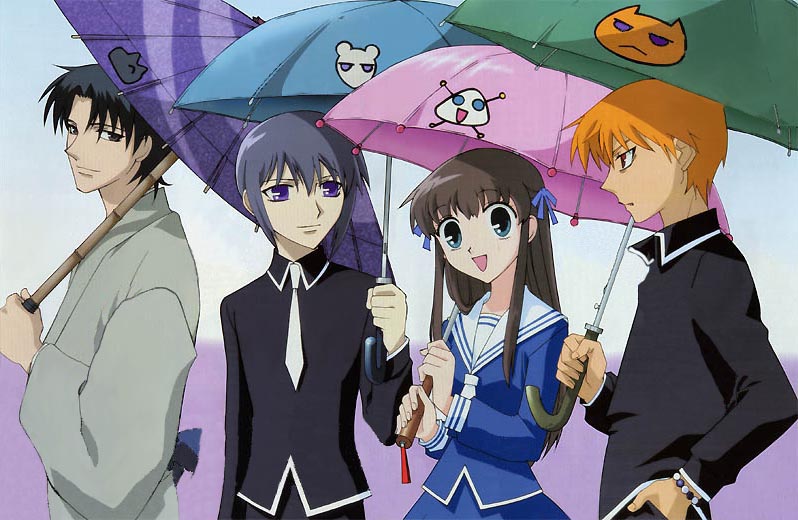
After the death of her mother, quiet, unassuming, high school girl Tohru Honda opts to live alone in the forest after the rest of her family rejects her. After an accident destroys her self made tent/home she is taken in by the Sohma's, a reserved family who take a liking to her kindness. Though Tohru quickly finds all is not well with the Sohmas, as they are actually cursed by the zodiac animals, and transform when shown any real affection.
I have to admit, judging by the pictures I avoided Fruits Basket for a long time, because it just looked too "bubbly." And for the first few episodes the show was very much that. Comically over the top, lots of random fighting, and really a collection of amusing moments. It doesn't take long for that tone to change though. As Tohru, and in turn ourselves, get to know the Sohma's better, we gain a deeper understanding of our painful their lives are. Unable to be held by their mothers, avoided by family, and ruled by a rather tyrannical family head, they are a somber group that struggles emotionally each day.
Tohru in essence becomes their cure (far more literally in the manga adaptation). Her unwavering kindness, and seemingly infinite sympathy, reaches deep into the heart of each of them. Throughout the series these are without a doubt my absolutely favorite moments. They're powerfully heartfelt, and really get deep into the struggles of each character.
Not to mention Tohru's close friends, who are able to provide a leveling factor for Tohru, and some great comedic moments (including one Blair Witch style episode). It allows for these heartfelt moments to gain a certain sentiment of levity. Creating a simple, enjoyable, tale for the viewer to be immersed in.
The show's real weakness lies in its main decision. Without the length of the manga, the show delves into 26 episodes in which about 20 characters are introduced and examined (with some getting a couple repeats). While this offers great insight into the world of the Sohma's, the huge downside is plot. Throughout the series the main arc of Tohru, the love two of the Sohma brothers Yuki (the "school prince") and Kyo (the red headed family reject) have for her is put on the back burner. It's never fully explored, and only a few real plot developments are made.
Of course the obvious upside of deep character analysis, and hilarious episodes, is a good countering factor. Still, there's always this overbearing knowledge that with a handful of cuts, they could have gone more into the core relationships. Putting aside the random episodes (while mostly amusing), and offering the viewer something truly epic.
Incredibly memorable, with a wide breadth of emotion, Fruits Basket is a powerfully entertaining, and emotionally wrenching series that'll keep you in until the final episode. The only thing that prevents it from near, to even absolute, perfection is too few episodes, and too many characters.
I have to admit, judging by the pictures I avoided Fruits Basket for a long time, because it just looked too "bubbly." And for the first few episodes the show was very much that. Comically over the top, lots of random fighting, and really a collection of amusing moments. It doesn't take long for that tone to change though. As Tohru, and in turn ourselves, get to know the Sohma's better, we gain a deeper understanding of our painful their lives are. Unable to be held by their mothers, avoided by family, and ruled by a rather tyrannical family head, they are a somber group that struggles emotionally each day.
Tohru in essence becomes their cure (far more literally in the manga adaptation). Her unwavering kindness, and seemingly infinite sympathy, reaches deep into the heart of each of them. Throughout the series these are without a doubt my absolutely favorite moments. They're powerfully heartfelt, and really get deep into the struggles of each character.
Not to mention Tohru's close friends, who are able to provide a leveling factor for Tohru, and some great comedic moments (including one Blair Witch style episode). It allows for these heartfelt moments to gain a certain sentiment of levity. Creating a simple, enjoyable, tale for the viewer to be immersed in.
The show's real weakness lies in its main decision. Without the length of the manga, the show delves into 26 episodes in which about 20 characters are introduced and examined (with some getting a couple repeats). While this offers great insight into the world of the Sohma's, the huge downside is plot. Throughout the series the main arc of Tohru, the love two of the Sohma brothers Yuki (the "school prince") and Kyo (the red headed family reject) have for her is put on the back burner. It's never fully explored, and only a few real plot developments are made.Of course the obvious upside of deep character analysis, and hilarious episodes, is a good countering factor. Still, there's always this overbearing knowledge that with a handful of cuts, they could have gone more into the core relationships. Putting aside the random episodes (while mostly amusing), and offering the viewer something truly epic.
Incredibly memorable, with a wide breadth of emotion, Fruits Basket is a powerfully entertaining, and emotionally wrenching series that'll keep you in until the final episode. The only thing that prevents it from near, to even absolute, perfection is too few episodes, and too many characters.Thursday, April 1, 2010
The Imaginarium of Doctor Parnassus (2009)
DIRECTED BY: TERRY GILLIAM
WRITTEN BY: TERRY GILLIAM & CHARLES McKEOWN
OVERALL SCORE: 7.25/10
WRITTEN BY: TERRY GILLIAM & CHARLES McKEOWN
OVERALL SCORE: 7.25/10
After thousands of years of making bets with Mr. Nick (Tom Waits), a physical personification of the devil, Doctor Parnassus (Christopher Plummer) must face the ultimate consequence. If he cannot claim five souls before his daughter's (Lily Cole) 16th birthday she will belong to Mr. Nick for all time. With only two days remaining Parnassus enlists the aid of charismatic, amnesiac, Tony (Heath Ledger) for one last go.
I have to admit, pretty much nine times out of ten I don't go for the Terry Gilliam idea over story framework. I like my stories far too much to delegate them to an afterthought. So, I went into watching Parnassus with a great deal of hesitancy, and worry as to what to expect. And, much to my surprise, here Gilliam has managed to find a strong balance between them.
Wonderfully navigating the old school good vs. evil for the souls of mankind tale, Gilliam maintains his tale with wonderful visuals interwoven, creative characters, and a solid, if ill-explained, plot, bounded in subtext. Parnassus knows it involves many plot devices, and openly utilizes them as it deems fit. For that's the benefit of its premise. In a world where your imagination defines what occurs, one can do anything, and manipulate anything they want. A powerful tool for any filmmaker.
And for the most part Gilliam captures his world wonderfully. He plays to the quirky side of things, but develops the characters fully. They go through emotional rides, and in return so does the audience. And as for the cast, they handle these transitions wonderfully. Ledger is a testament to the strength of his career, and the trio of Law, Depp, and Farrell support that persona. While Plummer stands out as a highly memorable Parnassus, Cole and Andrew Garfield (slight of hand/stage-man Anton) also manage to hold their own. Waits is also a nice surprise as the quasi-villain of the story, whose random appearances are filled with smooth, and amusing plays on humanity.
The only weak link the cast I found was in Verne Troyer, as Parnassus' long time follower and friend Percy. The character just felt flat, one note by comparison, and Troyer's never really had the vocal range with emotion to elevate a character beyond that. It's a shame, but hardly something to whip out the complaint stick too heavily over.
Parnassus, despite offering its actor a wide range of emotions, is really about the visual world it creates. The bright lighting and colorful Imaginarium is beautifully in contrast to the dark, cloudy, allies of these characters reality. Though at times, especially towards the end, I felt like the film gets ahead of itself. Mr. Nick's schemes and plans seem to weigh down, and get muddled up in I really don't get why he's doing that moments. Gilliam holds it together as best he can, but I think he could have gone for more in the ending. Instead he settles on a rather cheap, predictable, trick. It closes the movie with a smile, but it's hardly the hammer home a film as high minded as this could have had.
The Imaginarium of Doctor Parnassus isn't going to break the narrative bound, but it does offer a nice, refreshing, play on an old tale. Breathing life into each sequence, and giving a good deal of depth to an otherwise visual bound tale.
I have to admit, pretty much nine times out of ten I don't go for the Terry Gilliam idea over story framework. I like my stories far too much to delegate them to an afterthought. So, I went into watching Parnassus with a great deal of hesitancy, and worry as to what to expect. And, much to my surprise, here Gilliam has managed to find a strong balance between them.
Wonderfully navigating the old school good vs. evil for the souls of mankind tale, Gilliam maintains his tale with wonderful visuals interwoven, creative characters, and a solid, if ill-explained, plot, bounded in subtext. Parnassus knows it involves many plot devices, and openly utilizes them as it deems fit. For that's the benefit of its premise. In a world where your imagination defines what occurs, one can do anything, and manipulate anything they want. A powerful tool for any filmmaker.
And for the most part Gilliam captures his world wonderfully. He plays to the quirky side of things, but develops the characters fully. They go through emotional rides, and in return so does the audience. And as for the cast, they handle these transitions wonderfully. Ledger is a testament to the strength of his career, and the trio of Law, Depp, and Farrell support that persona. While Plummer stands out as a highly memorable Parnassus, Cole and Andrew Garfield (slight of hand/stage-man Anton) also manage to hold their own. Waits is also a nice surprise as the quasi-villain of the story, whose random appearances are filled with smooth, and amusing plays on humanity.
The only weak link the cast I found was in Verne Troyer, as Parnassus' long time follower and friend Percy. The character just felt flat, one note by comparison, and Troyer's never really had the vocal range with emotion to elevate a character beyond that. It's a shame, but hardly something to whip out the complaint stick too heavily over.
Parnassus, despite offering its actor a wide range of emotions, is really about the visual world it creates. The bright lighting and colorful Imaginarium is beautifully in contrast to the dark, cloudy, allies of these characters reality. Though at times, especially towards the end, I felt like the film gets ahead of itself. Mr. Nick's schemes and plans seem to weigh down, and get muddled up in I really don't get why he's doing that moments. Gilliam holds it together as best he can, but I think he could have gone for more in the ending. Instead he settles on a rather cheap, predictable, trick. It closes the movie with a smile, but it's hardly the hammer home a film as high minded as this could have had.
The Imaginarium of Doctor Parnassus isn't going to break the narrative bound, but it does offer a nice, refreshing, play on an old tale. Breathing life into each sequence, and giving a good deal of depth to an otherwise visual bound tale.Sunday, March 28, 2010
Alice in Wonderland (2010)
DIRECTED BY: TIM BURTON
WRITTEN BY: LINDA WOOLVERTON
NOVEL BY: LEWIS CARROLL
OVERALL SCORE: 5.25/10
WRITTEN BY: LINDA WOOLVERTON
NOVEL BY: LEWIS CARROLL
OVERALL SCORE: 5.25/10
Years after her first venture, Alice (Mia Wasikowska) returns to Underworld in order to rescue it from the brutal ruling of the Red Queen (Helena Bonham Carter).
When I first walked out of the theater after having viewed Alice in Wonderland I was lost in a sea of thought. On the one hand I didn't hate it, as it managed to fully hold my attention and present me with a wonderful array of visuals. Yet, I knew at the time what I disliked about it, that was aching at the back of my head... several weeks later, those things have only become more prevailing and frustrating.
So, why should I care about what I review this movie so much? I mean, I don't let others affect my scores, so why care? Well, to be honest, just about everyone I know is an unabashed fanatic for at least half of the talent involved in this movie... myself included! And I have to say, there's few things harder than giving talent you greatly admire, and enjoy, a negative score. But, alas, I would be lying if I scored the movie in any other way.
To be frank, Alice in Wonderland is Avatar in terms of awe, and visual creativity. Yet its development, in terms of story, and character, are rivaled by Saturday morning cartoons for depth. We get a seemingly obligatory intro for each character. Cheshire Cat (Stephen Fry) appears and goes poof, White Rabbit (Michael Sheen) hops in for a quick shot. Blue Catapillar (Alan Rickman) slides in for a drug addict paradise one-liner, and well same goes for just about everyone else.
In fact only four characters get any real screen time: Mad Hatter (Johnny Depp) does his mad thing, throws a hat, gets a flashback, sheds a tear, and sneaks a longing eye at Alice (I'm thinking he wants to mate). The White Queen (Anne Hathaway) sneaks in, throws some quasi-moral line, makes a potion, and looks like a serial killer. So that leaves us with Alice and the Red Queen. Alice here is the same as she's always been. Ignorant, kind-hearted, but dedicated, and strong. A solid, well rounded, female character, who, despite being the centerfold of the entire film, spends far too much of it running away from things, and not enough time addressing them.
The Red Queen is a solid villain, but far too forgettable. The whole "big" obsession never inspired a chuckle out of me, and stayed far longer than its welcome. What I really wanted was the movie to get into the story. To develop it, mold it, give me reason to love, and hate it. Breath life into it!
You see that's my favorite part of any film. Tim Burton can always catch my eye with visuals, but whether or not he can grip me with the story is always up in the air. Here, Alice in Wonderland is quirky, and goofy, signature Burton, but the story... well, there isn't much of one. We spend so much time on chase sequences, the film forgets to develop a plot. Something to really grab at us, make us hate the Red Queen, seek out justice, and fight for the White Queen! ... And Alice never delivers.
We see some vague hints at the Red Queen's injustice, but nothing concrete, or emotionally involving. So the movie comes down to whether or not white or red is more of your color. Personally, I'd rather wear red than white, but that's just me. I wanted more. I needed more. I needed to care. I never felt danger, or fear for their lives. And I never felt emotionally attached. I don't need that for every movie, but with the level of talent involved that's what I expected. Perhaps that was my mistake?
There's something unmistakeably charming about the movie. It walks that thin line between adult violence and grip, and childlike wonder and awe. The action scenes are well developed, and shine on a 3D setting (that debate is for another post entirely). So, I hold nothing against those who found themselves wrapped up in the world of Alice in Wonderland. I, unfortunately, am just not one of those people... despite desperately wishing I was.
Despite some impressive visual moments, Alice in Wonderland is a lackluster affair, with all the quirkiness you'd expect from Burton, but none of the heart, and subtext, you'd long for in such an offering venture.
When I first walked out of the theater after having viewed Alice in Wonderland I was lost in a sea of thought. On the one hand I didn't hate it, as it managed to fully hold my attention and present me with a wonderful array of visuals. Yet, I knew at the time what I disliked about it, that was aching at the back of my head... several weeks later, those things have only become more prevailing and frustrating.
So, why should I care about what I review this movie so much? I mean, I don't let others affect my scores, so why care? Well, to be honest, just about everyone I know is an unabashed fanatic for at least half of the talent involved in this movie... myself included! And I have to say, there's few things harder than giving talent you greatly admire, and enjoy, a negative score. But, alas, I would be lying if I scored the movie in any other way.
To be frank, Alice in Wonderland is Avatar in terms of awe, and visual creativity. Yet its development, in terms of story, and character, are rivaled by Saturday morning cartoons for depth. We get a seemingly obligatory intro for each character. Cheshire Cat (Stephen Fry) appears and goes poof, White Rabbit (Michael Sheen) hops in for a quick shot. Blue Catapillar (Alan Rickman) slides in for a drug addict paradise one-liner, and well same goes for just about everyone else.
In fact only four characters get any real screen time: Mad Hatter (Johnny Depp) does his mad thing, throws a hat, gets a flashback, sheds a tear, and sneaks a longing eye at Alice (I'm thinking he wants to mate). The White Queen (Anne Hathaway) sneaks in, throws some quasi-moral line, makes a potion, and looks like a serial killer. So that leaves us with Alice and the Red Queen. Alice here is the same as she's always been. Ignorant, kind-hearted, but dedicated, and strong. A solid, well rounded, female character, who, despite being the centerfold of the entire film, spends far too much of it running away from things, and not enough time addressing them.
The Red Queen is a solid villain, but far too forgettable. The whole "big" obsession never inspired a chuckle out of me, and stayed far longer than its welcome. What I really wanted was the movie to get into the story. To develop it, mold it, give me reason to love, and hate it. Breath life into it!
You see that's my favorite part of any film. Tim Burton can always catch my eye with visuals, but whether or not he can grip me with the story is always up in the air. Here, Alice in Wonderland is quirky, and goofy, signature Burton, but the story... well, there isn't much of one. We spend so much time on chase sequences, the film forgets to develop a plot. Something to really grab at us, make us hate the Red Queen, seek out justice, and fight for the White Queen! ... And Alice never delivers.
We see some vague hints at the Red Queen's injustice, but nothing concrete, or emotionally involving. So the movie comes down to whether or not white or red is more of your color. Personally, I'd rather wear red than white, but that's just me. I wanted more. I needed more. I needed to care. I never felt danger, or fear for their lives. And I never felt emotionally attached. I don't need that for every movie, but with the level of talent involved that's what I expected. Perhaps that was my mistake?
There's something unmistakeably charming about the movie. It walks that thin line between adult violence and grip, and childlike wonder and awe. The action scenes are well developed, and shine on a 3D setting (that debate is for another post entirely). So, I hold nothing against those who found themselves wrapped up in the world of Alice in Wonderland. I, unfortunately, am just not one of those people... despite desperately wishing I was.
Despite some impressive visual moments, Alice in Wonderland is a lackluster affair, with all the quirkiness you'd expect from Burton, but none of the heart, and subtext, you'd long for in such an offering venture.Wednesday, February 24, 2010
Ninja Scroll (1993)
WRITTEN AND DIRECTED BY: YOSHIAKI KAWAJIRI
OVERALL SCORE: 7.25/10
Wandering ninja for hire, Jubei (Koichi Yamadera) is suddenly thrust into the middle of a battle for the nation of japan when he rescues Kagero (Emi Shinohara), a fellow ninja who is quite literally poisonous, from being raped by a mysterious man, made of stone. Now the two must team up to uncover the mystery behind a group of demons... one of whom is tied heavily to Jubei's past.
Some anime films, even I openly admit, are incredibly hard to review. Ninja Scroll is well considered a classic staple of the samurai anime genre. At the same time it's not an easy pill to swallow. Dealing with homosexuality, rape, extreme violence, and demonic incarceration it's safe to say those with a weak stomach dare not enter here. Heck, for the first hour I was unsure what kind of anime film I was really watching (to say this film is shy in terms of sex, nudity, and blood would be an understatement for the record books). I was concerned I was had walked into the world of a sexually deprived monster grasping desperately on to any form of insane violence of odd sex they can come up with.
....Then it occurred to me, that's exactly the world I had walked in to! You see Ninja Scroll, while riddled with some amazing animation, intriguing plot developments, and action is a movie more about socially disconnected warriors, all trying to get what they can from society. Some want sex. Some want violence. Some want power. And others, well they just want to be left the hell alone. In some cases, well, they want a little bit of everything. Ninja Scroll walks deep into the darkest aspects of society, our hidden shadows, and attempts to show what happens when we fail to control ourselves. The villains aren't just villains, they're sadistic, highly sociopathic, and to be frank, our heroes are just barely a few steps above.
Still, I found myself a bit wary of what all it presents. While the story is solid, if not a bit out there (even considering), Ninja Scroll seems to lose focus at times, instead wanting to concentrate on swift visuals. As well, the animation struck me as a bit odd. Perhaps a bit too comical considering the dark nature of the film? Really, I get people have broad shoulders, but they're not 3/4 the size of the body. Still, even then, what it struggles at time in animation, it more than makes up for in consistent visual strength. Much attention is taken to the scenery, and rightly so as it plays a good part in much of the film. It may not blow your mind, but Ninja Scroll is rightfully beloved among fans of the genre.
Ninja Scroll is an incredibly violent and dark film, to say the least. But still there's enough commentary, and strength of story and visuals, to make up for any angst you may have in watching it. I just say, those with a weak stomach, dare not enter.
Some anime films, even I openly admit, are incredibly hard to review. Ninja Scroll is well considered a classic staple of the samurai anime genre. At the same time it's not an easy pill to swallow. Dealing with homosexuality, rape, extreme violence, and demonic incarceration it's safe to say those with a weak stomach dare not enter here. Heck, for the first hour I was unsure what kind of anime film I was really watching (to say this film is shy in terms of sex, nudity, and blood would be an understatement for the record books). I was concerned I was had walked into the world of a sexually deprived monster grasping desperately on to any form of insane violence of odd sex they can come up with.
....Then it occurred to me, that's exactly the world I had walked in to! You see Ninja Scroll, while riddled with some amazing animation, intriguing plot developments, and action is a movie more about socially disconnected warriors, all trying to get what they can from society. Some want sex. Some want violence. Some want power. And others, well they just want to be left the hell alone. In some cases, well, they want a little bit of everything. Ninja Scroll walks deep into the darkest aspects of society, our hidden shadows, and attempts to show what happens when we fail to control ourselves. The villains aren't just villains, they're sadistic, highly sociopathic, and to be frank, our heroes are just barely a few steps above.
Still, I found myself a bit wary of what all it presents. While the story is solid, if not a bit out there (even considering), Ninja Scroll seems to lose focus at times, instead wanting to concentrate on swift visuals. As well, the animation struck me as a bit odd. Perhaps a bit too comical considering the dark nature of the film? Really, I get people have broad shoulders, but they're not 3/4 the size of the body. Still, even then, what it struggles at time in animation, it more than makes up for in consistent visual strength. Much attention is taken to the scenery, and rightly so as it plays a good part in much of the film. It may not blow your mind, but Ninja Scroll is rightfully beloved among fans of the genre.
Ninja Scroll is an incredibly violent and dark film, to say the least. But still there's enough commentary, and strength of story and visuals, to make up for any angst you may have in watching it. I just say, those with a weak stomach, dare not enter.Tuesday, February 16, 2010
The Time Traveler's Wife (2009)
DIRECTED BY: ROBERT SCHWENTKE
WRITTEN BY: BRUCE JOEL RUBIN
NOVEL BY: AUDREY NIFFENEGGER
OVERALL SCORE: 6.25/10
WRITTEN BY: BRUCE JOEL RUBIN
NOVEL BY: AUDREY NIFFENEGGER
OVERALL SCORE: 6.25/10
Chicago librarian, Henry DeTamble (Eric Bana) as an odd genetic condition: at random times, triggered by various things, he jumps through time. Clare Abshire (Rachel McAdams) has been in love with Henry since she first met him as a child, when he was a much older adult. As their first meeting comes very difficult, can they make such a complicated relationship work?
Sometimes you watch a movie, and while it's perfectly fine, you can't help but feel as if it would be far more developed in its original novel form. The Time Traveler's Wife is perfectly fine in and of itself, and it ranges between drama, romance, and comedy, but at times it feels a bit underwhelming, and illexplained. You see Time Traveler's Wife is, for the most part, told from the point of view of Henry, and his time line (except when needed to develop a character or move a plot point along for scene purposes). Still I never found the film difficult to follow, and I quickly bought into its notion of time.
Eric Bana and Rachel McAdams are by no means amazing, but their natural charisma, and chemistry, really works in developing this romance. This is critical as we come in at two very different points in their romance. For Bana our first encounter, is his first encounter, and we see his confusion over this girl, who has known him her entire life, being so excited to see him. The supporting cast are perfectly fine, but aren't asked to deliver a whole lot of emotion. Overall the story does take some adjustment, as well as time to get to know their relationship, and the story's way of dealing with time travel.
If there's one thing I often find to be most people's constant complaint is that the film's perception of time travel, doesn't match their perception (similar to what happened in Star Trek). And since nobody's yet to prove anything time travel related, it's sort of like arguing who has the better wormhole in their basement... just stop your grumping already.
Overall though, Time Traveler's Wife is really nothing special. It works because it does everything just fine, and carries the interesting, and story from start to finish. It's executed well, and works within its own confines. It never tries to be anything more. It never tries to be something massive. It simply intends to be a love story, about two individuals torn apart by a complicated issue. There's a few things I could note that would have been better, had they done them differently, but overall I feel as if it executes its romance perfectly well enough to be worth a recommendation.
While it's by no means a perfect film, The Time Traveler's Wife works despite its flaws, because of a captivating story, and two charismatic (not to mention easy on the eyes) leads.
Sometimes you watch a movie, and while it's perfectly fine, you can't help but feel as if it would be far more developed in its original novel form. The Time Traveler's Wife is perfectly fine in and of itself, and it ranges between drama, romance, and comedy, but at times it feels a bit underwhelming, and illexplained. You see Time Traveler's Wife is, for the most part, told from the point of view of Henry, and his time line (except when needed to develop a character or move a plot point along for scene purposes). Still I never found the film difficult to follow, and I quickly bought into its notion of time.
Eric Bana and Rachel McAdams are by no means amazing, but their natural charisma, and chemistry, really works in developing this romance. This is critical as we come in at two very different points in their romance. For Bana our first encounter, is his first encounter, and we see his confusion over this girl, who has known him her entire life, being so excited to see him. The supporting cast are perfectly fine, but aren't asked to deliver a whole lot of emotion. Overall the story does take some adjustment, as well as time to get to know their relationship, and the story's way of dealing with time travel.
If there's one thing I often find to be most people's constant complaint is that the film's perception of time travel, doesn't match their perception (similar to what happened in Star Trek). And since nobody's yet to prove anything time travel related, it's sort of like arguing who has the better wormhole in their basement... just stop your grumping already.
Overall though, Time Traveler's Wife is really nothing special. It works because it does everything just fine, and carries the interesting, and story from start to finish. It's executed well, and works within its own confines. It never tries to be anything more. It never tries to be something massive. It simply intends to be a love story, about two individuals torn apart by a complicated issue. There's a few things I could note that would have been better, had they done them differently, but overall I feel as if it executes its romance perfectly well enough to be worth a recommendation.
While it's by no means a perfect film, The Time Traveler's Wife works despite its flaws, because of a captivating story, and two charismatic (not to mention easy on the eyes) leads.Saturday, January 16, 2010
The Lovely Bones (2009)
DIRECTED BY: PETER JACKSON
WRITTEN BY: PETER JACKSON, PHILIPPA BOYENS, & FRAN WALSH
NOVEL BY: ALICE SEBOLD
OVERALL SCORE: 5.00/10
WRITTEN BY: PETER JACKSON, PHILIPPA BOYENS, & FRAN WALSH
NOVEL BY: ALICE SEBOLD
OVERALL SCORE: 5.00/10
After her death, Susie Salmon (Saoirse Ronan) watches over her aching family and friends from the in-between world (between earth and heaven).
When I first started hearing calls for The Lovely Bones being an over-directed mess I was doing the equivalent of putting my hands on my ears and making noises to avoid hearing it. Upon watching it, I highly regret to inform that I have to agree on some level. Jackson's knack for striking images comes at the backlash of his desire to include a little bit of everything. He wants the action, the heartbreak, and the whimsical awe all wrapped up into something that stands for more than what it is. Unfortunately, in trying to jumble all of these, Jackson looses focus on many occasions and his efforts to put them together in a simple straight forward narrative fails to mesh.
Though I don't put it all at the foot of Jackson. The source material is inherently just not straight forward enough for a novel to cinema translation. Jackson tries to pull out that epic stature from Lord of the Rings to make it work, but even still the film feels all to weighed down by the many story lines, none of which are really ever fully explained enough for the audience to follow. Then again it doesn't help Jackson that much of the cast just feels detached from their performance. Ronan, Tucci, and Sarandon shine, but Whalberg continues his post oscar-nomination slump, while Rachel Weisz's role is far too underwritten to make anything of it. Even the small performance from Nikki Soohoo (whose character plays a transitioning character for Ronan) just feels more comical than real, and a such, connectible.
Lovely Bones ends up spending most of its runtime fumbling back and forth between striking visuals, great scenes, and horrid scenes. All too disconnected from one another to truly grab the audience. Years travel for these characters, and yet nothing seems to change. Their bonds as humans never leave, and while there's certainly something there for analysis as to why, it never begs you to get that deeply involved. Of course that's not to say that Jackson doesn't make it involving. Maintaining a brisk pace, Jackson keeps the viewer intrigued throughout the runtime, dragging them through the awful scenes, by utilizing that basic human nature of curiosity. Yet at the end of the film there's still that feeling of unfulfilled emotion. Nothing ties together well enough for any sort of closure, nor is it explained well enough for us to truly grasp the importance of some scenes. Jackson, sadly enough, can't bring it all together.
Despite his best efforts, and a couple of great performances (and a couple awful ones), Jackson can't tie everything together, and ultimately falls under the weight of trying to bring such a complex story to life.
When I first started hearing calls for The Lovely Bones being an over-directed mess I was doing the equivalent of putting my hands on my ears and making noises to avoid hearing it. Upon watching it, I highly regret to inform that I have to agree on some level. Jackson's knack for striking images comes at the backlash of his desire to include a little bit of everything. He wants the action, the heartbreak, and the whimsical awe all wrapped up into something that stands for more than what it is. Unfortunately, in trying to jumble all of these, Jackson looses focus on many occasions and his efforts to put them together in a simple straight forward narrative fails to mesh.
Though I don't put it all at the foot of Jackson. The source material is inherently just not straight forward enough for a novel to cinema translation. Jackson tries to pull out that epic stature from Lord of the Rings to make it work, but even still the film feels all to weighed down by the many story lines, none of which are really ever fully explained enough for the audience to follow. Then again it doesn't help Jackson that much of the cast just feels detached from their performance. Ronan, Tucci, and Sarandon shine, but Whalberg continues his post oscar-nomination slump, while Rachel Weisz's role is far too underwritten to make anything of it. Even the small performance from Nikki Soohoo (whose character plays a transitioning character for Ronan) just feels more comical than real, and a such, connectible.
Lovely Bones ends up spending most of its runtime fumbling back and forth between striking visuals, great scenes, and horrid scenes. All too disconnected from one another to truly grab the audience. Years travel for these characters, and yet nothing seems to change. Their bonds as humans never leave, and while there's certainly something there for analysis as to why, it never begs you to get that deeply involved. Of course that's not to say that Jackson doesn't make it involving. Maintaining a brisk pace, Jackson keeps the viewer intrigued throughout the runtime, dragging them through the awful scenes, by utilizing that basic human nature of curiosity. Yet at the end of the film there's still that feeling of unfulfilled emotion. Nothing ties together well enough for any sort of closure, nor is it explained well enough for us to truly grasp the importance of some scenes. Jackson, sadly enough, can't bring it all together.
Despite his best efforts, and a couple of great performances (and a couple awful ones), Jackson can't tie everything together, and ultimately falls under the weight of trying to bring such a complex story to life.Friday, January 8, 2010
The Girl Who Leapt Through Time (2006)
DIRECTED BY: MAMORU HOSODA
WRITTEN BY: SATOKO OKUDERA
NOVEL BY: YASUTAKA TSUTSUI
OVERALL SCORE: 7.25/10
WRITTEN BY: SATOKO OKUDERA
NOVEL BY: YASUTAKA TSUTSUI
OVERALL SCORE: 7.25/10
Makoto Konno (Riisa Naka) spends most of her days going to school and playing baseball with her best friends, the mysterious Chiaki (Takuya Ishida), and the kindly, Kousuke (Mitsutaka Itakura). On a particularly bad day, Makoto trips, and falls, inside the science room landing on a mysterious object. After narrowly avoiding a train incident a few hours later Makoto realizes she now has the power to leap back through time. Using this to her advantage Makoto starts getting good grades, avoids unwanted events..... but at what cost to herself and others does this new power come?
Listed by several sites as one of the best anime films of the decade, Hosoda's The Girl Who Leapt Through Time is a fun, off the wall, while emotionally in depth, anime film. The movie wonderfully tackles this rather old tale of the consequences of time travel while at the same time dealing with the emotional insecurities of teenage girls and boys. What caught me most off guard was the movie's surprising depth, and grasp of teenage life. The boring ends and outs, how even the little things matter, and the impact our events can have on the lives of others. We see Makoto's actions, how they nearly destroy the lives of some of those dearest to her, and the selfishness she pertains.
Make no mistake about it, while Makoto is a fun character, her actions are not always the most respectable. Of course it helps that Makoto is grounded by her two best friends Kousuke and Chiaki. They're attitudes perfectly balance out the playful, and somewhat ignorant, nature of Makoto. While Hosoda takes the necessary time to build them as characters, and not just leave them as cardboard cutouts. As the movie progresses we grow closer to this trio, and fond of their personality quirks. This all sets the groundwork for a strong, and emotional, finale that will put a smile on your face, and a little tear in your eye.
Though without the animation team behind the film there would be little emotion. While there's a handful of scenes I can easily pick out as badly drawn, the animation team has a talent for capturing scenery. And Hosoda knows how to use the fact that this is an animated film to the tee. Combining the endless bounds of an animated character with grounded realism (even with time travel as the backdrop) is a truly humanist heavy art form. And while I recognize few (if any) of my followers dig anime, The Girl Who Leapt Through Time is a firm example of how it can be both entertaining and emotional at the same time. The different journeys are often fun, random, and amusing, while the consequences can come heavy handed. An enjoyable, even if flawed, tale, worthy of any anime lovers time.
Capturing beautiful scenery, an emotional story, and a sense of wonder in the world, The Girl Who Leapt Through Time is a solid addition to the ever growing world of anime films.
Listed by several sites as one of the best anime films of the decade, Hosoda's The Girl Who Leapt Through Time is a fun, off the wall, while emotionally in depth, anime film. The movie wonderfully tackles this rather old tale of the consequences of time travel while at the same time dealing with the emotional insecurities of teenage girls and boys. What caught me most off guard was the movie's surprising depth, and grasp of teenage life. The boring ends and outs, how even the little things matter, and the impact our events can have on the lives of others. We see Makoto's actions, how they nearly destroy the lives of some of those dearest to her, and the selfishness she pertains.
Make no mistake about it, while Makoto is a fun character, her actions are not always the most respectable. Of course it helps that Makoto is grounded by her two best friends Kousuke and Chiaki. They're attitudes perfectly balance out the playful, and somewhat ignorant, nature of Makoto. While Hosoda takes the necessary time to build them as characters, and not just leave them as cardboard cutouts. As the movie progresses we grow closer to this trio, and fond of their personality quirks. This all sets the groundwork for a strong, and emotional, finale that will put a smile on your face, and a little tear in your eye.
Though without the animation team behind the film there would be little emotion. While there's a handful of scenes I can easily pick out as badly drawn, the animation team has a talent for capturing scenery. And Hosoda knows how to use the fact that this is an animated film to the tee. Combining the endless bounds of an animated character with grounded realism (even with time travel as the backdrop) is a truly humanist heavy art form. And while I recognize few (if any) of my followers dig anime, The Girl Who Leapt Through Time is a firm example of how it can be both entertaining and emotional at the same time. The different journeys are often fun, random, and amusing, while the consequences can come heavy handed. An enjoyable, even if flawed, tale, worthy of any anime lovers time.
Capturing beautiful scenery, an emotional story, and a sense of wonder in the world, The Girl Who Leapt Through Time is a solid addition to the ever growing world of anime films.