Showing posts with label 1930's. Show all posts

Saturday, May 29, 2010

Gone with the Wind (1939)

GONE WITH THE WIND
DIRECTED BY: VICTORY FLEMING
WRITTEN BY: SIDNEY HOWARD
NOVEL BY: MARGARET MITCHELL
REVIEWED FOR: 1001 MOVIE CLUB
TOP 100 FILMS: #17
OVERALL SCORE: 10/10


Southern beauty Scarlett O'Hara (Vivien Leigh) must deal with Civil War, passing family, weakening estate, and a turbulent romance with the ever smooth Rhett Butler (Clark Gable).

"If I have to lie, steal, cheat or kill. As God is my witness, I'll never be hungry again."

An interesting thing happened during the dawn of feature length cinema. Despite loosing the war, the South managed to gain a great deal of cinematic prestige. From the 1915 Birth of a Nation to 1927's The General, Gone with the Win is the ultimate culmination of the Civil War from the perspective of the south. Epic, and yet simple. Tragic, and yet sublime. Gone With the Wind is a tale that escapes all bounds, by simply being a work of cinematic art.

A work that can be far too easily lambasted for being racist, and for its idealistic portrayal of Confederate superiority. All the while overlooking the fact that it is a tale from the perspective of slave owning, Confederate supporting, white female character. So while I do not agree with how it portrays these factions in a positive light, I do not criticize it for doing so given our limited point of view.

What is perhaps most striking about the film is how it portrays its two central characters. Scarlett is manipulative, conceited, and selfish. While Butler is in many respects a war profiteer, selfish, and manipulative himself. The two well compliment each other, and their romance (if one dares really call it that) gives Gone With the Wind a certain sentiment of tragic nostalgia. Never able to truly be in sync with one another, they find themselves often seeking what the other had.

You see, for all its negative traits Gone With the Wind is about facing change. Throughout the film Scarlett must match her will to live with the ever changing world around her. Her struggles with loneliness, and the ultimate consequences of her vibrant lifestyle. The final scene, a testament to all that these characters have had to endure.

As well, one can not appropriately mention this film without discussing Hatti McDaniel as Mammy. Despite her character being the ever typecasted "happy slave," McDaniel brings a great deal of presence, and character to the stage. The moral, and emotional, center to Scarlett's wavering ways. A subtly progressive character, whose importance in cinema can never be understated (in many respects both positively and negatively).

Importance in cinema. It's hard to describe Gone with the Wind any other way. For all its negatives, it's a movie that helped make cinema what it is today. And when you can be both important, and captivating, you have a visual treat for all to share.

One of the most epic films in history holds the test of time with striking visuals, memorable lines, and dynamic characters. Serving now as an example to what cinema can truly be with such prevailing talent behind it.

Monday, December 7, 2009

All Quiet on the Western Front (1930)

ALL QUIET ON THE WESTERN FRONT
DIRECTED BY: LEWIS MILESTONE
WRITTEN BY: MAXWELL ANDERSON, GEORGE ABBOT, DEL ANDREWS, C. GARDNER SULLIVAN
BASED ON THE NOVEL BY: ENRICH MARIA REMARQUE
OVERALL SCORE: 8.00/10


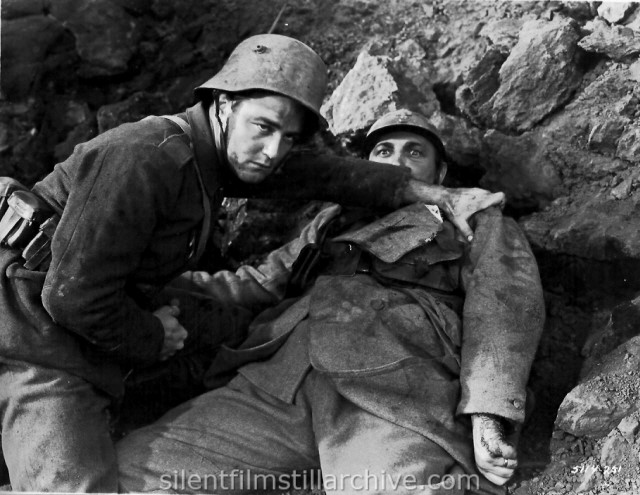
Paul (Lew Ayres) and his classmates join the German war effort during the beginning of World War I. Filled with thoughts of heroism and valor, the men soon find war is not all that they had built it up to be as death, isolation, and hunger take its toll.

If you were to ask me how many books I've read in my life I could quite honestly probably count it on both hands. If you asked me how many I truly enjoyed I could do that on one. All Quiet on the Western Front is one of those novels I absolutely love to death. So as you can imagine going into this film I did my absolute best to remove all novel comparison from my head, in the effort of giving it as good a shot as possible. What I found was a griping and powerful, yet glaringly flawed, war epic, filled with depth in moment, recognition of meaning, but lacking the time to truly delve in.

Lew Ayres was a mixed bag for me, I often found him looking the part, but his performance often felt all too staged, and really lacked the subtlety in emotion I expect from such a character. Meanwhile the classmates go up and down in terms of acting as well. Ben Alexander as Franz was a particular standout for me, with the task of playing such an emotionally torn character, while Louis Wolheim as Katczinsky is everything I could have ever wanted out of that character, and more on several occassions. Though the glue that holds this film together, through all the writers, and attempts is Milestone's strict direction.

Never allowing the story to hop around, maintaining strength in narrative transitions, and pushing onward into the harsh character moments, regardless of whether or not his actors can keep up, Milestone brings to life Remarque's amazing novel in full form. Milestone breaths a sort of life into the scenes, maintaining a sense of realism, while never sacrificing harsh story elements in favor of a more cheerful film. It's that sort of dedication to the meaning of the story that makes novel transitions to film possible, and in that respect I greatly admire Milestone's efforts.

A powerful film adaptation of Remarque's novel restricted only by the flailing quality in acting, but saved constantly by Milestone's direction.

Wednesday, December 2, 2009

Vampyr (1932)

VAMPYR
DIRECTED BY: CARL DREYER
WRITTEN BY: CHRISTEN JUL & CARL DREYER
WATCHED FOR: 1001 MOVIES TO SEE
OVERALL SCORE: 8.25/10


Upon his arrival in the town of Courteempierre, Allan Grey (Julian West), a young man fascinated by the supernatural, finds there is more going on than he anticipated. Taken in by a local mansion, he soon discovers the town is haunted by a vampire, which keeps people's shadowy spirits clung to this world.

If you were to grade a film solely on its visual strengths, it would be difficult to not give Vampyr a perfect 10. It's go it all. Effects well ahead of its time, great mood setting, strong use of scenery, and and all around aura of creepy it's difficult to shake. Dreyer is perfect at setting a tone to his film, beginning with the opening shot of an innocent Gray wondering into the town to the constant use of darkness and unique imagery. Though what ties it all together, allowing it to really stick with you, is that Dreyer's never compromises when it comes to the tone. He never cheapens out and utilizes quick scare tactics such as things popping out of nowhere, and instead he utilizes just natural eeriness of the situation. For example: shadows with no bodies, out of body experiences, and the notion of being buried alive.

Unfortunately for Dreyer, his desire to keep the film Silent in structure, with moments of dialogue, doesn't sit well with the tone. When actors do speak their voices constantly feel off, and the actors themselves are not the most talented, with West maintaining a single emotion pretty much throughout the run time. As well while I felt a sense of fear, Dreyer failed to really bring about a sense of danger. The scenes with the vampire are sparse, and not always effective. Instead it's the scenes not involving the vampires that I found most intriguing. The general mood is set so perfectly the vampire angle almost seems unnecessary at times.

Of course for all the negative, we'll never really know what Dreyer intended for us to see. Since it's release in 1932, mostly to much backlash, the original copy of Vampyr has long sense been lost, including Dreyer's personal edits following the first showing. All that exists now are compilations, combining the best from the few remaining copies, and what little dialogue could be salvaged. As such I feel a bit off about reviewing this film as it is presented too us. At best what we currently possess is a "best guess" of the film in its entirety, and as such any review is subject to much opinion, and guess work. Even then though it's impossible to deny the sheer impact of Dreyer's work, his skill behind the camera, and the mood with which Vampyr perfectly displays itself.

While it is unarguably masterful, and important in the development of the horror genre, Vampyr forces itself to overcome uninteresting characters with amazing cinematography and camera skill from director Dreyer.

Sunday, November 1, 2009

Night Must Fall (1937)

NIGHT MUST FALL
DIRECTED BY: RICHARD THORPE
WRITTEN BY: JOHN VAN DRUTEN
OVERALL SCORE: 7.00/10


When elderly Mrs. Bramson (Dame May Whitty) decides to hire the boyfriend of one of her servants, Danny (Robert Montogomery) she thinks she has found the perfect caretaker. Meanwhile her niece, and employee, Olivia (Rosalind Russell) is not so charmed by Danny, believing he may have something to do with the recent disappearance of a local woman.

Following Gaslight on TCM was the 1937 thriller Night Must Fall. A capable, and well respected 1930's thriller, that is part murder mystery, part analysis of how knowing a murderer affects the ones around them. Thorpe takes this approach very seriously, moving through the story step by step in order to ensure that he doesn't miss anything, and manages to hit all the notes necessary to make it work. This is the film's greatest strength and weakness. The movie is captivating but takes so long to get everywhere, the 30minute to 1 hour mark felt like it took forever. Though once some revelations are made and the characters begin to open up a bit I was sold.

Montgomery, Russell, and Whitty hold the film together throughout its slow moments, with a solid supporting cast who come and go as needed. The best thing about this is that each of the main characters is allowed to shine, and while we may not understand all their decisions there's a certain captivating quality to it all. Montgomery is unarguably the film's center piece, while Russell provides the complex moral counter to his personal struggles in daily life. This benefits the viewer as they can always find someone to attach to in each moment. While some of the more amusing side characters and plots are dumped along the way in favor of a more strict narrative there's a lot going for it.

The only real problem with the writing is it tends to be a bit speech oriented. What I mean by that is at random times during a conversation a character will drift on and deliver a heartfelt over the top speech and then return to the conversation as if nothing happened. I'm not sure if this is some way of letting the audience in to the subtext of the characters, but it doesn't always work so well. Perhaps the best thing the film has going for it is Thorpe. Working on so many projects at once allows Thorpe to be a strict script follower, really giving way to the dialogue and performances, relying heavily on the cast to carry the blunt force of the film. For so many scenes this works, it manages to counter the bad, and in turn create a very good dark vibe, perfect for a thriller.

While it's a very 30's film in terms of acting, scripting, and directing, Night Must Fall is a capable and thrilling film worth the time to view.
Related Posts with Thumbnails