Showing posts with label 2000's. Show all posts

Sunday, August 28, 2011

While You Were Busy Drooling Over Pixar

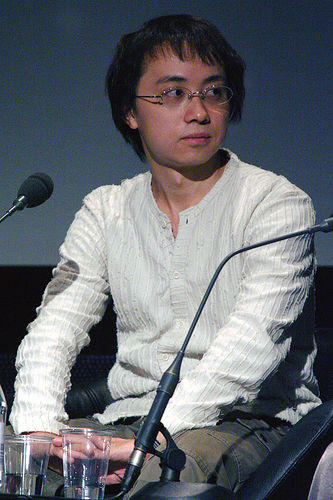
Meet Shinkai Makoto. Don't worry if you've never heard of him. That's kind of the point of this blog post. You see, he's one of the real up and coming bright spots of the Japanese animation scene and I'd like to tell you about him before you go all goo-goo refreshing Slash Film every minute in the hope that another Pixar related story pops up.

Yes, this is another Anime post. Hey wait, where are you going? Don't go, it'll only last for a minute. Just a little prick - like a need at the doctor's office. Hey, stop! Come back. Please! I love you! *cough cough* Too much? Alright, back to the serious stuff.

You see, Shinkai Makoto represents to me a sort of encompassing much of what Anime can be when done correct. Personally I'm not as big a fan of the turbulent, blood laden, long tongue monsters, half-human hybrids of the Ninja Scroll anime variety; generally finding myself far more engrossed in the whimsical fantasy and science fiction filled worlds often created by the likes of Makoto, and the much revered Hayao Miyazaki (hopefully you've at least heard of him). I enjoy a careful, methodical attention to detail and design, imagination and wonder. Something I can simultaneously engage in mentally and vainly enjoy the beauty of. That's not to say I don't enjoy realistic, heartfelt anime. After all Grave of the Fireflies sits firmly in the #2 spot on my all time anime films. Either way, there's something to be said for any film that can whisk you away to another world and make you truly want for its existence.

Which is perhaps ironic in the case of Makoto as what I would argue is his best film is entirely void of that science fiction/fantasy element and is far more grounded in reality. But more on that later. My first introduction to Makoto was, in fine fashion, his first feature length film, the 2004 romance-friendship tale The Place Promised in Our Early Days. A beautiful tale of two one-time friends who, in an alternate mid-war Japan, band together, despite their conflicts and possible damage to their own world, help heal their childhood whose conscience is trapped in an alternate universe.

Confused? Don't be, the film's elusive enough on its backstory as it is. It is a shame that, at times, the choppy narrative hinders the movie from ever escalating beyond being 'good,' but the heartfelt nature of the characters really beckons a want for their hapiness. Their dispondency clashing with their dedication, and in one of their cases deeply repressed romantic feelings, help glide the film from scene to scene. Not to mention Makoto is downright majestic when it comes to creating breath taking shots. The climax, in my assessment the film's real highlight, brings out much of what becomes a backhanded signature for Makoto. Not sad per say, but a somber optimism that weighs present love versus the possibility of a long term romance. Especially when you take into account the wonderful way he builds romance between characters who are often forced to be apart.

So after that emotionally rocky roller coaster, I thought it would be nice to continue by journey through the work of Makoto. More specifically of course checking out his much acclaimed first short, Voices of a Distant Star, clocking in a slim and trim twenty-five minutes. Which one might find a hindrance were it not for the speed and precision with which Makoto lays out each scene for the viewer to wholly engulf themselves in. Of course, this being a smaller scale installment, it also comes with a much lower budget than Makoto's following works, but I find a certain pleasure in seeing a more intimate approach - knowing that Makoto himself did most of the work (including one of the voices for the short's two characters) on the film himself. Yet I cannot deny that the melancholy nature of it is a bit overwhelming. You see, Voices of a Distant Star tells the tale of Nagamine, a teenage soldier sent into outer space to battle an army of aliens, who passes her time by emailing her adolescent love, Noboru. However, the longer the battle goes on, the farther she gets from Earth, and the longer her messages take to reach her beloved - up to a maximum of nine years. So you feel a real powerful disconnect and torn nature inside her. She is sending these messages, these declarations of love and want and friendship to someone who will have out aged her by a half her life by the time they are received.

It's a heartbreaking and heartwarming take on how far one may go for someone they love, and Makoto captures this beautifully. Despite the at times graphical woes, the emotional chords struck in the narrations by Noboru and Nagamine resound deep within. It is perhaps for that reason that this short is held in such high regard, and perhaps equally so why it is often derided by those who came seeking action.

With such ideas of sorrow and yearning I ventured out to experience Makoto's third film, the hour long 5 Centimeters Per Second. Which, having experienced Makoto's earlier work, really struck me in a series of ways I can't wholly explain. First there was the same sentiments and motifs that he explored in the earlier films. The notion of adolescent love, that first real love and how it can shape the entirety of our lives. The use of narration to make our character's inner most thoughts transparent instead of expository dialogue or an abundance of action. In fact 5 Centimeters Per Second seems to thrive on a lack of action. Its slowness is its greatest strength, and one Makoto molds into a mosaic of lights, colors, and background set pieces to leave you in awe. Each shot feels fresh, real, and humane, perhaps because this is Makoto's most human piece yet. Told in 3 "episodes" the film follows Takaki Tono and his struggle to escape his first love, Akari, as they are separated due to their parents and the consequences of his inability to stop looking back. Yet, Makoto takes 5cm Per Second beyond that. With a cast that basically only features three characters - the third being Kanae, a young girl with a crush on Takaki who is the focal point for the 2nd episode - we really get to know them in the brief time we have with them.

Through flashbacks and misdirection we see the collection of missed connections that came to define their absence in each others lives. The struggle they go through in traveling down a road of love that they know will only lead to loss and regret. If there is one complaint I would lodge it is that it shirks some responsibility of closure by keeping the 3rd episode short, and open to interpretation. Not to mention the gross absence of Kanae whose 2nd episode woes really capture that uncertainty that comes with young love and fear of the future at hand.

All in all one might say I find Shinkai Makoto to be one hell of an anime director, and I'm eagerly anticipating the US release of his latest anime film - Children Who Chase Lose Voices from Deep Below. Sure, he's a bit rough around the edges, but what he does well, he does so well it quite strongly stamps down any bad. So if you find yourself with a couple of hours to kill - all the time it would take to watch his three major works - please consider checking out his films. I simply cannot recommend them enough.

Sunday, September 19, 2010

The Red Riding Trilogy

In the Year of Our Lord - 1974:
Directed by: Julian Jarrold
Trilogy Written by: David Peace (novel) & Tony Grisoni

Grounded by a solid performance from Andrew Garfield, and a great supporting cast of Sean Bean, Eddie Marsan, and Rebecca Hall, 1974 is a beautifully shot introductory element to the trilogy. Setting the series in tone, and in narrative, it creates the starting point from which the other two films must follow.

The film's shining quality is how it blends plot, action, and character breakdown seamlessly. Capturing deep emotional struggles beneath, as each character tries to present their own uncaring to what's going on around them.

While it will provide some answers to the questions it presents, 1974 leaves you hooked, and begging for more. My one real complaint would lie in the middle in which the plot begins to drag before heading into a powerhouse of a finale. A finale which, quite honestly, saves the film several times over.

In the Year of Our Lord - 1980:
Directed By: James Marsh

In the context of the entire trilogy 1980 suffers from 3 problems. The first being that it is in many respects a stand alone story which provides some context which is later developed in the final installment. Secondly it lacks the beautiful imagery, and style, of the first and final installment. Lastly, there's just not enough depth there to make it gripping.

There's no hiding my enjoyment for watching Paddy Considine act, and here he brings some of his best acting to the forefront. As well you have lesser known British actors such as Sean Harris, Tony Pitts, Maxine Peake, and Warren Clarke stepping up to meet that level, giving 1980 one of the best all around performances of the trilogy.

1980 also benefits from having a rather quick paced plot with plenty going on. Lots of dealing with uncovering corruption, murder, and providing a bit of rounding out to some of the character's we've seen, but not known until now.

In the Year of Our Lord -1983:
Directed By: Anand Tucker


Perhaps the most visually surreal entry, 1983 does a brilliant job of tying together the loose ends left by 1974 and 1980. Linking the three films together in a story of redemption, and uncovering. Headlined by two strong performances by David Morrissey who spends the first two installments as a back ground character, and Mark Addy as a solicitor trying to prove the innocence of those accused of the lead in crimes.

Perhaps the most striking thing about 1983 is how those characters who merely served as background for the first two installments really come to light here. How much impact they really had on the plot development of the previous two films, and the crimes surrounding them. If nothing, I greatly enjoy how it all tied together, even if it isn't a perfect knot.

The only real issue I had with the plot lied in the heavy use of flashbacks. They were in many cases necessary, but not well blended, and towards the end it became hard to keep track of what time frame I was looking at. Luckily the placement of certain characters makes it a bit easier on the viewer.

--------------------------

As a whole you won't find many television movies as provocative, or indeed captivating, as this Red Riding trilogy. The acting is splendid throughout, and, while it never achieves an element of perfection, it certainly makes for a gripping weekend event.

Thursday, September 2, 2010

Ip Man (2008)

IP MAN
DIRECTED BY: WILSON YIP
WRITTEN BY: EDMOND WONG
OVERALL SCORE: 7.00/10


Master of the Chinese kung fu style Wing Chun, Ip Man (Donnie Yen), a young wealthy family man living in Foshan, spends his days honing his craft, and relaxing with his family. Suddenly his life is thrust into turmoil when his house, and wealth, is taken from him amidst the 1930's Japanese Invasion. Though when a General offers local fighters the chance to earn food via battle, Ip Man must battle moral principle, and family need.

------------------------------------------

When it comes to kung fu stars, Donnie Yen is cut of a different bread than most. Subtle, almost unassuming in his approach, Yen creates a likable, relatable, character out of Ip Man, with the help of a highly fictionalized telling of Ip Man's life.

Reminding me vaguely of the Ronny Yu/Jet Li film Fearless, Ip Man blends morality, Chinese propaganda, and action in a fun, albeit not mind blowing, cinematic effort. Wilson and Edmond put forth great effort into bringing about 1930's Foshan with great visuals, colorful characters, and exciting action sequences. Yen, whose always been a talented fighter/choreographer (see: Blade 2), is a delight to behold, and easily the film's shining element.

The supporting cast plays their way. Though often times they are caught up in rather overly dramatic subplots, some of which felt a bit soap opera in setup. I do admit that at first I worried the film would be riddled with too many throw away characters. Coming and going for only a fight or two, then leaving. Yet, Wilson and Edmond utilize the plot to their advantage and maintain many of its characters throughout. Giving, what is seemingly paper thin characters at first, a bit of time to flower. Though, none as much as our main character, of course.

As for the story: the fictionalized retelling works, in that it creates enjoyable fight sequences, and manages to bring the 1930's mindset to life. It's not a brilliant narrative. And at times it can feel a bit taxing, especially when it comes to the more "emotional" moments. Though it never flounders to the point of annoyance, keeping interest all the while.

Unfortunately the same can't be said for the film's extras. I usually don't harp on extras, but the one's taking part in this film really phone it in at times. This is most prevalent during the teaching, and group display of skill, sequences in the film. Far too many just idly make the hand gestures, at their own leisure, way off the pace set by the supposed teacher. No real rhythm, and when you're dealing with a city known for its Kung Fu dojos, the extras should look like they've at least tried.

I suppose, though, if that's all one really has to complain about, the film isn't all that bad off. No, Ip Man is a fine film that will entertain, but don't expect to be blown away.

Without the depth to make it a masterpiece, Ip Man gets by on strong fight sequences, and acceptable plot, and a strong turn by seasoned choreographer Donnie Yen. Whether or not you enjoy it likely be related to how many plot contrivances you can stand, and how much you enjoy your action.


Saturday, July 17, 2010

I'm a Cyborg, But That's OK (2006)

I'M A CYBORG, BUT THAT'S OK
DIRECTED BY: CHAN-WOOK PARK
WRITTEN BY: CHAN-WOOK PARK & SEO-GYEONG JEONG
OVERALL SCORE: 7.00/10


Cha Young-goon (Su-jeong Lim) is checked into a mental hospital after she attempts to plug herself into the wall, via cutting her wrists (something which is construed as a suicide attempt). Believing herself to be a Cyborg, she is immediately befriended by Park Il-Sun (Rain), a kleptomaniac seeking to save himself from non-existence.

--------------

A whimsically surreal adventure, torn between the dark underlying flaws of our main characters, and their almost childlike innocence... of course I'm excluding their self obsession, and one's dream of going on a killing rampage. I'm a Cyborg, But That's OK is Chan-Wook Park's embrassing of a more lighthearted analysis on the darker side of human life.

I'm a Cyborg, at its very core, deals with the many subtle worries humans face. Their troubles, dreams, desires, and the ultimate consequences when those whom are supposed to be protecting, ignore in favor of their own selfishness. Young-goon's journey to find her purpose in life is captivating, if not equally irritating, in the most comical sense. Her characters quirks put heavily on display give great moments of comedy, and heart to the viewer.

While at the same time we get to see Il-Sun, and his many efforts to help others through the only medium he understands (theft). Both of our main characters are brought to life through great performances from Su-jeong Lim and Rain (whom I was most worried about after having seen Ninja Assassin). With the supporting cast stepping up at each occasion, handling their scenes with great awareness to what Park seeks to present. A dark comical satire, with enough heart, and zaniness, to capture the raw emotion, without losing its surrealism. Confusing enough?

Where Park really stumbles is in the narrative. Seeking to be both a character study on finding ones purpose, and a surreal visual exercise, Park seems unsure of which to be at any given point. Spending much of the film leaning more towards character, and oddity, with surrealistic images slowly becoming more and more prominent. The downside to this is that it works in exact opposite of the plot. As the plot moves forward more and more the characters become closer, and I would argue, become less and less over the top. While our images becoming increasingly more so.

All of which culminates in an ending which will likely split most viewers. Beautifully captured, but not very fulfilling, Park leaves Cyborg feeling like the end of a chapter, rather than the end of a film. It's an exciting, fun, and emotional journey, that I feel could have used a better destination.

With beautiful imagery, and great characters, Park blends surrealism, hyperbole, with reality, and satire, to create a memorable, if not misguided effort in I'm a Cyborg, But That's OK. One you'll most definitely be captivated by, even if its narrative shortcomings don't inspire repeat viewings.


Wednesday, June 16, 2010

Spirited Away (2001)

SPIRITED AWAY
WRITTEN AND DIRECTED BY: HAYAO MIYAZAKI
TOP 100 FILMS: #15
OVERALL SCORE: 10/10


When Chihiro, and her parents, arrive at a ghost fair ground on the way to their new city of residence, they have little idea of what lay ahead. The parents quickly turned into pigs for eating food that wasn't theirs, Chihiro must find a way to survive. Save their parents, and understand the new world of gods, and monsters, while working at a local bathe.

"Once you do something, you never forget. Even if you can't remember."

What allows Miyazaki's 2001 anime masterpiece to be so widely loved is that, in every aspect, it's an anime film built to be widely loved. Filled with breathtaking visuals, Spirited Away serves as a perfect introductory film to the many lore of anime tales. A movie so rich in imagination, yet grounded in captivation, it creates the world from the perspective of someone completely unfamiliar with it.

For seasoned anime fans this may come a bit tedious, but to those with no real knowledge of the genre it's a welcome mat. A welcome mat to the world of fantasy anime (and yes there are many different types of anime - see my review of Grave of the Fireflies if you don't believe me). And that world has the potential to absorb the mind of a viewer unlike many others. Supported by ancient myths of Asian culture, the fantasy world developed is so deep, one would have to try hard not to be entranced by it.

Now, I will say Spirited Away is a very heavy character film. And there are a lot of characters to be had. Because of that the movie is long, and at times slow. Always for good reason. Miyazaki doesn't just want to make this movie about the allure, he wants it to be about the journey of a young girl (another prevailing theme throughout his films). The trials of youth, and the struggles that stem from them. All wrapped in a journey of mystical stature.

Spirited Away is all about coming to terms with the new challenges life presents. Some admittedly harder than others, but all conquerable if you're determined enough. That is the task presented to Chihiro. Can she learn to overcome her fears of change, without the support of her parents? Can she hold onto those most dear to her, when they are in most need? Spirited Away exists to tackle that challenge. To bring it to life. Ultimately presenting the viewer with a world so vast, and foreign to this world, but grounded in the moral challenges each and every one of us must face.

Aided by its ability to invite viewers of all backgrounds in, Spirited Away is a beautiful tale of one girl's coming of age. Her learning of what it means to be human, to be herself, and to overcome any obstacle that stands in her way. But only if she's willing to face those challenges head on, and with an open heart.


-----------------------------------

As a programming note: The reason I've started reviewing my all time favorite Anime's is that this will mark the end in my Anime Wednesday series as I move into other projects. I won't be able to watch anime with enough consistency to keep the weekly deadline, and I know only a handful of my regular readers enjoy it. But, I will still review anime, just on a more by the view basis. Stay tuned next week for the brand new Wednesday series!

Thursday, May 27, 2010

Black Dynamite (2009)

BLACK DYNAMITE
DIRECTED BY: SCOTT SANDERS
WRITTEN BY: MICHAEL JAI WHITE, BYRON MINNS, & SCOTT SANDERS
OVERALL SCORE: 7.75/10


Local legend Black Dynamite (Michael Jai White) must team up with a group of revolutionaries to take on The Man for a series of drug related incidents that have plagued his local ghetto.

"Your knowledge of scientific biological transmogrification is only outmatched by your zest for kung-fu treachery!"

Ever seen a film so indescribably awesome you secretly want to mate with it? No? Just me? Well, then you obviously haven't seen Black Dynamite. A pitch perfect parody of 1960's and 1970's blaxploitation films (specifically films like Shaft, Disco Godfather, Three The Hard Way, among many others).

In order to get you hooked, Black Dynamite dives right into the spoof, with scenes so incredibly over the top you're instantly aware of its comedic intentions. And while some may find it getting old, Michael Jai White and Scott Sanders are there at every turn to bring something new to the table. How do they do this? Quite simple: start small and just get exponentially bigger and crazier.

It's a brilliant scheme. Just when you think you've scene all this film has to offer, it brings something entirely out there to the table. This includes fight scenes involving ninjas, presidents, and just regular thugs. The kind of fun you can only get from films like this and I'm Gonna Git You Sucka (a fellow spoof on blaxploitation films made in 1988). Where each scene is a brilliant look into the low production values, the high cheese factor, and, above all, the notion that when it doubt, just entertain.

And entertain is what it most definitely does. Each cast member is willing to ham it up to the extreme to make it work. Nothing is taken too seriously, and the film glides on the wings of its own insanity. No comedy in the last few years has made me laugh nearly this hard. And that's saying something.

If you enjoy your films packed with plenty of cheesy goodness, Black Dynamite is the film for you. Never taking itself so seriously it looses sight of its main goal: to be a hilariously off the wall parody.

Saturday, May 15, 2010

A.I. Artificial Intelligence (2001)

A.I. ARTIFICIAL INTELLIGENCE
DIRECTED BY: STEVEN SPIELBERG
WRITTEN BY: STEVEN SPIELBERG & IAN WATSON
SHORT STORY BY: BRIAN ALDISS
REVIEWED FOR: 1001 MOVIE CLUB
OVERALL SCORE: 7.00/10


Young robot David (Haley Joel Osment), designed to perfectly imitate a human child, must confront various dangers after his "mother," (Frances O'Connor) finds herself torn between him, and her real life son, as the two vie for attention.

A.I. Artificial Intelligence is one of those weird movies that I happen to quite enjoy, despite constantly hearing about how horrible it is (surrounded by one too many Kubrick fanatics). The dynamic between David and his mother, Monica, is a uniquely human tale on the notion belonging through the viewpoint of robots.

It's a captivating film, trapped in a flawed narrative just begging to be opened up. In fact, for me, it's not until Spielberg begins to explore the dynamic of the world, and we meet Gigolo Joe (Jude Law) that things begin to get interesting. The way David deals with abandonment, his quest for acceptance, and the ultimate unveiling reveal a harsh look at what defines a human being. How do we separate ourselves from our creations, and what ultimately becomes our very essence.

Perhaps the greatest weakness in A.I. is that it never takes the time to explore all its realms to the fullest. It gets close, but I always felt it settled for imagery over substance. Don't get me wrong that imagery is quite beautiful, but I couldn't help but want more. The sort of in depth insight you gain in those final moments that really reach into the psyche of the character. David can be a bit one note, and while Joe is fun, and amusing, neither are strong enough to carry the entirety of the film.

Perhaps that's where Spielberg is at his strongest, directorally speaking. Spielberg emerges us in the various aspects of the world, and how they relate to humanity. It creates a sense of reality that one can understand, even relate to, despite its fantasy aspects. The kind of movie I really get behind, no matter the flaws.

While AI is not the masterpiece it could have been, it handles the complicated subject matter well enough to make it memorable, if not completely enjoyable. The kind of science fiction film not built on action and thrills, but rather characters, morality, and the ever present question of what is humanity?

Wednesday, May 5, 2010

Paprika (2006)

PAPRIKA
DIRECTED BY: SATOSHI KON
WRITTEN BY: SATOSHI KON & SEISHI MINAKAMI
NOVEL BY: YASUTAKA TSUTSUI
OVERALL SCORE: 8.00/10


When 3 machines, which allow one access to the dreams of another, are stolen, Dr. Chiba Atsuko, head of their creation, and moonlighting dream therapist known as Paprika, must do anything to get them back. The fate of reality itself depends on it.

Writing a plot synopsis for Paprika is practically useless, I only did it out of habit and for consistency sake. What Paprika truly exists as is far more complex, visually inspiring, and damned confusing. Not a movie that can be comprehended, so much as absorbed, analyzed, and dissected. Sure, it has a central plot, but the movie's plot is a back burner to the encompassing visual messages.

Plays on dreams, the blending of reality and fantasy, and our deepest desires. To understand oneself is to concur the dream world, leading in control. As people's dreams blend together a parade of detracted individuals march. These scenes are shockingly impressive, adding a great deal of depth to how Kon and Tsutsui view the psyche of the modern world. Our characters' journeys of self discovery leads each down a different path. Some to rule the world, others to be destroyed by it.

I wish I could say more about the movie, but it's something you have to see to believe. My one real complaint with the movie is that it doesn't offer much reason to care for the main characters (at least not initially). Leading me to be rather bored as the building blocks for the visuals are being put into play.

Still, the sheer depth of creativity reaches beyond the minor flaws, and creates something in the realm of an animated masterpiece.

Despite its narrative flaws, Paprika is a movie that immerses you into its world, one like none other. A powerful testament to the creative offerings animation can present. Mature enough to handle the tougher issues, while steadfast enough not escape its interpretational stature. Paprika is as true an exercise in cinematic art as I've ever seen.


Wednesday, April 14, 2010

Soul Eater (2008-2009)

SOUL EATER
SERIES DIRECTED BY: TAKUYA IGARASHI
STUDIO: BONES
NUMBER OF EPISODES: 51
OVERALL SCORE: 8.00/10


When the witch Medusa seeks to free Asura, an evil being who nearly destroyed the world over 800 years ago, the Death Weapon Meister Academy, run by Death himself, must band together to stop them. At the heart of the tale lies Maki, her scythe partner, Soul Eater, Black Star, his multi-weapon partner Tsubaki, and Death the Kid, the son of Death, and dual pistol partners Liz and Patty.

Being a male fan of anime is a bit of a tricky thing. There's really two contingents to the categorization of shounen (male oriented) anime. On the one hand you have your shows like Death Note, Code Geass, and Cowboy Bebop. Style, action, and strict story telling with some comedy. While on the other hand you have your Naruto and One Peace (which I think combine for about 1000 episodes by now). High comedy, episodic, with action, but mostly ride in the realm of absurdest comedy.

Soul Eater is a show that generously borrows from all of the previously mentioned, and manages to create something that's refreshingly original, if not blatantly copied. It's opening 3 episodes are exactly what you might expect. Episode 1 - intro for Maki. Episode 2 - intro for Black Star. Episode 3 - intro for Death the Kid. Covering each of the character quirks, and building the world they live in along the way. To be fair, it's safe to warn you that the early episodes of this show are just wow, out there. It's quick paced, frantic, and absolutely hilarious. But not in a I can't stop laughing now, but more of a, wow I can't believe I'm still laughing, way. But, fear not, as the series progresses it straightens out, and narrows its focus down to a single plot line that is constantly taking shape.

Still, until the latter half of the series, the characters are really at the heart of everything. They're fun, well developed, all with their complimentary character quirk. Black Star's ego, Soul's cool obsession, Death's need for symmetry. These can be fun, but only if you're open minded. While at the same time, the supporting cast, including Death, Dr. Franken Stein, and the like, also offer lots of fun, well rounded, characters for us to get to know. It's style isn't necessarily anything new, but it keeps it refreshing, fun, and most importantly, entertaining.


Not to mention, the music. Soul Eater wonderfully blends punk rock, with a bit of rap and melodic rock vibe, into the series. These opening and closing themes, often interspersed throughout the fight scenes, are some of the most fun I've had listening to a series music in quite some time. It also marks one of the few times where I really felt bad if I didn't sit through both opening and closing credit sequences. You can check out one of the opening themes above.

It's not until Soul Eater hits the final stretch, and deviates from the manga, that the show really gets on a bit of rocky ground. Not that I would say it's bad, as it's one of the few animes who actually ties up most of its plot points. Rather, it feels a bit rushed. Especially the epic final battle (and I do mean epic). The constant action backs off a bit on the characters, and it leaves out a bit of the heart that was so well on display early on.

The finale works best when it really dedicates itself to the action. The fight sequences are incredibly exciting, and are seldom, if ever, repetitive (something that often plagues an action anime series). Working in the favor of the various characters that have been established throughout the series. The few throw-away characters, and couple of incredibly annoying ones, seem hardly noteworthy in retrospect.

Soul Eater is ultimately the kind of show you just sit back and enjoy. I was moved through a wide array of emotions throughout the series, and really grew to care about the show's many unique individuals. At times it can lean towards over the top, but it's always best intentioned. And even the drawn out episodes always felt like it had something more to bring. For any anime, that's an important thing to have.

Despite a few bumps towards the end, Soul Eater is a thoroughly enjoyable show, if you can adapt to its goofy approach to things. Its dedication to its humor and characters is respectable. And that it does it with great care, and attention, to what makes them who they are is highly admirable. All of these help make Soul Eater the much beloved series it has become. One with mass appeal, and the strength to do what it does best.


Thursday, April 8, 2010

The Boondock Saints 2: All Saint's Day (2009)

THE BOONDOCK SAINTS 2: ALL SAINTS DAY
WRITTEN AND DIRECTED BY: TROY DUFFY
OVERALL SCORE: 4.00/10


After spending years living quietly in the hills of Ireland, the MacManus brothers, Connor (Sean Patrick Flanery) and Murphy (Norman Reedus) return to Boston to enact vengeance on the crime boss who had their ex-priest murdered.

The original Boondock Saints is about as polarizing a film as anyone I can think of. For me, is was hilarious in its own stupidity, lovable for its parody, and enjoyable for its style. A great guilty pleasure, one I've enjoyed revisiting on several occasions. So, when I heard a proper sequel was finally to be made and distributed, I began to get psyched up. What would Duffy bring to the table this time?

Well, the answer to that question is simple: nothing. Boondock Saints 2 is merely a hollow shell of its original form. A mimicry more than a continuation. It's as if Duffy's only talent is for trying to do the same thing he already did. Only one problem: this time, he just seems to have no direction.

The jokes are unfunny. The parody is bland, and uninspired. The action feels forced, and monotone. While our actors just feel happy to be in front of the camera. There's just nothing here. Dare I say, even by comparison, it's just a disaster of misguided efforts.

While the first was self-reflexive in its humor, this new one feels self-indulgent. Like a schoolyard bully proving his own awesomeness by doing the same trick over and over. Even in its most charged moments I couldn't care.

And the characters don't help either. I love Clifton Collings Jr., but his character here is a badly planned out Rocco replacement. While Julie Benz, as the Willem Dafoe replacement, suffers from horrid accent syndrome. And another character caught up in themselves.

There's just no real emotion this time around. It's all fabricated. The moral questioning, and questionable, nature of the original is lost in look at this spinning move moments that make the original seem tame. To be honest, I just couldn't stand what I was watching. It's bad on another level. The kind of movie you regret having seen, instead of walking away indifferent.

Despite the cult fanbase, Duffy's Boondock Saints 2 is everything you never wanted it to be, and less. It's a two hour car-wreck played in slow motion and bad design. Riddled with self superiority, but nothing to support it.

Thursday, April 1, 2010

The Imaginarium of Doctor Parnassus (2009)

THE IMAGINARIUM OF DOCTOR PARNASSUS
DIRECTED BY: TERRY GILLIAM
WRITTEN BY: TERRY GILLIAM & CHARLES McKEOWN
OVERALL SCORE: 7.25/10


After thousands of years of making bets with Mr. Nick (Tom Waits), a physical personification of the devil, Doctor Parnassus (Christopher Plummer) must face the ultimate consequence. If he cannot claim five souls before his daughter's (Lily Cole) 16th birthday she will belong to Mr. Nick for all time. With only two days remaining Parnassus enlists the aid of charismatic, amnesiac, Tony (Heath Ledger) for one last go.

I have to admit, pretty much nine times out of ten I don't go for the Terry Gilliam idea over story framework. I like my stories far too much to delegate them to an afterthought. So, I went into watching Parnassus with a great deal of hesitancy, and worry as to what to expect. And, much to my surprise, here Gilliam has managed to find a strong balance between them.

Wonderfully navigating the old school good vs. evil for the souls of mankind tale, Gilliam maintains his tale with wonderful visuals interwoven, creative characters, and a solid, if ill-explained, plot, bounded in subtext. Parnassus knows it involves many plot devices, and openly utilizes them as it deems fit. For that's the benefit of its premise. In a world where your imagination defines what occurs, one can do anything, and manipulate anything they want. A powerful tool for any filmmaker.

And for the most part Gilliam captures his world wonderfully. He plays to the quirky side of things, but develops the characters fully. They go through emotional rides, and in return so does the audience. And as for the cast, they handle these transitions wonderfully. Ledger is a testament to the strength of his career, and the trio of Law, Depp, and Farrell support that persona. While Plummer stands out as a highly memorable Parnassus, Cole and Andrew Garfield (slight of hand/stage-man Anton) also manage to hold their own. Waits is also a nice surprise as the quasi-villain of the story, whose random appearances are filled with smooth, and amusing plays on humanity.

The only weak link the cast I found was in Verne Troyer, as Parnassus' long time follower and friend Percy. The character just felt flat, one note by comparison, and Troyer's never really had the vocal range with emotion to elevate a character beyond that. It's a shame, but hardly something to whip out the complaint stick too heavily over.

Parnassus, despite offering its actor a wide range of emotions, is really about the visual world it creates. The bright lighting and colorful Imaginarium is beautifully in contrast to the dark, cloudy, allies of these characters reality. Though at times, especially towards the end, I felt like the film gets ahead of itself. Mr. Nick's schemes and plans seem to weigh down, and get muddled up in I really don't get why he's doing that moments. Gilliam holds it together as best he can, but I think he could have gone for more in the ending. Instead he settles on a rather cheap, predictable, trick. It closes the movie with a smile, but it's hardly the hammer home a film as high minded as this could have had.

The Imaginarium of Doctor Parnassus isn't going to break the narrative bound, but it does offer a nice, refreshing, play on an old tale. Breathing life into each sequence, and giving a good deal of depth to an otherwise visual bound tale.


Wednesday, March 24, 2010

A Good Year (2006)

A GOOD YEAR
DIRECTED BY: RIDLEY SCOTT
WRITTEN BY: MARC KLEIN
NOVEL BY: PETER MAYLE
OVERALL SCORE: 6.50/10


After his uncle (Albert Finney) passes away, self-obsessed stock trader Max Skinner (Russell Crowe) returns to the chateau where he spent many years of his childhood, only to find it rundown, and riddled with memories.

Despite its flaws, A Good Year is a surprisingly charming affair. I can see why several years after its infamous critic bashing (26% on RT) it still holds a soft spot among fans of those involved. To be succinct, A Good Year is a moving that goes where many have gone before. The reformation of an asshole, who has a secret emotional side they keep hidden is no surprise. And at the same time Klein, Scott, and company are in no rush to redefine the genre. It's a romantic comedy that's less of a romance between Skinner and Fanny Chenal (Marion Cotillard), and is instead more a romance to the quiet, country side of France.

This is by no means a bad thing either. Scott's up-tempo directing style, compounded with beautiful scenery of rich lavish lifestyles we can never afford is appealing. It's amusing to see the locals interact, and the central cast are perfect, even if their characters are generally one note. They can be witty, goofy, and easy to attach to. Though I hate to say Max and Henry (the uncle) are the only ones given any real depth, and ironically Henry, who spends most of the film dead or in flashbacks, seems to be given more depth than any mainstay character. It's a shame, but Crowe, being his typical self, knows how to get more out of a one-note character than anyone. And that's where the film finds its saving grace.

For all of Scott's high tempo direction, the movie is a rather slow evolving tale. Characters come and go, and it has a rather episodic feel too it. Klein's intelligent dialogue script, works in favor of the personalities he has created. I just wish Klein had taken a few pages to really get into these characters. I kept feeling like something was going to happen, and while lots of things happened, nothing that ever sent me drowning in a sea of enjoyment did. Ultimately as the film's runtime passed along I sat entertained, but only mildly amused, and even less emotionally invested. Still, I was solidly entertained, and for most people that's an important factor. I still enjoy a some real depth though.

While A Good Year has all the charm a film of its nature should have, it doesn't go deep enough to get an overwhelming recommendation. Yet, I think it's solid enough to be worth your time, at the very least.

-------------------------------------------------
NOTE:

This was a special Happy Birthday Review for Common Sense Movie Reviews, be sure you head over there at some point today and wish him well!!!

Wednesday, February 24, 2010

Eureka 7 (2005-2006)

EUREKA SEVEN
SERIES DIRECTOR: TOMOKI KYODA
SERIES WRITER: DAI SATO
STUDIO: BONES
NUMBER OF EPISODES: 50
OVERALL SCORE: 8.75/10


Renton Thurston, son of tragic military hero Adroc Thurston, spends most of his days bored in a small town, being trained by his grandfather to become a mechanic. Seeking an escape, Renton's life is dramatically changed when the seemingly emotionless Eureka, and her mysterious mecha the Nirvash typeZERO, crash into his bedroom. Instantly falling for Eureka's unique personality, Renton rushes off to join her and the Gekkostate, a group of counter-culture soldiers.... but all is not what he dreamed it would be.

When Bones set out to make Eureka 7 it's well known they went out to create something so memorable it would be historic. They recruited dozens of studios to help with the animation, got premium, seasoned, voice actors to handle the tale, and writers and directors who had taken part in some of the biggest series in anime history. They knew all the ground they had to cover, and they wanted to handle it all in a one season, 50 episode push... and for the most part they succeeded.

I'll openly admit that the first handful of episodes of Eureka 7 (mainly the first 3) were a bit of a chore to get through. They develop a small amount of a long period, and I wasn't sure this series would work for me... then, like a bolt of lightning I was struck. As the series developed it's layers introduced, its world began to unfold, and I found myself so incredibly absorbed, I felt like a kid all over again. I eagerly anticipated each episode, piled them up on my desktop so I wouldn't have to wait in between them... because, you see, Eureka 7, while flawed, is an amazingly emotional experience.

Eureka 7 isn't about a group of cool people just roaming around, instead it's a show with great depth. Tackling the age old question for soldiers: how does one repent for the crimes they committed? The heroes of the story have painful pasts, dark pasts, and each must deal with it. Yet, at the same time, it's a tale of love. Eureka, who doesn't understand human emotions, slowly understands what it means to care and love someone through Renton, who dedicates himself to her protection. We see how both Eureka and Renton are trying to separate themselves from their associations (to say any more would be to spoil a plot development over half way through - though you can probably guess it 20 episodes in).

The show's deep moral themes are never ending either. Throughout the show we see how Renton, Eureka, Holland (ex-soldier and leader of the Gekkostate) all deal with the many deaths they have caused. Renton's self depression and their various forms really breaths a sentiment of new life into the series, and how he and Eureka support each other blossoms into a beautiful romance. Of course it never hurts when you have a wide collection of go to stories, fun characters, and a variety of romances to explore, and how war affects them.

To top it all off, Eureka 7 has an absolutely premium soundtrack. Then again, with a group of counter-culturists and music buffs, you'd hope they had good taste in beats!

There are of course a few downsides to the series as well. At the half way point, as the plot really begins to take form, there is an obvious shift in narrative tone. A bit darker, and a bit more out there than viewers seeking realism may want (to be honest this show is way out there... literally, in its own world). As well a few characters, notably Anemone (Eureka's evil counterpart, and severe multiple-personality disorder), experience a sudden character shift, that may, or may not, sit well with some viewers. As for the ending I would file two complaints: 1) It handles some core, but not all, character aftermath and 2) It leaves a good amount open to interpretation (though I'm thinking all signs point to happy ever after).

Still, I haven't been absorbed into a series like this in some time. Even the filler episodes felt refreshing, and provided something to make them worth the time (despite one solely recap episode). There's a certain level of heart, and ability to find happiness in even the darkest situations, that removes this series from the downtrodden, darker, anime series (like Death Note or Code Geass), while giving it that same level of quality, and depth. It entertains, creates moves, and intrigues... and that's something worth the effort.

While it has its fair share of flaws, and is open to interpretation, Eureka Seven is a powerful and enjoyable anime series about finding love, yourself, and hope amidst death, and pain.

Wednesday, February 17, 2010

Gankutsuou: The Count of Monte Cristo (2004-2005)

GANKUTSUOU: THE COUNT OF MONTE CRISTO
SERIES DIRECTOR: MAHIRO MAEDA
WRITERS: NATSUKO TAKAHASHI & TOMOHIRO YAMASHITA
BASED ON THE NOVEL BY: ALEXANDRE DUMAS
STUDIO: GONZO
NUMBER OF EPISODES: 24
OVERALL SCORE: 6.00/10


While vacationing at Lunar, Albert de Morcerf encounters the vibrant Count of Monte Cristo, and is soon saved by him following a kidnapping. Enamored with the Count, Albert agrees to introduce the Count to the royal families upon his return to Paris. Little does Albert know he has just became a pawn in a very dangerous game of revenge.

A quick way to get me to watch an anime series is to tell me it's a futuristic take on the legendary Alexandre Dumas tale, recognized for its unique artistic qualities, and from the point of view of the young Albert, and odds are, you're going to peak my interest. Despite my reservations about reading, The Count of Monte Cristo is such a captivating tale, even I couldn't keep away. So I had very high hopes going into this one (especially considering the many rave reviews I had read)... perhaps they were too high though?

Throughout Gankutsuou it was apparently obvious, the best thing it had going for it was its writing. Gankutsuou is not for the faint of heart, or mind. It deals with revenge, suicide, murder, incest, homosexuality, prejudice, class distinction, and demonic possession. So much so I found each new episode deeply captivating, a strong sense of narrative need, willing to go the extra mile for the story, even if it will distance itself from those viewers unable to take it. Taking the tale to the future gave the crew the ability to use mecha for battle sequences, outer worldly items, and new twists (they do take some liberties with the plot). Still, it's an absolutely amazing, and dark, tale.

Yet despite the many claims of its artistic value, I found Gankutsuou's animation to be generally sub-par. Utilizing 3d layering, and graphics, on top of hand drawn animation, it's one of those situations that when it works, it is absolutely beautiful (see above picture), but when it doesn't... it's a disaster. The 3D graphics during many chase/fight scenes felt like an N64 video game, and often took me out of the more intense moments. The layering on the clothes sometimes works, but throughout it often felt odd to me, the texture and lighting always felt odd. As if it all didn't match, and in the end this irritated me the entire time. The few amazing sequences were seldom outweighed by the many disastrous ones, and when you have such heavy thematic elements, you don't need to try and overdo it with the animation.

*Spoilers Lay Ahead* One thing I found particularly interesting though, is that the final episode of the show is dedicated entirely to monologue. This is something I have to admit I champion heavily, as after you've spend 12-25+ hours with a show, I think a little knowledge of what lay ahead for them is earned... and I hate to say it but Gankutsuou drops the ball here. Much of this final act is spent watching the main character wonder around, and a subtle hint at the reunion with his love, but nothing concrete. It was nice to see a little bit of closure to some of the other storylines, but even with a final 23mins they seem more interested with their graphics, than closure to the story.

It's a shame too, as this is such a well written anime, I kept hoping for it to leave the animation alone and just go heavy on story. It's got tear jerkers, emotional farewells, and reunions. It's got all you could ever want from a narrative point of view, and still they want to go that extra 3D render too long. Sometimes it's simple that is better. Here is a case where too much effort at flair weighs down heavily an amazing story.

Despite an amazing story, it's a shame so much of whether or not you'll enjoy this series lays on whether or not it's unique style of animation works for you. For me, I found it obtrusive, but I admire the strength of the writing so much, I dare not give it a negative score.

Wednesday, February 10, 2010

Sword of the Stranger (2007)

SWORD OF THE STRANGER
DIRECTED BY: MASAHIRO ANDO
WRITTEN BY: FUMIHIKO TAKAYAMA
OVERALL SCORE: 7.00/10


On the run from Ming swordsmen, young orphan Kotaro (Yuuri Chinen) and his protective dog Tobimaru, encounter a nameless ronin. In desperate need of a guide and protector, Kotaro hires the ronin, and the two set off, both about to get in for more than they bargained for.

A staple of samurai anime shows and movies, it seems to me, is the feature character with no name, and a mysterious past. Applying that same motif, Sword of the Stranger throws a new spin on the staple figures, and tries to throw a combination of humanity and narrative nature on the character. All the while maintaining a high level of violence, and even higher level of blood splattering. I'm not against violence in anime, or films in general, and as much as I love the movies Yojimbo and Kill Bill Vol.1, the insane blood gushing can be a bit off putting. Though in the case of Sword of the Stranger I have to say for each blood explosion (if you will) there's a counter acting moment of humanity and amazing visuals that kept me hooked.

The voice acting is absolutely on queue, and the animators (from the ever increasingly popular studio Bones) really take the time to harness their emotional moments. There are a few wide shots I do remember that seem less finely detailed, but overall there's little to complain about from an animation point of view (especially in the finally). As for the story itself: it's simple, a bit far fetched, and cliche, but filled with enough heart, pacing, and determination, it carries the movie quite nicely. It works because they never question their own storyline. They allow it to evolve, and the characters to unveil their personal issues, all the while never forcing the viewer to accept more than they're willing to.

I can see why the movie has gained such beloved status (JapanCinema.net named it his best anime of the 2000's & Film Forager gave it 4.5/5). The movie has some amazing fight sequences, very creative stuff, and that typical aura of mystery the seems to attract anime lovers. It manages to explain the events without the need for spelling everything out. This can be both a strength and a weakness, and here it can be a bit of both. It takes a while for the story to develop, leaving us with a bunch of disconnected events, and fight sequences. As well as two traveling characters we know nothing about, except they're the protagonists. It's interesting to see how it develops, and still leaves a few questions out there, but it's still a very enjoyable and moving experience.

While it has plenty of anime cliches, and a few narrative flaws, Sword of the Stranger is carried by amazing visuals, a lot of heart, and a solid story to carry you threw.

Lovely Complex (2007)

LOVELY COMPLEX
DIRECTED BY: KONOSUKE UDA
STUDIO: TOEI ANIMATION
NUMBER OF EPISODES: 24
OVERALL SCORE: 6.00/10


At 5'8 Risa Koizumi struggles to find love given that she is as tall, if not taller, than most the men in her class. At 5'1 Atsushi Otani struggles to find love given that he is as short, if not shorter, than most of the girls in his class. Together the two create the famous Comedy Duo, both class representatives, known for their insane fights, and comical height difference. But their close friendship is threatened when Risa realizes she has fallen in love with Otani.

After the emotional roller coaster of my latest anime goes, I was looking for something a little more off the wall, random, romantic, comedic, and well a bit more Uni. At the recommendation of a friend, who noted it as chick flick meets absolute insanity, I decided to check out Lovely Complex, and found myself surprisingly pleased. To call this movie insane, might be a bit of an understatement. It's comedy relies on its ability to go over the board on the anime, random facial features, something I've found a staple of the comedy anime series.

Yet at the same time Lovely Complex is perfectly romantic in its own right. Love-Com manages to be both a tale of overcoming personal setbacks to find love, and a tale of finding the best inside yourself. Throughout the series there are a collection of oddball characters, each of whom seek love in their own way, and some who truly find it. It's an amazingly beautiful, and at the same time tearfully funny tale. It handles high school first loves with a sense of admiration, curiosity, and yet respect for how important it can be in the life of someone. If for no other reason than that, it allows Lovely Complex to overcome its many flaws.

While Lovely Complex is certainly charming, it suffers many setbacks. It's style of anime will only appeal to certain sections of anime fans (those who like their absurdity). It has several throw away characters, many thrown in towards the end to keep the drama rolling. As well it gets a bit repetitive early on during Risa's many attempts to tell Otani how she feels... and she tries a lot. Then again, I can't think of a single moment where Lovely Complex truly goes for that emotional home run. One thing I did notice is that all the kisses that do take place between Otani and Risa occur when they're at the same, or he's taller, than her. Not sure if that was intentional (or they just thought it was more romantic) or what.

It has its moments of sweet romance, and simple cuteness, but it's never the romantic emotional tug it could have been. Throughout the series it feels more like a springboard for series than a single season, stand alone, tale. Sure it possesses enough plot points to get it through, but there's always a feeling that they're setting up the tale for more, and not willing to go in depth on it. Though, it manages to create some great moments, such as the first kiss under the fireworks one night. It all ties together because it's not afraid to be itself, even if that's taking a risk the audience won't like. Such pure joy, it's a nice break from the emotional woes of many mainstream anime series.

While it's definitely flawed, Lovely Complex is a perfectly enjoyable anime series, with enough heart, and comedy, to win you over, if you allow it.

Wednesday, February 3, 2010

Code Geass (2006 - 2008)

CODE GEASS: THE COMPLETE SHOW
DIRECTED BY: GORO TANIGUCHI
WRITTEN BY: ICHIRO OKOUCHI
NUMBER OF EPISODES: 50
OVERALL SCORE: 8.50/10


Seventeen year old Lelouch Lamperouge has lived in hiding for the last 7 years with his crippled younger sister after the assassination of their mother and exilement from their father, the King of Britannia, the world's reigning empire. One day a chance encounter with an immortal, known only as C.C., grants him the power to control the mind of others, a power known only as Geass. Already a genius chess master, Lelouch creates the persona Zero, and uses this power to enact his plan for revenge... and in turn free the world from dictatorship.

Epic is the best way I can describe this anime series. Starting from a small squad of Japenese resistance fighters to a massive army, this latest Mecha anime series contains everything. Emotionally powerful, intelligent, and at the same time heartfelt, Code Geass is as much an action/adventure as a combination of tragedy, cautionary, and uplifting tale. It's creativity is quite astounding, and each episode brings something new to the table, each providing keen insight, and building the various characters that serve as the foundation of the tale.

To say this series has a few characters would be to call the Atlantic ocean, damp. Each character wonderfully adds a new dynamic to the show, each elevating our understanding of the main three characters: Lelouch, C.C., and Suzaku (Lelouch's childhood friend turned enemy). To watch this series is to be absorbed in its world, to be captivated by its tale. With each cliffhanger I quickly ran to the next episode as fast as humanly possible. Feeling as if I was caught up in a world not all that dissimilar from Lost. A world where anything is possible, mystery reigns supreme, and each passing moment is as important as the next.

Of course it doesn't hurt when your series is backed by amazing action sequences. Lelouch's tactics will get anyone's blood pumping, and the use of Mecha are animated to perfection (not as common as you might think these days). At the same time Code Geass deals with the notion of love in war. Kallen, Lelouch's right hand, and Shirley, Lelouch's high school friend, in many respects embodies the various struggles. While we see Lelouch's inability to cope with the massive violence he has to cause for this dream of his to be fulfilled, they provide emotional counters to him as C.C., an immortal, struggles to connect with the importance of human life. The dynamic built between them creates a unmatched collection of laughs, and tears, paved throughout the story.

Yet the series does suffer three obvious setbacks. The first setback is that it's quite obviously geared towards males. What do I mean by that? Well each female character possesses a great deal of strength, and a killer set of curves, a fact the show constantly reminds the viewer of. I know certain people, and sects of society, enjoy that sort of thing... but animated characters do little for me. The second is product placement, notably Pizza Hut which is featured throughout (as C.C. is an immortal with a pizza addiction - yeah, I know). And the third is what I would call the insane laugh. You know the wide eye, evil, way over the top, laugh. At times in the series it works in context, but I'm not a big fan of it, and I think there are better ways to show emotional breaks.

Still there's much to love and admire about Code Geass. The show is riddled with emotion, and that's because it takes the time to care about its characters. Throughout the show it recognizes the need to be smart, amusing, and action packed. It balances these through character building events, and side episodes meant to bring the viewer down after heavy emotional episodes. Notably an episode in which Lelouch chasing a cat through school that has stolen his Zero mask, which would give away his identity.

This combination and balance counter the stories more out there elements. Told in an alternate reality, Code Geass takes full advantage of its world, and takes that the nth degree. At times the show can get ahead of itself, and it may be too far out there for those who don't buy into anime. Though if you're willing to buy into the premise. If you're willing to be absorbed by it, Code Geass is a truly rewarding adventure. All encompassing, and epic, it possesses a strong moral look at the role of leadership in the world. And when dealing with the salvation of the world, does the path you choose to take matter? Should you be violent, or should you be pure? Two paths. That's at the heart of this series. A question it presses upon the viewer. Because make no mistake about it Lelouch is as much an anti-hero as he is a hero. It's up for the viewer to decide.

While it has its fair share of flaws, Code Geass is a powerful, and emotional, ride from start to finish. It'll get your blood pumping, tears going, and mind rolling, and that's why it accomplishes what it seeks to be so well.

Thursday, January 28, 2010

Last Exile (2003)

LAST EXILE
DIRECTED BY: VARIOUS DIRECTORS
CREATED BY: GONZO
NUMBER OF EPISODES: 26
OVERALL SCORE: 7.75/10

In a foreign world in which the two lead empires duel constantly, and all wars are overseen by the mysterious "Guild," 15 year old orphans Claus and Lavi get by day to day taking over their fathers' jobs as vanship (small airplanes) messengers. Dreaming of one day flying in Grand Stream, a huge vacuum-like cloud separating the world's two remaining countries... the very place their parents were killed years earlier while trying to deliver a peace treaty. Things get complicated quickly when the two receive a 7star (out of 10 in difficulty) package to deliver to the "unsinkable" warship, Sylvania which has made the destruction of the Guild its primary goal.

Few shows get off to as rocky of a start as the show Last Exile. Immediately thrust into the middle of this massive world, with practically no backstory, I thought for sure I had sat down for a bummer of a ride. Yet with the spawning of the third episode, and the kicking off of the show's central storyline I was immediately hooked and drawn into the world. The next 22 episodes are as much action as they are comical character developments. We see these characters grow, nourish, their personality quirks, and how they come to be the people they aspire to. Of course we also see the heartache that comes with it. Their deep regrets, personal sacrifices, and with each new turn comes more to love about the series.

At the same time, there's enough character present, that the directing crew really have an open range to attack the subject matter as they will. While the central relationship of Lavi and Claus is as the heart of the series, we get to see many different characters, each with their own unique personality. Perhaps best of all is that Last Exile never settles for anything less than a solid balance of entertainment and emotion. The battles these people go threw with the Guild cause death, pain, and yet there's something to be said for the sheer perseverance they display. Exile will move you to a variety of emotions, because it takes the time to build them up. It creates the very world it hopes to, and then thrusts you directly into the middle of it.

All of this works because Last Exile wants it to. It's got the story, it knows where it wants to go, and it's going to take you there. It's a character series caught in the form of an action-adventure with airplanes. Yet with these sort of series always comes the knowledge that not all will change for the better. The episodes 3 to 19 are quite masterful, and will inspire the viewer to want to hop right back into the world as quickly as humanly possible, if only for a few moments more. It's that sort of strength that allows it to carry to the ending... an ending it ultimately limps through.

The final handful of episodes for Last Exile are by no means bad, just non-descriptive. The show spends so much time developing its world, and the various mythos that go along with it, it's unable to finish its story, and answer all the questions it develops. This leaves you with an ending that'll most definitely whip a monster smile onto your face, but leave many aching questions in the back of your mind. None of these questions dreadfully ruin the series, but it calls into question several motives of the series main villains, while at the same time not really wrapping everything up.

Still you can't keep your eyes off of it. Episode 23, for example, is an absolutely beautiful episode. The finale for it is so incredibly moving, a battle set to the tone of a beautiful piano score, it quite literally moved me deeply. Then of course you have the series actual ending, one in which I can honestly say is a good hearted ending throughout. You see, Last Exile has no intention of being a painful, heart wrenching tale. It has its moments of emotional pain, but for the most part it seeks to build you a new world. One that you can visit every now and again, and in that respect it's quite successful.

There are some things about Last Exile I did find particularly amusing. The show plays off the notion of sexuality quite a bit, with a few characters whose personality are quite hilariously thrown about. As well we gain a strong human side to the debate of war. It's not a tale of the troubles of war, but rather the union of those willing to fight together. It brings death, and pain, but it also brings prospects of new life, something all are willing to fight for. So while it may not be perfect, Last Exile is by all accounts a truly enjoyable affair.

While it leaves a few too many questions unanswered, Last Exile is a highly entertaining, action packed, anime backed by a strong cast of characters, that thrusts you into the thick of an entirely new world.
Related Posts with Thumbnails