New Adventures in Modern Slang
-
As a middle-aged movie blogger who eschews Letterboxd and artificially
intelligent writing assistants, I do try to maintain contact with elements
of pop ...
Showing posts with label Interpretational. Show all posts
Thursday, December 23, 2010
Black Swan (2010)
OVERALL SCORE: 8.75/10
As a director, Darren Aronofsky is a lot of things. He is devious, eclectic, nuanced, calculating, and above all mind boggling. One thing Aronofsky is most indisputably not, is subtle. Aronofsky's volatile style to filmmaking embeds each film with a mixture of reality and delusion. Every twist and turn is an exercise in the viewer's mind, and understanding of the world. He plays against audience's understanding that seeing is believing, while asking them to feed into that role. In essence, he makes movies that need to be watched multiple times. I should have known that going in.
It is perhaps appropriate that Aronofsky's next film is a studio blockbuster. For Black Swan is the accumulation of everything he has done to date. Like The Wrestler it deals with the physical and emotional strain of working in a world where eyes are constantly upon you. The need to present this idealistic image regardless of the cost. Like The Fountain and Pi, Black Swan disjoints reality. There is no focal point from which we can derive fact from fiction. Any argument made in one direction, could easily be opposed by those in other directions. Then of course you have Requiem for a Dream. Frantic, dubious, and obsessed, Black Swan dives into the territory of addiction. However, unlike drugs, Nina Sayers' (Natalie Portman) addiction is to perfection. She has to be perfect. She was raised to be perfect. Anything less means the destruction of her self image and the way she views the world.
To capture that Aronofsky brilliantly uses mirrors. At every turn, twist, and move, Nina is constantly being reminded of how she looks. Interestingly still, the mirrors represent something entirely unique for Nina. When she looks into them she sees not herself, but a projection of all the things she can't see elsewhere. All her faults and transformations are bundled up into the mirrors, and only they can show her what she fears she is, or what she wishes to be. As her mind loses control on reality, these projections become increasingly more realistic. Eventually reaching a boiling point by which Nina destroys the projection she has slowly manifested throughout the film, and imbues herself with that image.
One of the aspects of Black Swan that I found most captivating is the obsession with physical perfection. Nina and her fellow company members are constantly being pushed to perform more and more strenuous tasks. A nail file Nina steals, which she uses aggressively to remove even the slighted imperfections, becomes the manifestation of that physical perfection for her. Still, on a subconscious level, Nina seems to reject the notion of perfection. She files away any imperfection in her nails, yet in a pseudo-masochistic release she uses these same fingernails to scratch at her shoulders to the point of causing physical damage. Destroying the facade of perfection, it ironically merely adds another thing for Nina to obsess over.
Now whether or not her self-harm is a mental projection Aronofsky leaves up to the viewer. As he does much of the film. A certain number of elements in Black Swan seem to be grounded enough that they maintain some sentiment of reality, but there's lots of leeway for discussion and disorientation. Luckily enough, Portman is perfect in guiding us through these flailing frames of reference. She embodies the conflicting maturity and childlike attributes that make Nina a captivating character. Every crick, crack, and pop is pronounced to the viewer, highlighting Portman's borderline Bale/Machinist style physicality. Whenever I was worried that her character was starting to get stale, Aronofsky would step in and crank up the mental deterioration of Nina. Portman never shies away from these, and fully engulfs herself in the role.
Mila Kunis ups her game tenfold as Nina's nemesis (of sorts) Lily. She is seductive, deceiving, and exactly what Nina needs (or doesn't need) her to be. Barbara Hershey as Nina's controlling ex-ballerina mother, Erica, serves as the perfect counter to Lily. Like a devil on one shoulder and a flawed angel on the other, Hershey and Kunis represent the conflicting duality Nina faces as stress takes hold. Hershey may be obsessive, but her primary goal is the well being, and supporting, of Nina. Lily, on the other hand, constantly pulls Nina into a world of sexuality and malice. Add in Vincent Cassel's confident turn as the alluring Thomas, and Winona Ryder's ghost of Christmas future incarnation as the forcefully defunct ballerina Beth, it becomes easy to see why Nina's breakdown reaches a boiling point at supersonic speeds.
When the credits role on Black Swan the only coherent thought that sprang to my mind was 'crap, now I have to watch it again.' Unlike so many films which would like for you to watch them again, Black Swan requires it. Nitpicky issues I had with the film could be justifiable problems. Or they could be expository moments interwoven by Arronofsky that can't be fully absorbed unless viewed with knowledge of the greater context of the film. It's the sort of movie I imagine watching five years from now on my nth viewing and being mesmerized by all the intricacies imbued throughout Aronofsky's tale. Yet that's only one possibility. The chance that I very well may watch this years from now and feel as if something is still missing always looms overhead. As such, Black Swan is a film I believe can be appreciated to the highest of degrees on a first viewing, but not wholly understood. Only time will tell if there really is an intrinsic power underneath all that chaos. For Aronofsky's sake, and to some extent my own, I truly and deeply hope so.
Film Credits:
Directed By: Darren Aronofsky
Written By: Mark Heyman, Andres Heinz, and John J. McLaughlin
Sunday, July 25, 2010
Inception (2010)
WRITTEN AND DIRECTED BY: CHRISTOPHER NOLAN
OVERALL SCORE: 7.50/10
Hoping to get back to his family, professional information extractor Cobb (Leonardo DiCaprio) takes one final job for company boss Saito (Ken Watanabe). The job? To plant a single thought into the mind of future business mogul Robert Fischer Jr. (Cillian Murphey) - destroy everything his father worked for.
"Do you want to take a leap of faith?"
I'd be hard pressed to think of a modern director with as much knack for building, and delivering, pure tension than Christopher Nolan. The man has a down to a true art form. And how does he do it? Well as best I can tell: 1) lots of loud thumps 2) keep piling one problem on top of another and 3) let the audience fill in any gaps.
Putting that to the test, Nolan has presented us with Inception: The most visually bending live action film since The Matrix. Astounding in its creativity, confident in its execution, and powerful in its delivery. I, for one, am not in the least bit shocked it has grabbed at the awe of those most susceptible to its charms.
Like any Nolan film, he delivers the hook early, and drags the viewer throughout the run time right until you're in his grasp. It's a tactic that takes a lot of risk: if he misses early, he'll never get you back.
And I have to say, right from the start, he just about missed. With an opening that felt rushed (and dare I say sloppy), Nolan thrusts us right into the world of corporate espionage, multi-layered dreams, and creative imagery. All the while not explaining a lot, trying to tie it all around a very thinly laid out plot. Not to mention a horrid case of the Thank You for Smoking explanation write offs (thank god the government invented X or this would be hard!).
So, kicking and screaming, I went along with it. Accepted the 2 minute random appearance of Michael Caine for a little back drop. Didn't begrudge a painfully underused Pete Postlethwaite (...maybe). And allowed Nolan to deliver me his vision, and the quicker he did it, the better we all were for it.
Once Nolan is able to enter the mind. Once the main plot kicks in. The movie really begins. Able to open his directorial vision to the maximum, Nolan captivates, awes, and wows with each passing dream. Constantly building more. Constantly delivering more. Each new layer of dream not only opens a new plot hook, but also a new door to the inner workings of our main characters. We get to know them better. Finally develop the attachments the prior half lacked. And, most importantly, develop an understanding for the world Nolan wishes to create.
A world were time is always available, if you know the tricks. A world were the mind is key to entrance and escape. And, most importantly, a world where control of the mind can mean the difference between success, and insanity. Delivering this world with swift thumps, and high octane fuel, Nolan powers the film straight through each new development. Constantly keeping the audience on their heels, forcing their eyes to not sway from the screen. It's a gripping experience.
Then, dare I say, comes the ending. An ending I can safely say is meant to inspire repeat viewings and debate (as it already has) among the truly sold of audience members. I, unfortunately, wasn't one of them. I loved the action. I loved the delivery. I was absorbed in every fabric of the world. It's just, when it came down to it, I don't care enough to debate the ending. I liked the characters, but never enough to want to analyze their deepest dreams. Examine scenes in a manner of Holmes. Sure, it makes me wonder. But there in ends my desire.
I don't doubt that Inception may well be the visual film of the year. It may well be the directorial film of the year (if for no other reason than it's latter half). And, I'm quite sure, it'll make for one hell of a journey even on repeat viewings. Still, I don't love it. I admire, and appreciate, it. Not to mention, I loved the ride. I only just vaguely cared. And before you say my expectations were too high. I went in expecting it to be mediocre at best (as my recent tweets and posts can most account for). Inception is one hell of a ride. Definitely the best ride I've been on all year. But if you ask me what I most remember. It was the action. Not the story, or the characters. And for movies I love. Those two are my key points.
A visual feast, Nolan's Inception brings all the thrills we've waited all Summer to get in one jam packed punch. Masking its narrative short comings in massive ambiguity, Inception will (and has) inspired legions of fans to analyze, dissect, and attempt to understand any deeper meaning. Though I do wonder how much of that meaning is projected onto the film, and how much is really analyzed in the film (to any real extent). Tense to the nth degree, Inception will keep you on the edge of your seat, with a little kick just before the credits role.
Putting that to the test, Nolan has presented us with Inception: The most visually bending live action film since The Matrix. Astounding in its creativity, confident in its execution, and powerful in its delivery. I, for one, am not in the least bit shocked it has grabbed at the awe of those most susceptible to its charms.
Like any Nolan film, he delivers the hook early, and drags the viewer throughout the run time right until you're in his grasp. It's a tactic that takes a lot of risk: if he misses early, he'll never get you back.
And I have to say, right from the start, he just about missed. With an opening that felt rushed (and dare I say sloppy), Nolan thrusts us right into the world of corporate espionage, multi-layered dreams, and creative imagery. All the while not explaining a lot, trying to tie it all around a very thinly laid out plot. Not to mention a horrid case of the Thank You for Smoking explanation write offs (thank god the government invented X or this would be hard!).
So, kicking and screaming, I went along with it. Accepted the 2 minute random appearance of Michael Caine for a little back drop. Didn't begrudge a painfully underused Pete Postlethwaite (...maybe). And allowed Nolan to deliver me his vision, and the quicker he did it, the better we all were for it.
Once Nolan is able to enter the mind. Once the main plot kicks in. The movie really begins. Able to open his directorial vision to the maximum, Nolan captivates, awes, and wows with each passing dream. Constantly building more. Constantly delivering more. Each new layer of dream not only opens a new plot hook, but also a new door to the inner workings of our main characters. We get to know them better. Finally develop the attachments the prior half lacked. And, most importantly, develop an understanding for the world Nolan wishes to create.
A world were time is always available, if you know the tricks. A world were the mind is key to entrance and escape. And, most importantly, a world where control of the mind can mean the difference between success, and insanity. Delivering this world with swift thumps, and high octane fuel, Nolan powers the film straight through each new development. Constantly keeping the audience on their heels, forcing their eyes to not sway from the screen. It's a gripping experience.
Then, dare I say, comes the ending. An ending I can safely say is meant to inspire repeat viewings and debate (as it already has) among the truly sold of audience members. I, unfortunately, wasn't one of them. I loved the action. I loved the delivery. I was absorbed in every fabric of the world. It's just, when it came down to it, I don't care enough to debate the ending. I liked the characters, but never enough to want to analyze their deepest dreams. Examine scenes in a manner of Holmes. Sure, it makes me wonder. But there in ends my desire.
I don't doubt that Inception may well be the visual film of the year. It may well be the directorial film of the year (if for no other reason than it's latter half). And, I'm quite sure, it'll make for one hell of a journey even on repeat viewings. Still, I don't love it. I admire, and appreciate, it. Not to mention, I loved the ride. I only just vaguely cared. And before you say my expectations were too high. I went in expecting it to be mediocre at best (as my recent tweets and posts can most account for). Inception is one hell of a ride. Definitely the best ride I've been on all year. But if you ask me what I most remember. It was the action. Not the story, or the characters. And for movies I love. Those two are my key points.
A visual feast, Nolan's Inception brings all the thrills we've waited all Summer to get in one jam packed punch. Masking its narrative short comings in massive ambiguity, Inception will (and has) inspired legions of fans to analyze, dissect, and attempt to understand any deeper meaning. Though I do wonder how much of that meaning is projected onto the film, and how much is really analyzed in the film (to any real extent). Tense to the nth degree, Inception will keep you on the edge of your seat, with a little kick just before the credits role.Saturday, July 17, 2010
I'm a Cyborg, But That's OK (2006)

I'M A CYBORG, BUT THAT'S OK
DIRECTED BY: CHAN-WOOK PARK
WRITTEN BY: CHAN-WOOK PARK & SEO-GYEONG JEONG
OVERALL SCORE: 7.00/10
DIRECTED BY: CHAN-WOOK PARK
WRITTEN BY: CHAN-WOOK PARK & SEO-GYEONG JEONG
OVERALL SCORE: 7.00/10
Cha Young-goon (Su-jeong Lim) is checked into a mental hospital after she attempts to plug herself into the wall, via cutting her wrists (something which is construed as a suicide attempt). Believing herself to be a Cyborg, she is immediately befriended by Park Il-Sun (Rain), a kleptomaniac seeking to save himself from non-existence.
--------------
A whimsically surreal adventure, torn between the dark underlying flaws of our main characters, and their almost childlike innocence... of course I'm excluding their self obsession, and one's dream of going on a killing rampage. I'm a Cyborg, But That's OK is Chan-Wook Park's embrassing of a more lighthearted analysis on the darker side of human life.
I'm a Cyborg, at its very core, deals with the many subtle worries humans face. Their troubles, dreams, desires, and the ultimate consequences when those whom are supposed to be protecting, ignore in favor of their own selfishness. Young-goon's journey to find her purpose in life is captivating, if not equally irritating, in the most comical sense. Her characters quirks put heavily on display give great moments of comedy, and heart to the viewer.
While at the same time we get to see Il-Sun, and his many efforts to help others through the only medium he understands (theft). Both of our main characters are brought to life through great performances from Su-jeong Lim and Rain (whom I was most worried about after having seen Ninja Assassin). With the supporting cast stepping up at each occasion, handling their scenes with great awareness to what Park seeks to present. A dark comical satire, with enough heart, and zaniness, to capture the raw emotion, without losing its surrealism. Confusing enough?
Where Park really stumbles is in the narrative. Seeking to be both a character study on finding ones purpose, and a surreal visual exercise, Park seems unsure of which to be at any given point. Spending much of the film leaning more towards character, and oddity, with surrealistic images slowly becoming more and more prominent. The downside to this is that it works in exact opposite of the plot. As the plot moves forward more and more the characters become closer, and I would argue, become less and less over the top. While our images becoming increasingly more so.
All of which culminates in an ending which will likely split most viewers. Beautifully captured, but not very fulfilling, Park leaves Cyborg feeling like the end of a chapter, rather than the end of a film. It's an exciting, fun, and emotional journey, that I feel could have used a better destination.
With beautiful imagery, and great characters, Park blends surrealism, hyperbole, with reality, and satire, to create a memorable, if not misguided effort in I'm a Cyborg, But That's OK. One you'll most definitely be captivated by, even if its narrative shortcomings don't inspire repeat viewings.
--------------
A whimsically surreal adventure, torn between the dark underlying flaws of our main characters, and their almost childlike innocence... of course I'm excluding their self obsession, and one's dream of going on a killing rampage. I'm a Cyborg, But That's OK is Chan-Wook Park's embrassing of a more lighthearted analysis on the darker side of human life.
I'm a Cyborg, at its very core, deals with the many subtle worries humans face. Their troubles, dreams, desires, and the ultimate consequences when those whom are supposed to be protecting, ignore in favor of their own selfishness. Young-goon's journey to find her purpose in life is captivating, if not equally irritating, in the most comical sense. Her characters quirks put heavily on display give great moments of comedy, and heart to the viewer.
While at the same time we get to see Il-Sun, and his many efforts to help others through the only medium he understands (theft). Both of our main characters are brought to life through great performances from Su-jeong Lim and Rain (whom I was most worried about after having seen Ninja Assassin). With the supporting cast stepping up at each occasion, handling their scenes with great awareness to what Park seeks to present. A dark comical satire, with enough heart, and zaniness, to capture the raw emotion, without losing its surrealism. Confusing enough?
Where Park really stumbles is in the narrative. Seeking to be both a character study on finding ones purpose, and a surreal visual exercise, Park seems unsure of which to be at any given point. Spending much of the film leaning more towards character, and oddity, with surrealistic images slowly becoming more and more prominent. The downside to this is that it works in exact opposite of the plot. As the plot moves forward more and more the characters become closer, and I would argue, become less and less over the top. While our images becoming increasingly more so.
All of which culminates in an ending which will likely split most viewers. Beautifully captured, but not very fulfilling, Park leaves Cyborg feeling like the end of a chapter, rather than the end of a film. It's an exciting, fun, and emotional journey, that I feel could have used a better destination.
With beautiful imagery, and great characters, Park blends surrealism, hyperbole, with reality, and satire, to create a memorable, if not misguided effort in I'm a Cyborg, But That's OK. One you'll most definitely be captivated by, even if its narrative shortcomings don't inspire repeat viewings.
Labels:
2000's,
Dark Comedy,
Drama,
Interpretational
Wednesday, May 5, 2010
Paprika (2006)
DIRECTED BY: SATOSHI KON
WRITTEN BY: SATOSHI KON & SEISHI MINAKAMI
NOVEL BY: YASUTAKA TSUTSUI
OVERALL SCORE: 8.00/10
WRITTEN BY: SATOSHI KON & SEISHI MINAKAMI
NOVEL BY: YASUTAKA TSUTSUI
OVERALL SCORE: 8.00/10
When 3 machines, which allow one access to the dreams of another, are stolen, Dr. Chiba Atsuko, head of their creation, and moonlighting dream therapist known as Paprika, must do anything to get them back. The fate of reality itself depends on it.
Writing a plot synopsis for Paprika is practically useless, I only did it out of habit and for consistency sake. What Paprika truly exists as is far more complex, visually inspiring, and damned confusing. Not a movie that can be comprehended, so much as absorbed, analyzed, and dissected. Sure, it has a central plot, but the movie's plot is a back burner to the encompassing visual messages.
Plays on dreams, the blending of reality and fantasy, and our deepest desires. To understand oneself is to concur the dream world, leading in control. As people's dreams blend together a parade of detracted individuals march. These scenes are shockingly impressive, adding a great deal of depth to how Kon and Tsutsui view the psyche of the modern world. Our characters' journeys of self discovery leads each down a different path. Some to rule the world, others to be destroyed by it.
I wish I could say more about the movie, but it's something you have to see to believe. My one real complaint with the movie is that it doesn't offer much reason to care for the main characters (at least not initially). Leading me to be rather bored as the building blocks for the visuals are being put into play.
Still, the sheer depth of creativity reaches beyond the minor flaws, and creates something in the realm of an animated masterpiece.
Despite its narrative flaws, Paprika is a movie that immerses you into its world, one like none other. A powerful testament to the creative offerings animation can present. Mature enough to handle the tougher issues, while steadfast enough not escape its interpretational stature. Paprika is as true an exercise in cinematic art as I've ever seen.
Writing a plot synopsis for Paprika is practically useless, I only did it out of habit and for consistency sake. What Paprika truly exists as is far more complex, visually inspiring, and damned confusing. Not a movie that can be comprehended, so much as absorbed, analyzed, and dissected. Sure, it has a central plot, but the movie's plot is a back burner to the encompassing visual messages.
Plays on dreams, the blending of reality and fantasy, and our deepest desires. To understand oneself is to concur the dream world, leading in control. As people's dreams blend together a parade of detracted individuals march. These scenes are shockingly impressive, adding a great deal of depth to how Kon and Tsutsui view the psyche of the modern world. Our characters' journeys of self discovery leads each down a different path. Some to rule the world, others to be destroyed by it.
I wish I could say more about the movie, but it's something you have to see to believe. My one real complaint with the movie is that it doesn't offer much reason to care for the main characters (at least not initially). Leading me to be rather bored as the building blocks for the visuals are being put into play.
Still, the sheer depth of creativity reaches beyond the minor flaws, and creates something in the realm of an animated masterpiece.
Despite its narrative flaws, Paprika is a movie that immerses you into its world, one like none other. A powerful testament to the creative offerings animation can present. Mature enough to handle the tougher issues, while steadfast enough not escape its interpretational stature. Paprika is as true an exercise in cinematic art as I've ever seen.Saturday, April 17, 2010
2001: A Space Odyssey (1968)
DIRECTED BY: STANLEY KUBRICK
WRITTEN BY: STANLEY KUBRICK & ARTHUR C. CLARKE
TOP 100 FILMS: #19
REVIEWED FOR: 1001 MOVIE CLUB
OVERALL SCORE: 10/10
WRITTEN BY: STANLEY KUBRICK & ARTHUR C. CLARKE
TOP 100 FILMS: #19
REVIEWED FOR: 1001 MOVIE CLUB
OVERALL SCORE: 10/10
From the dawn of man to the discovery Monoliths, a group of astronauts seek out to uncover the mystery behind these objects, and their relevance to humanity.
Not every movie goes down right the first time. I remember my first viewing of 2001: A Space Odyssey. Sitting down one afternoon, ready to watch the much acclaimed Kubrick masterpiece. After an hour of random Moon talk, giant dominoes, and bone wielding monkeys, I turned off the TV. Immeasurably bored, and annoyed beyond description, I told myself that I would simply just never watch that movie again... at least that's what I told myself.
Some years later a friend of mine convinced me to revisit the film (after what I would label as months of heckling). Begrudgingly I agreed, and once again sat down on another afternoon to watch this masterpiece of cinema.
I'm not sure what changed in the 3 odd years since I last watched 2001. Perhaps I became more open to art films, but from the opening score to the final, legendary, shot, 2001 had me hook, line, and sinker. Captivating, engrossing, and visually impressive, Kubrick breaths new, slow, and methodical, life into the science fiction genre with every scene. While at the same time Kubrick's film engages questions of humanity, morality, and the consequences of ever growing intellectual technology.
Sure the subtext can get a bit muddled, but like any art house interpretational film, 2001 has all the questions, none of the answers, and is willing to lay it all out for you. For those who can handle that, it's truly a sight to see. For those who can't, well I recommend checking out the sequel 2010, less interpretational, more straight forward.
Still, to this day, I am surprised how much my opinion of the film changed in only a handful of years. What was once boring is now a fixture of my core watching group. A movie I revisit whenever I have the chance, if for no other opportunity than to try and understand, all the while appreciating, it a little bit more.
While it's not for everyone, especially not your more mainstream film goer, 2001 A: Space Odyssey is a captivating science fiction film, riddled with amazing visuals and intelligent writing. The kind of film that forever redefines the possibilities of a genre. Reaching beyond accepted norms, and bringing something entirely original to the table.
"I'm afraid. I'm afraid, Dave. Dave, my mind is going. I can feel it. I can feel it. My mind is going. There is no question about it. I can feel it. I can feel it. I can feel it. I'm a... fraid."
Not every movie goes down right the first time. I remember my first viewing of 2001: A Space Odyssey. Sitting down one afternoon, ready to watch the much acclaimed Kubrick masterpiece. After an hour of random Moon talk, giant dominoes, and bone wielding monkeys, I turned off the TV. Immeasurably bored, and annoyed beyond description, I told myself that I would simply just never watch that movie again... at least that's what I told myself.
Some years later a friend of mine convinced me to revisit the film (after what I would label as months of heckling). Begrudgingly I agreed, and once again sat down on another afternoon to watch this masterpiece of cinema.
I'm not sure what changed in the 3 odd years since I last watched 2001. Perhaps I became more open to art films, but from the opening score to the final, legendary, shot, 2001 had me hook, line, and sinker. Captivating, engrossing, and visually impressive, Kubrick breaths new, slow, and methodical, life into the science fiction genre with every scene. While at the same time Kubrick's film engages questions of humanity, morality, and the consequences of ever growing intellectual technology.
Sure the subtext can get a bit muddled, but like any art house interpretational film, 2001 has all the questions, none of the answers, and is willing to lay it all out for you. For those who can handle that, it's truly a sight to see. For those who can't, well I recommend checking out the sequel 2010, less interpretational, more straight forward.
Still, to this day, I am surprised how much my opinion of the film changed in only a handful of years. What was once boring is now a fixture of my core watching group. A movie I revisit whenever I have the chance, if for no other opportunity than to try and understand, all the while appreciating, it a little bit more.
While it's not for everyone, especially not your more mainstream film goer, 2001 A: Space Odyssey is a captivating science fiction film, riddled with amazing visuals and intelligent writing. The kind of film that forever redefines the possibilities of a genre. Reaching beyond accepted norms, and bringing something entirely original to the table.
Labels:
1001 Movies Club,
1960's,
Drama,
Interpretational,
Science Fiction,
Top 100 Films
Friday, March 19, 2010
Dreams (1990)
DIRECTED BY: AKIRA KUROSAWA & ISHIRO HONDA (uncredited)
WRITTEN BY: AKIRA KUROSAWA
OVERALL SCORE: 8.00/10
WRITTEN BY: AKIRA KUROSAWA
OVERALL SCORE: 8.00/10
A collection of 8 short films, taken from dreams by directors' Kurosawa and Honda.
"A scene that looks like a painting doesn't make a painting. If you look closely, all of nature has its beauty."
The beautiful, almost portrait like elegance of Kurosawa's dreams, found in stark contrast with the gritty climactic visuals of Honda, Dreams is a surreal visual experience like few others. These interpretational sequences range from simple, child-like wonder and awe, to the painful, and apocalyptic. There's lots that can be derived, and I'm sure those prone to analysis will find themselves absorbed fully into the worlds created with each new sequence. It's honestly one of the most intriguing films I've watched in a long while.
Now I admit interpretational films aren't really my thing, but I found the ones here to be quite solid. They're out there enough that they engross you into their outer worldly stature, while being simple enough they contain a solid message. The nightmarish quality of some, perfectly counterbalances the wonder of the dream world in others. The Tunnel sequence, for example, is an amazingly powerful scene of a man dealing with the ghosts of the war, literally. While those who love art, much like Kurosawa himself, will enjoy Kurosawa's journey through the mind of Van Gogh (played by Martin Scorsese, pictured above), as his paintings come to life (this is perhaps the most beautifully directed sequence, in my opinion).
It's an amazingly beautiful feat. Though I must admit Blizzard and Mount Fuji in Red both left me a bit underwhelmed, the writing and shot composition in both is simply breathtaking. It's one of those rare collective experiences where there's not one I didn't enjoy, even if they felt a bit simple. I have to say, if you're looking for a better example of why Kurosawa was a visual genius, you're not going to do much better than right here. It's just mind numbingly beautiful.
While it won't appeal to everyone, Dreams is a surreal experience, that goes well beyond the normal confines, and into the work of true film art.
Labels:
23 Days of Kurosawa,
Akira Kurosawa,
Drama,
Interpretational
Friday, March 5, 2010
Rashomon (1950)
DIRECTED BY: AKIRA KUROSAWA
WRITTEN BY: AKIRA KUROSAWA & SHINOBU HASHIMOTO
OVERALL SCORE: 8.75/10
WRITTEN BY: AKIRA KUROSAWA & SHINOBU HASHIMOTO
OVERALL SCORE: 8.75/10
Woodcutter (Takashi Shimura) and Priest (Minoru Chiaki) struggle to understand a court hearing they just witnessed in which a well known thief Tajomaru (Toshiro Mifune) was being charged with the rape of a woman (Machiko Kyo) and murder of her samurai husband (Masayuki Mori). The problem? Every account of the events told was entirely different.
Throughout my years as a Kurosawa fanatic I've always had a rather overbearing love-hate relationship with his breakthrough film, Rashomon. On the one hand I indescribably admire it for everything it has accomplished throughout the years in cinema. It's importance just simply can't be measured in words, or actions. While on the other hand I'm never really certain just exactly what I feel about it. It's not a movie you walk away from with an overwhelming feeling of excitement, usually a feeling of mental anguish and analysis. It's the kind of movie that entertains those willing to analyze and attempt to understand. A movie about the dark side of human nature is seldom a cheerful affair.
Perhaps that's where my review should begin. With all of the Kurosawa films I've seen, it's easy to say that Rashomon is one that wears its message right on its sleeves. It's about our need to lie, cheat, anything to retain some semblance of honor. It analyzes the old Japanese code of honor, critiques it for what it leads men to do. At the same time it goes in the opposite direction. It shows us what becomes of those of us with no honor. And ultimately wonders: how great a difference is there really? Throughout the film just about every character lies, cheats, steals, anything to make themselves seem more honorable. Somehow they wish to portray a level of self-perfection in any instance.
It's analysis may be argued to be better than its contents. Like I discussed with Ran, the acting here is very theatrical, very over the top, and intentionally so. Kurosawa wants you to see every feeling right down to the extreme of their eye flinches. This works, for the most part, but is a bit comical. This is especially evident in the over the top laugh of Tajomaru and the Commoner, a bit more like a hyena than anything. When watching it with my sister it was quite evident these took a bit out of the intensity of some situations, but I personally feel they were put there as emotion breakers. They transition from harsh conversations to harsh scenes.
Still that's where Rashomon's strength lies. Somewhere in the void between absurdity and depression, it wonders trying to understand humanity. Because, there's no logical transition from rape to purity. No way to go from murder to self sacrifice. Or as Rashmon would put it: There's no way to make those transitions..... except in the self-justifying done in one's own mind.
There's no likable characters in Rashomon. Even the sympathetic aren't admirable. It's a movie about our own attempts to justify ourselves. To somehow explain away our own misgivings. Something even Rashmon itself tries to do. It's greatness is not a matter of being a perfect film. Even I'll admit it's narrative is well flawed, structurally speaking. Rather, it's a matter of how well it forces you to confront humanity.
------------------------------------------------------------
Alternate Perspectives:
"It's remarkable how one event can be twisted and manipulated to produce multiple narratives, woven into a repetitive but engaging structure" - Film Forager
"As a landmark piece of cinema then yes but as a film in it's own right there are too many muddled morals and over-long scenes for me, although it's easy to see why others will overlook, forgive or not recognise Rashomon's failings to ensure its place as a cinematic great." - This Time it Will be Different
"It made me feel proud to be so obsessed with film and what such a medium offers. Its not representation or a substitute for sound - it is an art form in and of itself..." - Entertain Me (Film Reviews)
"...Kurosawa takes the viewer on a visual whirlwind, with some of the most breathtaking cinematography and art design you will ever see on screen! The performances are operatic in tone, which perfectly match the profound explorations that exist within." - Brian's Film Review Blog
"It's this viewer's belief anyone willing to venture into some Kurosawa material is intelligent enough to figure out at least most of what's going on here. The exchanges near the end feel very 'black on white'" - Between the Seats
Priest: "I don't want to hear it. No more horror stories."
Commoner: "They are common stories these days. I even heard that the demon living here in Rashômon fled in fear of the ferocity of man"
Throughout my years as a Kurosawa fanatic I've always had a rather overbearing love-hate relationship with his breakthrough film, Rashomon. On the one hand I indescribably admire it for everything it has accomplished throughout the years in cinema. It's importance just simply can't be measured in words, or actions. While on the other hand I'm never really certain just exactly what I feel about it. It's not a movie you walk away from with an overwhelming feeling of excitement, usually a feeling of mental anguish and analysis. It's the kind of movie that entertains those willing to analyze and attempt to understand. A movie about the dark side of human nature is seldom a cheerful affair.
Perhaps that's where my review should begin. With all of the Kurosawa films I've seen, it's easy to say that Rashomon is one that wears its message right on its sleeves. It's about our need to lie, cheat, anything to retain some semblance of honor. It analyzes the old Japanese code of honor, critiques it for what it leads men to do. At the same time it goes in the opposite direction. It shows us what becomes of those of us with no honor. And ultimately wonders: how great a difference is there really? Throughout the film just about every character lies, cheats, steals, anything to make themselves seem more honorable. Somehow they wish to portray a level of self-perfection in any instance.
It's analysis may be argued to be better than its contents. Like I discussed with Ran, the acting here is very theatrical, very over the top, and intentionally so. Kurosawa wants you to see every feeling right down to the extreme of their eye flinches. This works, for the most part, but is a bit comical. This is especially evident in the over the top laugh of Tajomaru and the Commoner, a bit more like a hyena than anything. When watching it with my sister it was quite evident these took a bit out of the intensity of some situations, but I personally feel they were put there as emotion breakers. They transition from harsh conversations to harsh scenes.
Still that's where Rashomon's strength lies. Somewhere in the void between absurdity and depression, it wonders trying to understand humanity. Because, there's no logical transition from rape to purity. No way to go from murder to self sacrifice. Or as Rashmon would put it: There's no way to make those transitions..... except in the self-justifying done in one's own mind.
There's no likable characters in Rashomon. Even the sympathetic aren't admirable. It's a movie about our own attempts to justify ourselves. To somehow explain away our own misgivings. Something even Rashmon itself tries to do. It's greatness is not a matter of being a perfect film. Even I'll admit it's narrative is well flawed, structurally speaking. Rather, it's a matter of how well it forces you to confront humanity.------------------------------------------------------------
Alternate Perspectives:
"It's remarkable how one event can be twisted and manipulated to produce multiple narratives, woven into a repetitive but engaging structure" - Film Forager
"As a landmark piece of cinema then yes but as a film in it's own right there are too many muddled morals and over-long scenes for me, although it's easy to see why others will overlook, forgive or not recognise Rashomon's failings to ensure its place as a cinematic great." - This Time it Will be Different
"It made me feel proud to be so obsessed with film and what such a medium offers. Its not representation or a substitute for sound - it is an art form in and of itself..." - Entertain Me (Film Reviews)
"...Kurosawa takes the viewer on a visual whirlwind, with some of the most breathtaking cinematography and art design you will ever see on screen! The performances are operatic in tone, which perfectly match the profound explorations that exist within." - Brian's Film Review Blog
"It's this viewer's belief anyone willing to venture into some Kurosawa material is intelligent enough to figure out at least most of what's going on here. The exchanges near the end feel very 'black on white'" - Between the Seats
Labels:
23 Days of Kurosawa,
Akira Kurosawa,
Drama,
Interpretational,
Samurai
Saturday, January 2, 2010
8 1/2 (1963)
DIRECTED BY: FEDERICO FELLINI
WRITTEN BY: ENNIO FLAIANO, TULLIO PINELLI, FEDERICO FELLINI, & BRUNELLO RONDI
REVIEWED FOR: 1001 MOVIES CLUB
OVERALL SCORE: 7.00/10
WRITTEN BY: ENNIO FLAIANO, TULLIO PINELLI, FEDERICO FELLINI, & BRUNELLO RONDI
REVIEWED FOR: 1001 MOVIES CLUB
OVERALL SCORE: 7.00/10
While working on his latest film famous director, Guido Anselmi (Marcello Mastroianni) finds himself suffering from a case of director's block. Desiring to make something important, marketable, and explaining his life thus far, Guido's caught in a mix mash of bad relationships with the women around him.
When I selected 8 1/2 for the 1001 movie club, I did so not thinking Nine would be the struggling bomb it is slowly becoming. Having only seen one other Fellini film, and enjoying it thoroughly (La Strada), I thought this would be a solid selection for everyone. What I found most striking while watching Fellini's classic 8 1/2 is just how self-aware it really is. Meant to be part comedy, part analysis of the life of director, 8 1/2 is a striking combination of visuals, and an eccentric, surreal sense of the world.
Fellini spends much of 8 1/2 inside the mind of Guido, his youth, dreams, and wants out of life. At one point we go into a 20 minute brothel scene taking place in the mind of Guido, in which all the women in his life worship his every move. That's good and all, but what does it really tell us about our main characters? Simply put: he's a sexist male incapable of handling the horrid women decisions he's made throughout his life. Guido has a mistress, a wife (a good one at that), and his desires for his feature starlet, Claudia (the ever beautiful Claudia Cardinale). Though Guido has no idea how to manage each of them, his relations with them seem entirely built on self desires, and what he needs at any particular time. This does not create a very relatable character.
Of course to top off Guido's women issues, the film he's starting, his massive big budget spectacle, he doesn't even know where he wants to go. With only a basic idea, Guido is avoiding his producers and fellow workers, for fear of they're finding out. Yet as I said before, 8 1/2 is a very self-aware film. At times hinting at Fellini's own personal angst, certain sections of dialogue striked me as the director realizing his movie was ultimately about a very unlikable character. Unlikable, indeed. Much of 8 1/2 I spent admiring the visuals while boringly wandering from scene to scene. I felt no emotional, or intellectual, connection with the film, often pausing to check email, or other such events. I couldn't keep myself focused on such an unfocused film. Hopping throughout Guido's life felt more like a chore than an act of intrigue. Ultimately 8 1/2 will be notched up to a film I greatly respect for its cinematic importance, but would not watch again for entertainment purposes.
With striking visuals, unique perspective, and an intriguing narrative Fellini's 8 1/2 has inspired countless films, all the while stuck in the minefield of an inaccessible main character, few will like, or care about.
When I selected 8 1/2 for the 1001 movie club, I did so not thinking Nine would be the struggling bomb it is slowly becoming. Having only seen one other Fellini film, and enjoying it thoroughly (La Strada), I thought this would be a solid selection for everyone. What I found most striking while watching Fellini's classic 8 1/2 is just how self-aware it really is. Meant to be part comedy, part analysis of the life of director, 8 1/2 is a striking combination of visuals, and an eccentric, surreal sense of the world.
Fellini spends much of 8 1/2 inside the mind of Guido, his youth, dreams, and wants out of life. At one point we go into a 20 minute brothel scene taking place in the mind of Guido, in which all the women in his life worship his every move. That's good and all, but what does it really tell us about our main characters? Simply put: he's a sexist male incapable of handling the horrid women decisions he's made throughout his life. Guido has a mistress, a wife (a good one at that), and his desires for his feature starlet, Claudia (the ever beautiful Claudia Cardinale). Though Guido has no idea how to manage each of them, his relations with them seem entirely built on self desires, and what he needs at any particular time. This does not create a very relatable character.
Of course to top off Guido's women issues, the film he's starting, his massive big budget spectacle, he doesn't even know where he wants to go. With only a basic idea, Guido is avoiding his producers and fellow workers, for fear of they're finding out. Yet as I said before, 8 1/2 is a very self-aware film. At times hinting at Fellini's own personal angst, certain sections of dialogue striked me as the director realizing his movie was ultimately about a very unlikable character. Unlikable, indeed. Much of 8 1/2 I spent admiring the visuals while boringly wandering from scene to scene. I felt no emotional, or intellectual, connection with the film, often pausing to check email, or other such events. I couldn't keep myself focused on such an unfocused film. Hopping throughout Guido's life felt more like a chore than an act of intrigue. Ultimately 8 1/2 will be notched up to a film I greatly respect for its cinematic importance, but would not watch again for entertainment purposes.
With striking visuals, unique perspective, and an intriguing narrative Fellini's 8 1/2 has inspired countless films, all the while stuck in the minefield of an inaccessible main character, few will like, or care about.Sunday, October 25, 2009
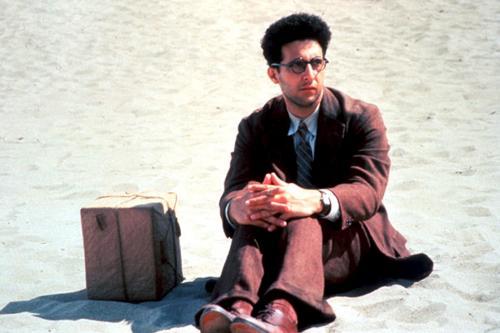
Barton Fink (1991)
BARTON FINKWRITTEN AND DIRECTED BY: JOEL AND ETHAN COEN
OVERALL SCORE: 6.00/10
New York playwright, Barton Fink (John Tuturro) has just finished his first widely successful play on the modern working man. He is given a heavy contract with Hollywood to write a wrestling picture for them, but he struggles to determine what is expect of him, and suffers from writer's block. Seeking solace in his heavy drinking, car insurance salesman, neighbor Charlie (John Goodman), and the secretary of another successful playwright, Audrey (Judy Davis).
Going into Barton Fink I had no idea what it was about, I know it had something to do with a playwright and that it starred a personal favorite of mine (excluding some of his more recent films) John Tuturro. In hindsight that was probably a mistake... I've stated on here before I'm rather grumpy when it comes to interpretational films, mostly because they often come off as self important with a heavy handed moral agenda masked by the selling of none. It takes a lot to put me into the mood to really hop into the subtext of a film, and maybe 4-5 films I've seen in my lifetime have pulled it off. Anyways, no ranting needed, Barton Fink is definitely a unique flair of a film, entertaining in its intrigue, and oddly mysterious.
As a character Fink isn't all that interesting, he's heavy in ideology, weak in action, not that observant, and sort of annoying. To make up for this the Coen brothers provide us Charlie. Charlie's tough, funny, off the cuff, likable, but at the same time we're not sure if we trust him, and in that the two provide a solid odd couple, and their moments together are probably the film's highlights (especially the final conversation). Their unveiling, and struggles makes us wonder what this mysterious world, filled with empty hallways, and crazed characters, holds. The certain flair and intrigue is aided by Coen brothers knack for setting up shots, best of all when their film is lacking in the writing department.
What keeps Barton Fink from being boring, or dull, lies in several great laughs with the absurd characters to bring them home. The film's intrigue comes from great directing, and without it I can't see audiences staying awake unless they are really into this genre of film. The main problem I ran into with this film is that I found the side characters more interesting than the main one. Sure Tuturro is masterful, but the character is dull, not really likable, and really never does anything (literally and metaphorically). I'm sure if I was to bother to dwelve into this film's analogies, subtext, and such I'd enjoy it quite a bit more, analyzing each scene with careful critique, but the movie just didn't inspire me to do it. Because of that I struggle to recommend the film beyond those to who are already fans of the genre, but hey, they've probably already seen it.
Heavy on interpretation, Barton Fink is an entertaining and mysterious film that will probably encompass all range of emotions (pure hatred to absolute obsession) for the viewers... it's just where on the line you'll fit is unpredictable at best.
Going into Barton Fink I had no idea what it was about, I know it had something to do with a playwright and that it starred a personal favorite of mine (excluding some of his more recent films) John Tuturro. In hindsight that was probably a mistake... I've stated on here before I'm rather grumpy when it comes to interpretational films, mostly because they often come off as self important with a heavy handed moral agenda masked by the selling of none. It takes a lot to put me into the mood to really hop into the subtext of a film, and maybe 4-5 films I've seen in my lifetime have pulled it off. Anyways, no ranting needed, Barton Fink is definitely a unique flair of a film, entertaining in its intrigue, and oddly mysterious.
As a character Fink isn't all that interesting, he's heavy in ideology, weak in action, not that observant, and sort of annoying. To make up for this the Coen brothers provide us Charlie. Charlie's tough, funny, off the cuff, likable, but at the same time we're not sure if we trust him, and in that the two provide a solid odd couple, and their moments together are probably the film's highlights (especially the final conversation). Their unveiling, and struggles makes us wonder what this mysterious world, filled with empty hallways, and crazed characters, holds. The certain flair and intrigue is aided by Coen brothers knack for setting up shots, best of all when their film is lacking in the writing department.
What keeps Barton Fink from being boring, or dull, lies in several great laughs with the absurd characters to bring them home. The film's intrigue comes from great directing, and without it I can't see audiences staying awake unless they are really into this genre of film. The main problem I ran into with this film is that I found the side characters more interesting than the main one. Sure Tuturro is masterful, but the character is dull, not really likable, and really never does anything (literally and metaphorically). I'm sure if I was to bother to dwelve into this film's analogies, subtext, and such I'd enjoy it quite a bit more, analyzing each scene with careful critique, but the movie just didn't inspire me to do it. Because of that I struggle to recommend the film beyond those to who are already fans of the genre, but hey, they've probably already seen it.
Heavy on interpretation, Barton Fink is an entertaining and mysterious film that will probably encompass all range of emotions (pure hatred to absolute obsession) for the viewers... it's just where on the line you'll fit is unpredictable at best.
Labels:
Dark Comedy,
Drama,
Interpretational,
Thriller