Showing posts with label Sports. Show all posts

Wednesday, November 9, 2011

Moneyball (2011)


Moneyball is perhaps the most difficult film of the year for me to appropriately gauge my own enjoyment of. I know I enjoyed it. I remember laughing, smiling, cheering, feeling completely engaged in the subject matter like it was yesterday. Just what prompted those emotions to rise out from within me remains a bit of a mystery.

I remember the sequences which most tickled my various emotional receptors, but the interconnecting components which built to those sequences are foggy at best. If I had to narrow it down to a single reason, it would be the way Moneyball is designed.

Moneyball relies heavily on an interweaving of plot structures that could be most accurately defined as being part of the beginning or middle of a narrative. This is a technique that co-writer Aaron Sorkin executed to great effect in 2010's Social Network, where once again there was no singular climatic point which the narrative reached out to. Instead both films rely on character building, witty interplay, and audience interest in development of the backdrop device to build the film.

However, Moneyball lacks one of the more crucial aspects of Social Network's success, colorful characters. Outside of Beane (Brad Pitt) and Brand (Jonah Hill), there's not much left for viewers to hold onto. The core group of players which earn themselves the most screen time are generally down played, given a few good scenes, and then moved past. Even in the most crucial moment of one of their careers - and the film's closest thing to a climax - the setup is not wholly capable of meeting the viewer half way on the emotional response.

I suppose the most clear cut word for describing the feeling Moneyball inspires is "almost." From the direction to the acting to the writing, every bit feels like it's almost right where it needs to be. But it is that minute missing component that ultimately ends up weighing down Moneyball's potential. It's enough for two hours, and for many that's enough for all.

Overall Score: 7.00/10

Credits
Director: Bennett Miller
Screenplay: Steven Zaillian and Aaron Sorkin
Story: Stan Chervin
Book: Michael Lewis

Wednesday, January 5, 2011

The Fighter (2010)


OVERALL SCORE: 8.25/10

Perhaps it is because a bout can be easily analogized to life itself that we find ourselves gravitating to the many tales of overcoming odds found in boxing. They may, at times, flirt with predictability, but in the hands of any storyteller of note, even the most straightforward tales of success can find welcome ears. Enter David O. Russell, the talented writer-director behind the stylistic Three Kings and controversial I Heart Huckabees.

Teaming up for the third time with Mark Wahlberg, the dynamic duo bring together the story of Micky Ward, an Irish boxer hailing from Lowell, Massachusetts. He's lost several of his recent fights, and seems on a downward spiral. His half-brother, and trainer, Dicky Eklund (Christian Bale) is an ex-boxer himself, famous in their hometown for his one-time match against Sugar Ray Leonard, and a struggling crack addict. Their respective mother, Alice Ward (Melissa Leo), serves as manager for Micky and seems lost in love for the heyday of her eldest son, Dicky.

Together, Dicky and Alice create an overbearing situation in which Micky simply cannot win. If he veers away from them, he's seen as betraying the family. But if he sticks with them, eventually their self-destructive ways will take him down with them.

Condensing a series of events which took place over a near ten year period, THE FIGHTER chronicles Micky Ward's efforts at finding a balance between the two extremes facing him. When Charlene (Amy Adams), a local barmaid, enters the picture as his romantic interest, the pressure on Ward to finally step up and take control of his life hits a boiling point. As he rightly notes, he's 'not getting any younger' and what he does now must be for him, and entirely about him. No longer can his life be lived vicariously through those around him.

Mark Wahlberg has never been the most dynamic actor, and as such he plays Micky Ward on an even keel. Never one to 'blow up' or 'break down,' Wahlberg takes Ward through his series of emotions with declarative statements and a sympathy inducing sad puppy face. Wahlberg's restrained performance turns out to be a blessing in disguise for The Fighter as it puts the career defining performances of Bale and Leo on a pedestal to be admired.

From the pencil-thin body shape and twitchy eyes to the manner of speak, and exaggerated personality, Bale takes Dicky Eklund off the screen and right into your chair. Seemingly hyperbolic, the staunch knowledge that Eklund is in fact the way he is portrayed supplies added need to praise Bale. Bale's upbeat Eklund provides the film with a much needed complex character through which we can siphon humor and sadness during the film's intermediary moments between fights. Leo's constantly pursed face, and controlling persona as Alice supplies the movie with someone who is not so much a villian, but a sympathetic focal point for any rage the audience feels. Her destructive obsession with an idealistic life in which Dicky doesn't do drugs and Micky loves every decision she makes forces the very things she wishes to avoid upon the ones she loves.

The rest of the supporting cast step up to the caliber of the aforementioned and deliver their performances with steadfast determination. Adams is particularly strong, but seldom asked to do a lot other than be sexy, and occasionally angry/melancholy (both of which she excels at). It may be a bit cruel to say this, but the roles of the sisters rely as much on hair as they do on their respective acting chops. In the confines of the entire film, they work alongside Micky's father (Jack McGee), and occasionally Dicky, to provide a bit of comic relief.

Coasting over many of the major underlying issues, Russell does a tactful job of keeping The Fighter sentimental without forcing major waterworks. Placing the focus squarely on the actors, Russell shows considerable confidence in their ability to carry a film. A surprise considering Russell's prior films are often recognizable for his vibrant style, blending imagery and real world in presenting the tale. During some of the montages, that picturesque quality presents itself in an effort to show the passage of time and events Russell doesn't feel the need to harp on.

If there's one component of The Fighter I really feel as if O. Russell and company whiff, it's time. Many of the events that transpire occurred over years in real life. The long, winding road aided in the deconstructing of Ward's world and presented the true lengths to which he had to go for a viable title shot. I know in cinema terms you can't be expected to traverse years without losing some of the moments in between, but I feel as if here the emotional connection molded between the audience and main characters would have benefited greatly.

Now, much has been made of Russell's decision to use an HBO presentation style when shooting the fight scenes, particularly the final match-up. Personally, I found it neither overtly beneficial, nor necessarily detracting. There's something to be said for keeping ourselves as observers in those final scenes, and only bearing brief witness to the ringside conversations. As well, I felt as if putting us into the middle of the fight, and the pain in each punch only works if that is a crucial component to your story (such as can be found in Cinderella Man). Here, the hits Ward takes in the ring matter little in comparison to the ones he takes out of it. In that respect, The Fighter delivers exactly what it intends and exceeds admirably.

Wednesday, December 16, 2009

Invictus (2009)

INVICTUS
DIRECTED BY: CLINT EASTWOOD
WRITTEN BY: ANTHONY PECKHAM
NOVEL BY: JOHN CARLIN
OVERALL SCORE: 7.25/10

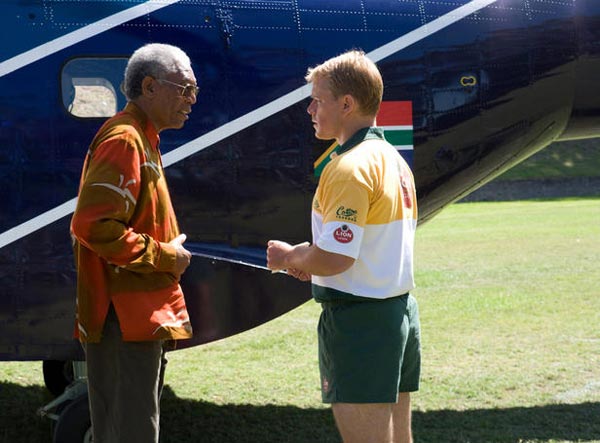
Facing heavy racial tension, white fears, and black hope, newly elected President Nelson Mandela (Morgan Freeman) has many issues to tackle, most crucial of which is national pride. Struggling to find a way to unite his nation, he sees an opportunity in the Springboks, South Africa's national rugby team, who still represent white racism during the apartheid to many blacks. With his nation hosting the World Cup in a year, and the Springboks struggling in daily play, Mandela meets with team captain Francois Pienaar (Matt Damon) in hopes of creating a team the country can get behind.

As directors go few can express such a sense of style by doing so little as well as Clint Eastwood has. His knack of quiet moments, powerful use of somber piano scores, and seemingly unlimited supply of great scripts to act upon. As a film Invictus is well flawed, but there's hardly an argument that can be made for its lack of power. Imagine yourself in a cell no bigger than the span of your arms at your side for 27 years. How would you react to those that put you in there? These are the questions Mandela, and Invictus, must tackle. Sure the movie Invictus is about the rugby team, and Mandela's impact on them, but far more it's about the man Mandela himself. We spend many scenes following his lonely morning walks with his security detail, the lack of family, and his desire to create a national powerhouse on his own terms. In fact Invictus is almost two films in one. The first half on how to build the nation through Mandela's eyes, while the second half follows Francois Pienaar's task to unite them.

To do so Eastwood brought on two of the most powerful actors today. Freeman's Mandela is strong, sensitive, but always smart and polite (very Jimmy Stewart I must say). While Damon's Pienaar is young, idealistic, but grounded, unsure of what his full potential may be. I must say that neither actor is necessarily jaw dropping. Freeman's performance is aided by wonderful moments of writing, while Damon's character serves merely as a bridge between white and black relations in the country. The rest of the cast comes through in fine form, but none are asked to truly stand out as actors. Though of course Invictus is certain to show close to home examples of how Mandela's decisions affect its people.

To display this Eastwood and Peckham utilize Mandela's personal security detail. The blacks, whose hopes and dreams lay with Mandela, must work with the season veteran white security in order to protect him from attacks. Throughout the film we see their initial hate, their growth under Mandela, and their ultimate unification. Unification is the central ideal behind the film, its real life counterparts, and the message it hopes to bring. In every scene Eastwood seeks to show all facets of South African life in 90's. The horrible living conditions, the weak economy, the racial tensions. All of which must be overcome by the films 2 hour + run time, and Eastwood executes this rather well.

Perhaps the best thing Eastwood does about this transformation is not Hollywoodize. Eastwood shows a series of events that lead to the unification of the nation, not just one overscored, over dramatized, moment. He shows the Springboks interacting with local South African children, their many ups and downs, self conflict, and how they managed to unite among themselves. Of course the crutch of all of this lies in the actual Rugby games. Here is where Eastwood tends to struggle. At times I'm not sure if its Eastwood's lack of knowledge on Rugby but the game is not always the easiest to follow, often halting mid match to tell us the score, and its impact with quick cuts to Mandela. Striking visuals are muddled with CGI laden crowd shots, few of which work that well, meant to show us the national pride in the team.

During the all important big, and final matchup, Eastwood will often quick cut to show families at home reacting to the events, these being represented by a group of blacks at a local rundown bar, and a group of whites at a nice country home. These scenes are far too standardized Hollywood for me, but I understand why. The desire to show the broad appeal is far too grand to be limited solely to stadium reaction, there's a need in a film like this to show national pride. Then again I'm not sure Eastwood's selected method is best at that. The best thing he does is show the entire nation celebrating in the streets at the end, a true display of how important this team has become to the entire nation of South Africa.

Of course there's a lot to admire about Invictus. It's story is one of real life triumph over impossible odds (as a note to film reviewers: you can't fault a film for predictability if it's grounded in historical fact - buy a history book). Invictus manages to be seemingly Hollywood, and at the same time very special, a true powerhouse of a narrative. Much of that I would say lies in Eastwood's brilliant opening hour, full of entertainment, strong moral statements, and a semblance of national dreams. It is here alone that Eastwood manages to create such a powerful film despite its obvious flaws. Sure it's not the greatest film of the year, but it's as solid of an outing as you're likely to see.

The Poem Invictus By William Ernest Henley:

Out of the night that covers me,
Black as the pit from pole to pole,
I thank whatever gods may be
For my unconquerable soul.

In the fell clutch of circumstance
I have not winced nor cried aloud.
Under the bludgeonings of chance
My head is bloody, but unbowed.

Beyond this place of wrath and tears
Looms but the Horror of the shade,
And yet the menace of the years
Finds and shall find me unafraid.

It matters not how strait the gate,
How charged with punishments the scroll,
I am the master of my fate:
I am the captain of my soul.

Friday, September 25, 2009

The Boxer (1997)


THE BOXER
DIRECTED BY: JIM SHERIDAN
WRITTEN BY: JIM SHERIDAN & TERRY GEORGE
OVERALL SCORE: 6.75/10


Just released from prison, after spending 14 years due to his part in an IRA attack when he was 19, boxing prodigy Danny Flynn (Daniel Day Lewis) attempts to re-ignite his once promising boxing career. Kicking up a friendship with his once girlfriend (Emily Watson), who is now married to his best friend, and his childhood trainer (Ken Stott), his fights soon become a symbol for peace in the war torn nation. Unfortunately though, not all IRA members take so kindly to his decisions, and Flynn must decide who matters most to him in life.

The third, and final, Sheridan+Lewis combination is by far and wide agreed to be the weakest of the 3 (the other two being My left foot and In the Name of the Father). And so far I can't really disagree with that. Lewis is predictably good in the role of Flynn, while Sheridan takes a keen eye to bringing to life the social issues of the time. Unfortunately though all the parts on this film don't mesh well.

Sheridan's decision to keep the audience at arms length, while great in allowing perspective, forces the audience out of the emotion of our main characters. We like them, we want to get to know them, and we feel bad when something happens to them, but it's never really impactful, all the way in your stomach. As such we get a film that's sad at times uplifting at times, has a good plot, good characters, and interest, but never really evolves into something memorable.

The best you get here is watching Brian Cox (the diplomatic leader of the IRA), Lewis, and the always lovable Watson interacting. Lewis and Watson's chemistry allows their budding romance, and yet cautious attitude, to really get you through the film. The fight scenes are quiet, no background noise, no slow motion whams, very standard, and I have to say I kind of liked them. The pacing for them does feel a bit off, but they exist solely as ways of showing us a little bit of insight to our main character, perhaps the only place we really find it.

Overall though, The Boxer is a fine film with some good qualities, but it never takes the next step, and is sadly forgettable.

Sunday, September 20, 2009

Sugar (2009)


SUGAR
WRITTEN AND DIRECTED BY: ANNA BODEN & RYAN FLECK
OVERALL SCORE: 8.00/10


20 years old, Dominican Republic baseball player, Miguel 'Sugar' Santos has dreams of coming to the US one day and becoming a big league pitcher. When he finally gets his chance to play in Single A ball with a small-town Kansas City squad, he soon finds himself in social isolation, separated by a language barrier, and unsure of his dream.

The only thing more shocking when it comes to modern Baseball than the number of out of country players who currently play in the major leagues, is the number of players who never made it. Sugar is in a sense, their story, told through the eyes of a 20 year old kid suddenly thrown into a world he was not ready for, and forced to make decisions well above his maturity. Sugar as a film deals with all the insane number of pressures that face players who come up here: the dreams and hopes of their family, need to be the best in order to survive, dealing with an inability to speak conversational English, racism, and the personal pressures of being told that only success matters.

In dealing with these directing team Boden and Fleck take a good amount of time analyzing three aspects of Sugars life (I won't say them all to avoid spoilers), each taking up about 1/3rd of the film. In that we're given a complete portrait of only a single year in the life of Sugar, a year that would encompass most people's entire life times. As such, we, the audience, are rewarded with a very telling and powerful drama, that extends beyond the basic confines of your generic sports film. Boden & Fleck's writing takes control of the story, and its obvious their directing is built mostly around it. There's no over the top style, no crazed combination of close ups and wide shots during sports events, no slow motion for every good play in a game. Instead you just watch this man's journey, and hope for the best.

If I dare pick a negative aspect, it would be that even with its relatively short run time it does drag its feet a bit at times, and could have probably cut out about 10 minutes worth of scenes. Yet if you're wanting to watch this, don't let that discourage you, it's nothing that takes you out of the film, nor hurt the film's overall message. As such, it's one of the better films of 2009, one worthy of more acclaim than it has received.


A great film about a real modern issue in society, Sugar shows both the good and bad of those whose only way out, may just be to sacrifice their own dreams.
Related Posts with Thumbnails