Showing posts with label Anime. Show all posts

Wednesday, November 23, 2011

What I'm Into Right Now

It's quite easy to paint me as a man woefully detached from the society in which I'm geographically inclined to operate. So much so that I often play up the role of being an angry curmudgeon just to help explain to people why I really don't care for the latest dealings in a certain celebrity's life or the latest reality show. All the same, I thought it would be fair game to bring you all up to speed on what I do spend my time on when I'm not purveying all your lovely blogs and a never battle against the oncoming waves of movies being release.

So, without further ado these are the various things I'm into right now:

QI with Stephen Fry
The Walking Dead
Shakugan no Shana
Barclay's Premier League
A Dance With Dragon - Book 5 of the A Song of Ice and Fire series
Fairy Tail
Bones
Adele

Things People Have Recommended To Me That I'm Catching Up On:
Kimi Ni Todoke
Breaking Bad
Yes I'm one of those guys who plays games years after they're releases


So there you have it. Pretty much the gamut of my viewing/reading/playing catalog at the moment. Got any recommendations of your own? Or anything non-movie related you're checking out and really passionate about? Share it in the comments!

Sunday, August 28, 2011

While You Were Busy Drooling Over Pixar

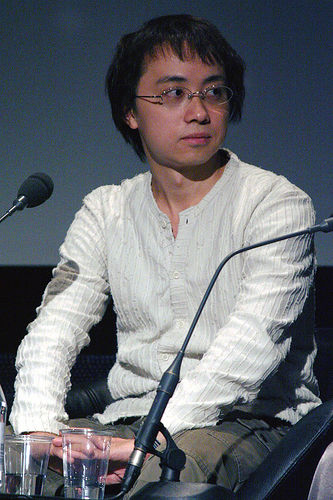
Meet Shinkai Makoto. Don't worry if you've never heard of him. That's kind of the point of this blog post. You see, he's one of the real up and coming bright spots of the Japanese animation scene and I'd like to tell you about him before you go all goo-goo refreshing Slash Film every minute in the hope that another Pixar related story pops up.

Yes, this is another Anime post. Hey wait, where are you going? Don't go, it'll only last for a minute. Just a little prick - like a need at the doctor's office. Hey, stop! Come back. Please! I love you! *cough cough* Too much? Alright, back to the serious stuff.

You see, Shinkai Makoto represents to me a sort of encompassing much of what Anime can be when done correct. Personally I'm not as big a fan of the turbulent, blood laden, long tongue monsters, half-human hybrids of the Ninja Scroll anime variety; generally finding myself far more engrossed in the whimsical fantasy and science fiction filled worlds often created by the likes of Makoto, and the much revered Hayao Miyazaki (hopefully you've at least heard of him). I enjoy a careful, methodical attention to detail and design, imagination and wonder. Something I can simultaneously engage in mentally and vainly enjoy the beauty of. That's not to say I don't enjoy realistic, heartfelt anime. After all Grave of the Fireflies sits firmly in the #2 spot on my all time anime films. Either way, there's something to be said for any film that can whisk you away to another world and make you truly want for its existence.

Which is perhaps ironic in the case of Makoto as what I would argue is his best film is entirely void of that science fiction/fantasy element and is far more grounded in reality. But more on that later. My first introduction to Makoto was, in fine fashion, his first feature length film, the 2004 romance-friendship tale The Place Promised in Our Early Days. A beautiful tale of two one-time friends who, in an alternate mid-war Japan, band together, despite their conflicts and possible damage to their own world, help heal their childhood whose conscience is trapped in an alternate universe.

Confused? Don't be, the film's elusive enough on its backstory as it is. It is a shame that, at times, the choppy narrative hinders the movie from ever escalating beyond being 'good,' but the heartfelt nature of the characters really beckons a want for their hapiness. Their dispondency clashing with their dedication, and in one of their cases deeply repressed romantic feelings, help glide the film from scene to scene. Not to mention Makoto is downright majestic when it comes to creating breath taking shots. The climax, in my assessment the film's real highlight, brings out much of what becomes a backhanded signature for Makoto. Not sad per say, but a somber optimism that weighs present love versus the possibility of a long term romance. Especially when you take into account the wonderful way he builds romance between characters who are often forced to be apart.

So after that emotionally rocky roller coaster, I thought it would be nice to continue by journey through the work of Makoto. More specifically of course checking out his much acclaimed first short, Voices of a Distant Star, clocking in a slim and trim twenty-five minutes. Which one might find a hindrance were it not for the speed and precision with which Makoto lays out each scene for the viewer to wholly engulf themselves in. Of course, this being a smaller scale installment, it also comes with a much lower budget than Makoto's following works, but I find a certain pleasure in seeing a more intimate approach - knowing that Makoto himself did most of the work (including one of the voices for the short's two characters) on the film himself. Yet I cannot deny that the melancholy nature of it is a bit overwhelming. You see, Voices of a Distant Star tells the tale of Nagamine, a teenage soldier sent into outer space to battle an army of aliens, who passes her time by emailing her adolescent love, Noboru. However, the longer the battle goes on, the farther she gets from Earth, and the longer her messages take to reach her beloved - up to a maximum of nine years. So you feel a real powerful disconnect and torn nature inside her. She is sending these messages, these declarations of love and want and friendship to someone who will have out aged her by a half her life by the time they are received.

It's a heartbreaking and heartwarming take on how far one may go for someone they love, and Makoto captures this beautifully. Despite the at times graphical woes, the emotional chords struck in the narrations by Noboru and Nagamine resound deep within. It is perhaps for that reason that this short is held in such high regard, and perhaps equally so why it is often derided by those who came seeking action.

With such ideas of sorrow and yearning I ventured out to experience Makoto's third film, the hour long 5 Centimeters Per Second. Which, having experienced Makoto's earlier work, really struck me in a series of ways I can't wholly explain. First there was the same sentiments and motifs that he explored in the earlier films. The notion of adolescent love, that first real love and how it can shape the entirety of our lives. The use of narration to make our character's inner most thoughts transparent instead of expository dialogue or an abundance of action. In fact 5 Centimeters Per Second seems to thrive on a lack of action. Its slowness is its greatest strength, and one Makoto molds into a mosaic of lights, colors, and background set pieces to leave you in awe. Each shot feels fresh, real, and humane, perhaps because this is Makoto's most human piece yet. Told in 3 "episodes" the film follows Takaki Tono and his struggle to escape his first love, Akari, as they are separated due to their parents and the consequences of his inability to stop looking back. Yet, Makoto takes 5cm Per Second beyond that. With a cast that basically only features three characters - the third being Kanae, a young girl with a crush on Takaki who is the focal point for the 2nd episode - we really get to know them in the brief time we have with them.

Through flashbacks and misdirection we see the collection of missed connections that came to define their absence in each others lives. The struggle they go through in traveling down a road of love that they know will only lead to loss and regret. If there is one complaint I would lodge it is that it shirks some responsibility of closure by keeping the 3rd episode short, and open to interpretation. Not to mention the gross absence of Kanae whose 2nd episode woes really capture that uncertainty that comes with young love and fear of the future at hand.

All in all one might say I find Shinkai Makoto to be one hell of an anime director, and I'm eagerly anticipating the US release of his latest anime film - Children Who Chase Lose Voices from Deep Below. Sure, he's a bit rough around the edges, but what he does well, he does so well it quite strongly stamps down any bad. So if you find yourself with a couple of hours to kill - all the time it would take to watch his three major works - please consider checking out his films. I simply cannot recommend them enough.

Wednesday, June 16, 2010

Spirited Away (2001)

SPIRITED AWAY
WRITTEN AND DIRECTED BY: HAYAO MIYAZAKI
TOP 100 FILMS: #15
OVERALL SCORE: 10/10


When Chihiro, and her parents, arrive at a ghost fair ground on the way to their new city of residence, they have little idea of what lay ahead. The parents quickly turned into pigs for eating food that wasn't theirs, Chihiro must find a way to survive. Save their parents, and understand the new world of gods, and monsters, while working at a local bathe.

"Once you do something, you never forget. Even if you can't remember."

What allows Miyazaki's 2001 anime masterpiece to be so widely loved is that, in every aspect, it's an anime film built to be widely loved. Filled with breathtaking visuals, Spirited Away serves as a perfect introductory film to the many lore of anime tales. A movie so rich in imagination, yet grounded in captivation, it creates the world from the perspective of someone completely unfamiliar with it.

For seasoned anime fans this may come a bit tedious, but to those with no real knowledge of the genre it's a welcome mat. A welcome mat to the world of fantasy anime (and yes there are many different types of anime - see my review of Grave of the Fireflies if you don't believe me). And that world has the potential to absorb the mind of a viewer unlike many others. Supported by ancient myths of Asian culture, the fantasy world developed is so deep, one would have to try hard not to be entranced by it.

Now, I will say Spirited Away is a very heavy character film. And there are a lot of characters to be had. Because of that the movie is long, and at times slow. Always for good reason. Miyazaki doesn't just want to make this movie about the allure, he wants it to be about the journey of a young girl (another prevailing theme throughout his films). The trials of youth, and the struggles that stem from them. All wrapped in a journey of mystical stature.

Spirited Away is all about coming to terms with the new challenges life presents. Some admittedly harder than others, but all conquerable if you're determined enough. That is the task presented to Chihiro. Can she learn to overcome her fears of change, without the support of her parents? Can she hold onto those most dear to her, when they are in most need? Spirited Away exists to tackle that challenge. To bring it to life. Ultimately presenting the viewer with a world so vast, and foreign to this world, but grounded in the moral challenges each and every one of us must face.

Aided by its ability to invite viewers of all backgrounds in, Spirited Away is a beautiful tale of one girl's coming of age. Her learning of what it means to be human, to be herself, and to overcome any obstacle that stands in her way. But only if she's willing to face those challenges head on, and with an open heart.


-----------------------------------

As a programming note: The reason I've started reviewing my all time favorite Anime's is that this will mark the end in my Anime Wednesday series as I move into other projects. I won't be able to watch anime with enough consistency to keep the weekly deadline, and I know only a handful of my regular readers enjoy it. But, I will still review anime, just on a more by the view basis. Stay tuned next week for the brand new Wednesday series!

Wednesday, June 9, 2010

Grave of the Fireflies (1988)

GRAVE OF THE FIREFLIES
WRITTEN AND DIRECTED BY: ISAO TAKAHATA
NOVEL BY: AKIYUKI NOSAKA
TOP 100 FILMS: #21
OVERALL SCORE: 10/10


After the death of their mother during an air raid, and the continuing departure of their soldier father, overly proud Seita must face the harsh conditions of war-time Japan, trying to protect his younger sister.

"Why must fireflies die so young?"

There are a handful of films in this world I would mention among those I would never seek out the opportunity to watch twice. Not because they lack in quality, but rather because they are an emotional struggle unlike any other. Grave of the Fireflies is not a movie about the adventures of two children struggling to survive. Rather, in the first few minutes it tells you, it's about the slow, painful, lonely, events that would define their legacy.

Events so ridden with stupidity on the characters' behalf. So riddled with stupidity on the government's behalf. So riddled with stupidity on war's behalf. It becomes impossible to keep your eyes off the screen. For it is slow. It is agonizingly painful. And every step of the way it will grab at the very heart of your emotional strings. Taking them, holding them dear, and not letting go until well after the credits have gone.

As perfect a measurement of quality as any I can imagine. Grave of the Fireflies is an animated film that reaches beyond its narrative method, and into the realm of human exploration. Why can it do this? Because it's real. Stories like this, experienced even by the novelist themselves, have filled the pages of Japanese History. The sort of stories nobody wants to hear, but everyone should. A cost of war unseen in big battles, and groundbreaking effects. The cost of war for those who have nothing to do with it.

In that respect I hold Grave of the Fireflies in the highest of regard. The sort of movie I recommend everyone see once. If for no other reason than the sheer magnitude of its power. The sort of movie I recommend everyone avoid. If for no other reason than the depth of emotion it requires. Perhaps the most pure, and powerful, example of what anime possesses the capability to be.

An anime so exceptional it could very well be labeled the greatest of its genre. If not one of the greatest films ever made. A beautiful, emotional, heartfelt look at the cost of war on those at home.

Wednesday, June 2, 2010

Princess Mononoke (1997)

PRINCESS MONONOKE
WRITTEN AND DIRECTED BY: HAYAO MIYAZAKI
TOP 100 FILMS: #53
OVERALL SCORE: 10/10


After a demon boar infects his arm, Prince Ashitaka, the last remaining royal heir of a tribe wiped out by the emperor, sets off on a journey to find his destiny. Along the way he finds himself caught in the middle of a war between the animal god Moro, her human child, and an ever expanding Iron Town which seeks control of the forest.

"What exactly are you here for?"
"To see with eyes unclouded by hate."


Early in the film, just after having been told his condition is irreversible where he now lives, the town elder tells Ashitaka that now all he can do is rise to meet his fate. To accept the path his life has taken, and go off to seek his destiny. Perhaps that is what is most earth shaking about Miyazaki's 1997 masterpiece (says me). The movie, no matter how you slice it, is the ultimate combination of everything Miyazaki had worked to create up until that point.

A movie about man's desire to control nature, it's desire to repel us, and the work of one to show them how they can find a middle ground. The notion of living in harmony with the earth so prevalent throughout his work, finds itself at the forefront of this visual art. And art is what it is. Using tons of textures, and amazing images Miyazaki created a world as rich as any he's created before, and since (though Spirited Away still takes my #1 spot).

To get this Miyazaki pushes his narrative into realms far darker than he had ever traversed before. Princess Mononoke deals with the most rash, and dark, of animal instincts: hate. And when you combine hate with greed, you can destroy everything pure. It's something each character in the film must rise to face. Everyone loses when you can't let go.

In showing us this, Miyazaki takes the time and effort to develop all of his characters. We see multiple sides to them. Their dark ambitions, and their saving graces. None of the leads are left too simple, straight, and each falters along the way. Breathing life into each scene, they become as deep as the forest itself. Rich with layers, and mysteries to solve. Each new scene with something to offer the viewer to chow down.

Ashitaka provides heart, and morality. San (the human child) provides perspective. Eboshi (female leader of Iron Town) offers us the future, with sympathy. Monk god-hunter Jigo the cost of greed. While the Gods Moro and Okkoto giving us experience and depravity. So much richness, with beautiful lines to deliver. And when you have such amazing voice work in both Japanese (Yoji Matsuda, Yuriko Ishida, Yuko Tanaka, etc.) and English (Gillian Anderson, Billy Bob Thorton, Mini Driver, Billy Crudup, Claire Dames, etc.), it's just a sight to be had.

Not to mention the action. Easily becoming Miyazaki's most violent film (for a PG-13 animated film there sure are a lot of decapitations). But in that violence Miyazaki builds character. A rarity in cinema these days, where violence is used for quick shots of entertain. Here it combines both to create something more. And for that the viewer gains a wondrous story to absorb.

The kind of story that's morals stick with you. The kind of story you can revisit anytime. Because it is so deep. Because there is so much too it. A new treat for each visit. A rare film that exceeds any genre by being a bit of all genres. One I highly recommend you check out any chance you get.

Princess Mononoke is the rare kind of animated film that reaches beyond all genres, creating a life unto itself. A story packed with heart, depth, and life you can't help but be absorbed by it. While the performances and writing are there each step of the way to match Miyazaki's ambition.


Wednesday, May 19, 2010

Busou Renkin (2006 - 2007)

BUSOU RENKIN
DIRECTED BY: TAKAO KATO
MANGA BY: NOBUHIRO WATSUKI
STUDIO: XEBEC
NUMBER OF EPISODES: 26
OVERALL SCORE: 6.25/10


After sacrificing his life to save the life of Tokiko, an arms alchemy warrior battling those who would use it for evil, Kazuki Muto is offered a Kakugane, alchemy stone, as a replacement to his heart. Now with no real shot at a normal life, Kazuki teams up with Tokiko to rid the world of evil alchemy users.

Think of Full Metal Alchemist. Take all the cliches of the man grows strong to save woman genre. Through in a kick ass female lead. And you've pretty much got Watsuki's, writer of the infamous Rurouni Kenshin, latest offering. It's a battle against genre cliches, that both aid, and hurt the series throughout its 26 episodes.

Where Renkin separates itself is in its characters. A clear romantic lead subtext, strong concentration on building the characters with action secondary, and some of the most "unique" characters you'll ever find. All of these make Busou Renkin an exciting show, but also offer a divide for viewers that they may never overcome.

For, you see, these characters range from the kind hearted lead to a butterfly dressing perverted sociopath, who enjoys feeding off people, and well, let's just say is one hell of a creepy character. It works as much as it fails, ultimately leaving the dynamic relationship between the two leads as the main staying force.

This relationship is strong, and the characters are well developed, but as the episodes wear on it gets a bit repetitive. Especially as a slew of new characters are introduced in the final 10 episodes, all leading up to the big finale. Perhaps that's where my shakey feelings for the show go.

It's one of those shows that's never so bad you have to turn it off, but never so good that you feel like you absolutely have to see the next episode. It's too predictable, even in its characterizations, despite the fact that it tries to take them to deeper levels than before. It works because there's little to hate about it. But at the same time it fails to inspire because it's way too safe of a series.

Even its opening song (despite being incredibly catchy - I mean it, I had it stuck in my head for hours) is a rather safe, loud, rock ballad. It's one of those shows that bothers you for the chances it doesn't take, rather than the strength of what it really presents. That may not be fair, but when you're a legendary manga author, I'd love for just a little chance to have been taken.

Busou Renkin breaks no new ground in terms of its genre characters and story. Instead it tries to offer you a refreshing deeper look at the characters, which barely succeeds given the strength of the talent involved. Unfortunately there's just not enough there to tie it all together, and make it as epic as it possessed the strength to be.


Wednesday, May 12, 2010

Fruits Basket (2001)

FRUITS BASKET
SERIES DIRECTOR: AKITARO DAICHI
MANGA BY: NATSUKI TAKAYA
STUDIO: STUDIO DEEN
NUMBER OF EPISODES: 26
OVERALL SCORE: 8.25/10


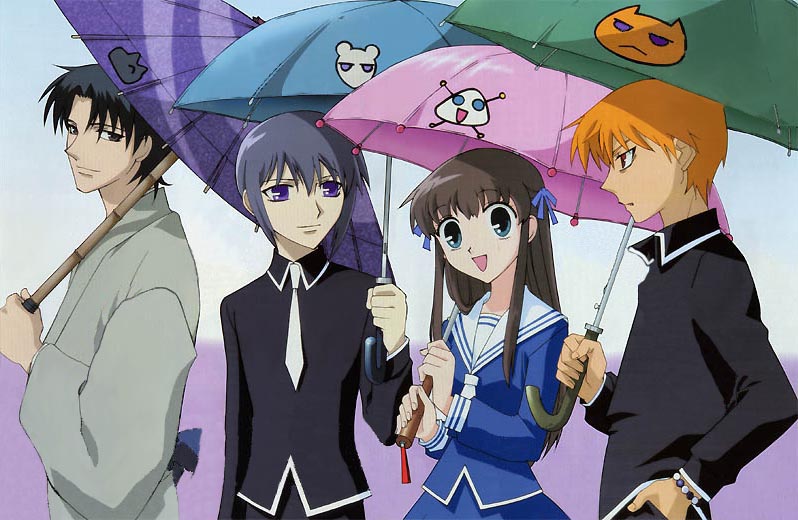
After the death of her mother, quiet, unassuming, high school girl Tohru Honda opts to live alone in the forest after the rest of her family rejects her. After an accident destroys her self made tent/home she is taken in by the Sohma's, a reserved family who take a liking to her kindness. Though Tohru quickly finds all is not well with the Sohmas, as they are actually cursed by the zodiac animals, and transform when shown any real affection.

I have to admit, judging by the pictures I avoided Fruits Basket for a long time, because it just looked too "bubbly." And for the first few episodes the show was very much that. Comically over the top, lots of random fighting, and really a collection of amusing moments. It doesn't take long for that tone to change though. As Tohru, and in turn ourselves, get to know the Sohma's better, we gain a deeper understanding of our painful their lives are. Unable to be held by their mothers, avoided by family, and ruled by a rather tyrannical family head, they are a somber group that struggles emotionally each day.

Tohru in essence becomes their cure (far more literally in the manga adaptation). Her unwavering kindness, and seemingly infinite sympathy, reaches deep into the heart of each of them. Throughout the series these are without a doubt my absolutely favorite moments. They're powerfully heartfelt, and really get deep into the struggles of each character.

Not to mention Tohru's close friends, who are able to provide a leveling factor for Tohru, and some great comedic moments (including one Blair Witch style episode). It allows for these heartfelt moments to gain a certain sentiment of levity. Creating a simple, enjoyable, tale for the viewer to be immersed in.

The show's real weakness lies in its main decision. Without the length of the manga, the show delves into 26 episodes in which about 20 characters are introduced and examined (with some getting a couple repeats). While this offers great insight into the world of the Sohma's, the huge downside is plot. Throughout the series the main arc of Tohru, the love two of the Sohma brothers Yuki (the "school prince") and Kyo (the red headed family reject) have for her is put on the back burner. It's never fully explored, and only a few real plot developments are made.

Of course the obvious upside of deep character analysis, and hilarious episodes, is a good countering factor. Still, there's always this overbearing knowledge that with a handful of cuts, they could have gone more into the core relationships. Putting aside the random episodes (while mostly amusing), and offering the viewer something truly epic.

Incredibly memorable, with a wide breadth of emotion, Fruits Basket is a powerfully entertaining, and emotionally wrenching series that'll keep you in until the final episode. The only thing that prevents it from near, to even absolute, perfection is too few episodes, and too many characters.


Wednesday, May 5, 2010

Paprika (2006)

PAPRIKA
DIRECTED BY: SATOSHI KON
WRITTEN BY: SATOSHI KON & SEISHI MINAKAMI
NOVEL BY: YASUTAKA TSUTSUI
OVERALL SCORE: 8.00/10


When 3 machines, which allow one access to the dreams of another, are stolen, Dr. Chiba Atsuko, head of their creation, and moonlighting dream therapist known as Paprika, must do anything to get them back. The fate of reality itself depends on it.

Writing a plot synopsis for Paprika is practically useless, I only did it out of habit and for consistency sake. What Paprika truly exists as is far more complex, visually inspiring, and damned confusing. Not a movie that can be comprehended, so much as absorbed, analyzed, and dissected. Sure, it has a central plot, but the movie's plot is a back burner to the encompassing visual messages.

Plays on dreams, the blending of reality and fantasy, and our deepest desires. To understand oneself is to concur the dream world, leading in control. As people's dreams blend together a parade of detracted individuals march. These scenes are shockingly impressive, adding a great deal of depth to how Kon and Tsutsui view the psyche of the modern world. Our characters' journeys of self discovery leads each down a different path. Some to rule the world, others to be destroyed by it.

I wish I could say more about the movie, but it's something you have to see to believe. My one real complaint with the movie is that it doesn't offer much reason to care for the main characters (at least not initially). Leading me to be rather bored as the building blocks for the visuals are being put into play.

Still, the sheer depth of creativity reaches beyond the minor flaws, and creates something in the realm of an animated masterpiece.

Despite its narrative flaws, Paprika is a movie that immerses you into its world, one like none other. A powerful testament to the creative offerings animation can present. Mature enough to handle the tougher issues, while steadfast enough not escape its interpretational stature. Paprika is as true an exercise in cinematic art as I've ever seen.


Wednesday, April 28, 2010

Steamboy (2004)

STEAMBOY
DIRECTED BY: KATSUHIRO OTOMO
WRITTEN BY: KATSUHIRO OTOMO & SADAYUKI MURAI
OVERALL SCORE: 5.75/10


After an accident splits his father and grandfather's view on the use of science in the world, young aspiring inventor James Steam (Anne Suzuki) is quickly thrust into an underworld of corporate and government schemes, with a world war as the price.

Often noted as being one of the most expensive anime films ever made, Steamboy is a shockingly safe action/adventure film... something one would not expect to say with the director of Metropolis and Akira behind the scenes.

Basically the movie has all the morality, coherence, and plot development of a Michael Bay action film. The morality gets lost to amazing effects, and intense action sequences, while the character development gets boiled down to a single line. It's huge, exciting, and riddled with explosions, but ultimately nobody is really sure why.

The characters are simple enough to keep you caring, but they are hardly depth driven. While at the same time, the movie suffers from idiotic explosion disorder. Where one can destroy an entire city, but if you show a couple of kids are safe, everything's good for more explosions. At the same time the movie really drags out its plot about 20 minutes longer than it needed to be, just to fill it with more action scenes. To most these are probably all that anyone may need, but it's just not enough.

An exciting visual spectacle that's forgotten as quickly as it starts. The use of steampunk adds a nice visual and creative spin, but it's all for not if the depth isn't there. This is most prevalent in the middle section of the film, as we lay in between the two big action sequences. The characters can't hold the attention, and nobody has the strength to push the film through. It lulls, sitting in waiting, as if it's only goal is that you just don't leave yet.

I didn't, and while I'll note I found the film highly excited, afterwards it just felt a bit empty. I wanted to care more, be attached more. To be fair my review is probably a bit too harsh. But alas, leaving a void always gets the shun from me.

While Steamboy will thrill you with its action sequences, everything in between is just a muddled effort of mediocrity. The captivating visuals fail to counter the impeccably safe characters, and over the top plot.

Wednesday, April 21, 2010

Top 5 Hayao Miyazaki Films!

As I've stated before there are only a handful of directors whose entire work collection (film-wise) I've seen. You may still be surprised to know Kurosawa is not among them (real hard to get ahold of his early stuff). Alas Japanese anime director Hayao Miyazaki is among the select few who I really enjoy, and have seen all of his feature length films (there's only 10 so it's not like that hard to have seen them all).

The follow is my top 5 favorite Miyazaki films in descending order:


5. PORCO ROSSO:

A heartfelt and enjoyable adventure film, Porco Rosso (The Crimson Pig) follows the journey of
ex-war fighter pilot Rosso who has since been turned into a pig. Finding out why, the journey he takes, and the friends he makes along the way is simply a beautiful affair. Visually stunning, and with awesome voice work (Jean Reno's french dubbing is to die for, Michael Keaton in english ain't too shabby either), it's just one of those movies I really enjoy watching over and over again.

4. LAPUTA: CASTLE IN THE SKY:

Full of heart, Miyazaki's romantic adventure is perhaps one of his most all around family accessible films. Filled with action as we uncover the mystery behind the mysterious girl and her crystal. The fun characters along the way only add to the experience. The only thing I would say is avoid the English dubbing of this at all costs (I mean it's horrendous). Beyond that this adventure tale is beautifully drawn, creatively developed, and fully immerses you into its world.

3. NAUSICAA OF THE VALLEY OF THE WIND:

Strong female character, environmental issues, human morality, all wrapped up into an action packed animated fantasy film. The framework of just about any Miyazaki film, Nausicaa's journey to save her dying planet is an absolute thrill. The action is perfect, the dialogue amazing, and it's one of the most heartfelt of all his films. You can feel the bond created during Miyazaki's years spent writing the manga version (which he self-adapted). The care for the characters, creatures, and world, it's a sight to see that's for sure.

2. PRINCESS MONONOKE:

Breaking the barrier, and combining hand drawn animated with cgi created effects, Miyazaki's Princess Mononoke is one of Miyazaki's crowning visual achievements. A straight forward fantasy film with amazingly detailed characters, riddled to the frame with action. The movie simply hops right off the screen and into your mind, as these characters journey to save the forest, and the lives they've built. The dark pasts, the hopeful futures, selfish, and selfless, it's simply got it all. One of the greatest anime films ever, a top 100 film for me, I simply can't praise it enough.


DRUM-ROLL........

1. SPIRITED AWAY


Out of all of Miyazaki's work, Spirited Away is, in my mind, without a doubt his greatest achievement. Visually awe inspiring with hand drawn animation, and creativity, that'll baffle any viewer's mind. Incredibly in depth characters, powerfully analyzing the difficulties of a child in over her head. Not to mention the movie is packed with comedy, situations, and heart. The story of Chihiro, her journey, and what she gains along the way is one of the more breathtaking of Miyazaki's tales. The kind of movie you revisit often just to be absorbed by the sheer depth to which the world has been given.


Well, that's my top 5 Miyazaki films!
For completeness sake, and if you're curious here's how the rest would be rated:
6. Howl's Moving Castle, 7. My Neighbor Totoro, 8. Lupin the Third: Castle of Cagliostro, 9. Kiki's Delivery Service, 10. Ponyo.

So, what are your favorite Miyazaki films?

Wednesday, April 14, 2010

Soul Eater (2008-2009)

SOUL EATER
SERIES DIRECTED BY: TAKUYA IGARASHI
STUDIO: BONES
NUMBER OF EPISODES: 51
OVERALL SCORE: 8.00/10


When the witch Medusa seeks to free Asura, an evil being who nearly destroyed the world over 800 years ago, the Death Weapon Meister Academy, run by Death himself, must band together to stop them. At the heart of the tale lies Maki, her scythe partner, Soul Eater, Black Star, his multi-weapon partner Tsubaki, and Death the Kid, the son of Death, and dual pistol partners Liz and Patty.

Being a male fan of anime is a bit of a tricky thing. There's really two contingents to the categorization of shounen (male oriented) anime. On the one hand you have your shows like Death Note, Code Geass, and Cowboy Bebop. Style, action, and strict story telling with some comedy. While on the other hand you have your Naruto and One Peace (which I think combine for about 1000 episodes by now). High comedy, episodic, with action, but mostly ride in the realm of absurdest comedy.

Soul Eater is a show that generously borrows from all of the previously mentioned, and manages to create something that's refreshingly original, if not blatantly copied. It's opening 3 episodes are exactly what you might expect. Episode 1 - intro for Maki. Episode 2 - intro for Black Star. Episode 3 - intro for Death the Kid. Covering each of the character quirks, and building the world they live in along the way. To be fair, it's safe to warn you that the early episodes of this show are just wow, out there. It's quick paced, frantic, and absolutely hilarious. But not in a I can't stop laughing now, but more of a, wow I can't believe I'm still laughing, way. But, fear not, as the series progresses it straightens out, and narrows its focus down to a single plot line that is constantly taking shape.

Still, until the latter half of the series, the characters are really at the heart of everything. They're fun, well developed, all with their complimentary character quirk. Black Star's ego, Soul's cool obsession, Death's need for symmetry. These can be fun, but only if you're open minded. While at the same time, the supporting cast, including Death, Dr. Franken Stein, and the like, also offer lots of fun, well rounded, characters for us to get to know. It's style isn't necessarily anything new, but it keeps it refreshing, fun, and most importantly, entertaining.


Not to mention, the music. Soul Eater wonderfully blends punk rock, with a bit of rap and melodic rock vibe, into the series. These opening and closing themes, often interspersed throughout the fight scenes, are some of the most fun I've had listening to a series music in quite some time. It also marks one of the few times where I really felt bad if I didn't sit through both opening and closing credit sequences. You can check out one of the opening themes above.

It's not until Soul Eater hits the final stretch, and deviates from the manga, that the show really gets on a bit of rocky ground. Not that I would say it's bad, as it's one of the few animes who actually ties up most of its plot points. Rather, it feels a bit rushed. Especially the epic final battle (and I do mean epic). The constant action backs off a bit on the characters, and it leaves out a bit of the heart that was so well on display early on.

The finale works best when it really dedicates itself to the action. The fight sequences are incredibly exciting, and are seldom, if ever, repetitive (something that often plagues an action anime series). Working in the favor of the various characters that have been established throughout the series. The few throw-away characters, and couple of incredibly annoying ones, seem hardly noteworthy in retrospect.

Soul Eater is ultimately the kind of show you just sit back and enjoy. I was moved through a wide array of emotions throughout the series, and really grew to care about the show's many unique individuals. At times it can lean towards over the top, but it's always best intentioned. And even the drawn out episodes always felt like it had something more to bring. For any anime, that's an important thing to have.

Despite a few bumps towards the end, Soul Eater is a thoroughly enjoyable show, if you can adapt to its goofy approach to things. Its dedication to its humor and characters is respectable. And that it does it with great care, and attention, to what makes them who they are is highly admirable. All of these help make Soul Eater the much beloved series it has become. One with mass appeal, and the strength to do what it does best.


Wednesday, April 7, 2010

Claymore (2007)

CLAYMORE
DIRECTED BY: HIROYUKI TANAKA
MANGA BY: NORIHIRO YAGI
STUDIO: MADHOUSE
NUMBER OF EPISODES: 26
OVERALL SCORE: 7.75/10


After losing his brother, and final living family member, to a demon, Raki becomes the traveling companion of Clare, a Claymore (man made half demon/half human demon hunter). But as Raki soon finds out, the life of a Claymore is a troubling one. Constantly fighting, not only demons, but the dual sides of themselves, all haunted by traumatic pasts. And each, forever at risk of turning into a demon themselves.

To sum up Claymore in a single sentence would be hard. It should suffice to say, don't watch this series while eating, or just after. It's brutally violent, dark, and incredibly graphic. It hits you right in the gut with every episode, and really knows how to pull the emotional cords. It's a plot that lends itself to that area of visuals. The sharp character designs and unique visual attitude are built around the need for a very monster-like visual. There's nothing sexy about what's going on, and the show isn't going to try and make it. The show even hints throughout that the body of a Claymore is so disgusting anyone who sees it would throw up (don't worry though, we're never shown this).

That's because these Claymores are created by man. They're humans who have experienced some trauma in their lives, and how requests demon be combined with their flesh, no matter the cost. And Clare is no different. Perhaps then it's no surprise her character receives a multi-episode flashback right smack in the start of the series. It's a story very emotionally powerful, and one that seems to grasp at the heart of what the Claymores' are. They seek power, not for themselves, but rather for their past. And I have to say the first 13 episodes of this series are simply perfect.

The show moves itself plot fluidly, managing to cover a lot of points in a small period without feeling demanding, while at the same time giving the viewer the action they so desperately seek. The Raki and Clare dynamic is handled with great care, and we really feel a family like relationship develop between them. Not to mention the series is just so well animated, and acted, it's hard to take your eyes off of it. The show hits all the right notes, and really brings up the questions to entice the viewer to seek out more.

If only, the series could have maintained that momentum. Seeking to finalize everything in a single season, just in case, the show quickly vacates the manga plotarc, and goes for the cliff note, action crammed, monster laden, finale. It's high octane, frantic, and full of graphic violence. At the same time it also develops many of the characters, and we see them grow into what they will eventually become.

There's just one problem. After it's finale, the viewer is left with a mountain of unanswered questions and unfinished plot points. And I'm not even talking side plots. The main central, highly developed, plot arcs throughout the series are just left on the table. Sure the finale had a huge fight sequence, but what's the point if nothing comes of it? It feels more like a lead in to a non-existent second season than anything. And since it's abandoned the manga, you can't even go there to find all that you want to know.

It's just a sad way to end such a strong show. The other two downsides to the series is, first: because all the Claymores (by nature) are blond, pale white, and wear mostly the same body armor, it's difficult to tell them apart (especially during the big 23+ battle royale finale). A few subtle face alterations and hair is about the best you get for differentiation. Not too bad though as each has a well developed personality (at least the heart of the crew). With the second downside being some cheap, rather cheesy, and misplaced music, but nothing worth crying over.

Don't let those fool you though. If you can bear through said issues, I'm sure you'll find a lot to be engrossed by with Claymore. It's the kind of series you don't regret watching, even with the ending as it is. It's powerfully epic, full of emotion, heart, and really gets into the characters. The kind of show that if it ever gets a proper second season could really develop into something special. But, until then, it's solid, but not great as a stand alone show.

While Claymore has an amazing amount to offer fans of graphic action anime, in terms of character, and violence, it's desire to stand alone from the manga leaves lots of hanging plots in the end. The kind of show one hopes gets more time to evolve, and close off those, if at least in some form.

Wednesday, March 31, 2010

Rurouni Kenshin (1996 - 1998)

RUROUNI KENSHIN (AKA SAMURAI X)
SERIES DIRECTOR: KAZUHIRO FURUHASHI
STUDIO: STUDIO GALLOP + STUDIO DEEN
NUMBER OF EPISODES: 95
OVERALL SCORE: 8.75/10


Himura Kenshin, formerly known for his brutal manslaying, has taken it upon himself to leave behind his violent ways, and now wanders Japan aiding those in need with his reverse blade sword. Haunted by his past, he meets local dojo master Kamiya Kaoru, and the two begin a deep friendship, and go on many harrowing journeys.

It's nearly impossible to review a series like Rurouni Kenshin by today's standards. It was a breakthrough in more ways than one, and laid the ground work for episodic samurai tales that would follow. Still, for a movie with as much dark and entrancing past, the series is a rather goofy and amusing affair.

Basically the series breaks down into three parts. There's the first 20 episodes or so, which are mostly episodic, and serve the purpose of introducing the key characters that will re-occur throughout the series. The second is what is commonly known as the Kyoto Arc, which is a single, near 40 episode, story that evolves and delves into the various established characters. Then there's the final 30 episodes which returns to the episode format, and is more of a "return home" series, and a cool down from the emotionally intense central arc.

It's hard to review these as a whole, but when stepping back the strengths and weakness of the entire story are rather well laid out throughout each. It's easy to say that the Kyoto Arc is the highlight. It's dark, action packed, and yet develops the characters, and exposes their various struggles, especially with their past. While on the other side of things, the first and last series are much more fun, and goofy, with some emotion, usually around side characters, introduced. Don't let that fool you though, some of the arcs will really hit you in the gut emotionally.

Compound that emotional impact with some absolutely beautiful imagery and animation, and it's no wonder the series gets so much love and respect. Personally, I was hooked from the get go. Watching all 95 episodes in about a week. The characters are fun, creative, and supplied with enough depth to make them interesting. Their relationship dynamics, and how that evolves, stands strong as a centerpoint to the series.

As for the downside of things, my complaints really lay in two parts. First, since our main character is such an incredibly powerful one, it's hard to take many of the challenges he faces seriously. And some attempts to make them more severe feel forced, and not all that effective. This is especially prevalent after the Kyoto Arc, and the raw intensity it presented. In some part this is due to the series heavy departure from the manga, avoiding Kenshin's personal, and painful, past and instead opting for a more episodic flair. Though this past is touched on in one of the OVAs (Trust and Betrayal).

The other is its approach to the romance. While the manga has no problem being a romance journey, the anime seems much less confident in the characters. Instead the series opts to dance around the issue. Throwing you reasons to believe it and reasons to doubt it, and while that works for some, after 95 episodes, just making up their minds would suffice... and, they never do. The final episode is the most painfully obvious testament to this. As it manages to offer nothing that episode 65, 30 prior offered in development.

But, the fact that you watch those 30 episodes is proof of just how well done the series is overall. These filler episodes, like any show, range from great to mediocre, but I found even the worst ones entertaining. If only they hadn't deviated so much from the anime, the final collection wouldn't feel so much like a stumble to the finish line. Then again, few shows know when to go out on top.

While Rurouni Kenshin is undoubtedly classic in the anime genre, and a truly enjoyable viewing experience, the strength of its middle section does highlight the weaknesses of the other two, as it drags out its finale with far too many filler episodes.

Wednesday, February 24, 2010

Ninja Scroll (1993)

NINJA SCROLL
WRITTEN AND DIRECTED BY: YOSHIAKI KAWAJIRI
OVERALL SCORE: 7.25/10


Wandering ninja for hire, Jubei (Koichi Yamadera) is suddenly thrust into the middle of a battle for the nation of japan when he rescues Kagero (Emi Shinohara), a fellow ninja who is quite literally poisonous, from being raped by a mysterious man, made of stone. Now the two must team up to uncover the mystery behind a group of demons... one of whom is tied heavily to Jubei's past.

Some anime films, even I openly admit, are incredibly hard to review. Ninja Scroll is well considered a classic staple of the samurai anime genre. At the same time it's not an easy pill to swallow. Dealing with homosexuality, rape, extreme violence, and demonic incarceration it's safe to say those with a weak stomach dare not enter here. Heck, for the first hour I was unsure what kind of anime film I was really watching (to say this film is shy in terms of sex, nudity, and blood would be an understatement for the record books). I was concerned I was had walked into the world of a sexually deprived monster grasping desperately on to any form of insane violence of odd sex they can come up with.

....Then it occurred to me, that's exactly the world I had walked in to! You see Ninja Scroll, while riddled with some amazing animation, intriguing plot developments, and action is a movie more about socially disconnected warriors, all trying to get what they can from society. Some want sex. Some want violence. Some want power. And others, well they just want to be left the hell alone. In some cases, well, they want a little bit of everything. Ninja Scroll walks deep into the darkest aspects of society, our hidden shadows, and attempts to show what happens when we fail to control ourselves. The villains aren't just villains, they're sadistic, highly sociopathic, and to be frank, our heroes are just barely a few steps above.

Still, I found myself a bit wary of what all it presents. While the story is solid, if not a bit out there (even considering), Ninja Scroll seems to lose focus at times, instead wanting to concentrate on swift visuals. As well, the animation struck me as a bit odd. Perhaps a bit too comical considering the dark nature of the film? Really, I get people have broad shoulders, but they're not 3/4 the size of the body. Still, even then, what it struggles at time in animation, it more than makes up for in consistent visual strength. Much attention is taken to the scenery, and rightly so as it plays a good part in much of the film. It may not blow your mind, but Ninja Scroll is rightfully beloved among fans of the genre.

Ninja Scroll is an incredibly violent and dark film, to say the least. But still there's enough commentary, and strength of story and visuals, to make up for any angst you may have in watching it. I just say, those with a weak stomach, dare not enter.

Eureka 7 (2005-2006)

EUREKA SEVEN
SERIES DIRECTOR: TOMOKI KYODA
SERIES WRITER: DAI SATO
STUDIO: BONES
NUMBER OF EPISODES: 50
OVERALL SCORE: 8.75/10


Renton Thurston, son of tragic military hero Adroc Thurston, spends most of his days bored in a small town, being trained by his grandfather to become a mechanic. Seeking an escape, Renton's life is dramatically changed when the seemingly emotionless Eureka, and her mysterious mecha the Nirvash typeZERO, crash into his bedroom. Instantly falling for Eureka's unique personality, Renton rushes off to join her and the Gekkostate, a group of counter-culture soldiers.... but all is not what he dreamed it would be.

When Bones set out to make Eureka 7 it's well known they went out to create something so memorable it would be historic. They recruited dozens of studios to help with the animation, got premium, seasoned, voice actors to handle the tale, and writers and directors who had taken part in some of the biggest series in anime history. They knew all the ground they had to cover, and they wanted to handle it all in a one season, 50 episode push... and for the most part they succeeded.

I'll openly admit that the first handful of episodes of Eureka 7 (mainly the first 3) were a bit of a chore to get through. They develop a small amount of a long period, and I wasn't sure this series would work for me... then, like a bolt of lightning I was struck. As the series developed it's layers introduced, its world began to unfold, and I found myself so incredibly absorbed, I felt like a kid all over again. I eagerly anticipated each episode, piled them up on my desktop so I wouldn't have to wait in between them... because, you see, Eureka 7, while flawed, is an amazingly emotional experience.

Eureka 7 isn't about a group of cool people just roaming around, instead it's a show with great depth. Tackling the age old question for soldiers: how does one repent for the crimes they committed? The heroes of the story have painful pasts, dark pasts, and each must deal with it. Yet, at the same time, it's a tale of love. Eureka, who doesn't understand human emotions, slowly understands what it means to care and love someone through Renton, who dedicates himself to her protection. We see how both Eureka and Renton are trying to separate themselves from their associations (to say any more would be to spoil a plot development over half way through - though you can probably guess it 20 episodes in).

The show's deep moral themes are never ending either. Throughout the show we see how Renton, Eureka, Holland (ex-soldier and leader of the Gekkostate) all deal with the many deaths they have caused. Renton's self depression and their various forms really breaths a sentiment of new life into the series, and how he and Eureka support each other blossoms into a beautiful romance. Of course it never hurts when you have a wide collection of go to stories, fun characters, and a variety of romances to explore, and how war affects them.

To top it all off, Eureka 7 has an absolutely premium soundtrack. Then again, with a group of counter-culturists and music buffs, you'd hope they had good taste in beats!

There are of course a few downsides to the series as well. At the half way point, as the plot really begins to take form, there is an obvious shift in narrative tone. A bit darker, and a bit more out there than viewers seeking realism may want (to be honest this show is way out there... literally, in its own world). As well a few characters, notably Anemone (Eureka's evil counterpart, and severe multiple-personality disorder), experience a sudden character shift, that may, or may not, sit well with some viewers. As for the ending I would file two complaints: 1) It handles some core, but not all, character aftermath and 2) It leaves a good amount open to interpretation (though I'm thinking all signs point to happy ever after).

Still, I haven't been absorbed into a series like this in some time. Even the filler episodes felt refreshing, and provided something to make them worth the time (despite one solely recap episode). There's a certain level of heart, and ability to find happiness in even the darkest situations, that removes this series from the downtrodden, darker, anime series (like Death Note or Code Geass), while giving it that same level of quality, and depth. It entertains, creates moves, and intrigues... and that's something worth the effort.

While it has its fair share of flaws, and is open to interpretation, Eureka Seven is a powerful and enjoyable anime series about finding love, yourself, and hope amidst death, and pain.
Related Posts with Thumbnails